IN Brief:
- The Royal Navy has taken delivery of two uncrewed surface vessels and three SeaCat underwater vehicle sets under the Mine Hunting Capability programme.
- Training now covers mission planning, deployment, recovery, data exploitation, and routine maintenance — a sign that autonomy is moving from procurement into usable fleet capability.
- Industrially, the programme points to long-tail demand for software support, operator training, systems integration, and sustainment across autonomous naval packages.
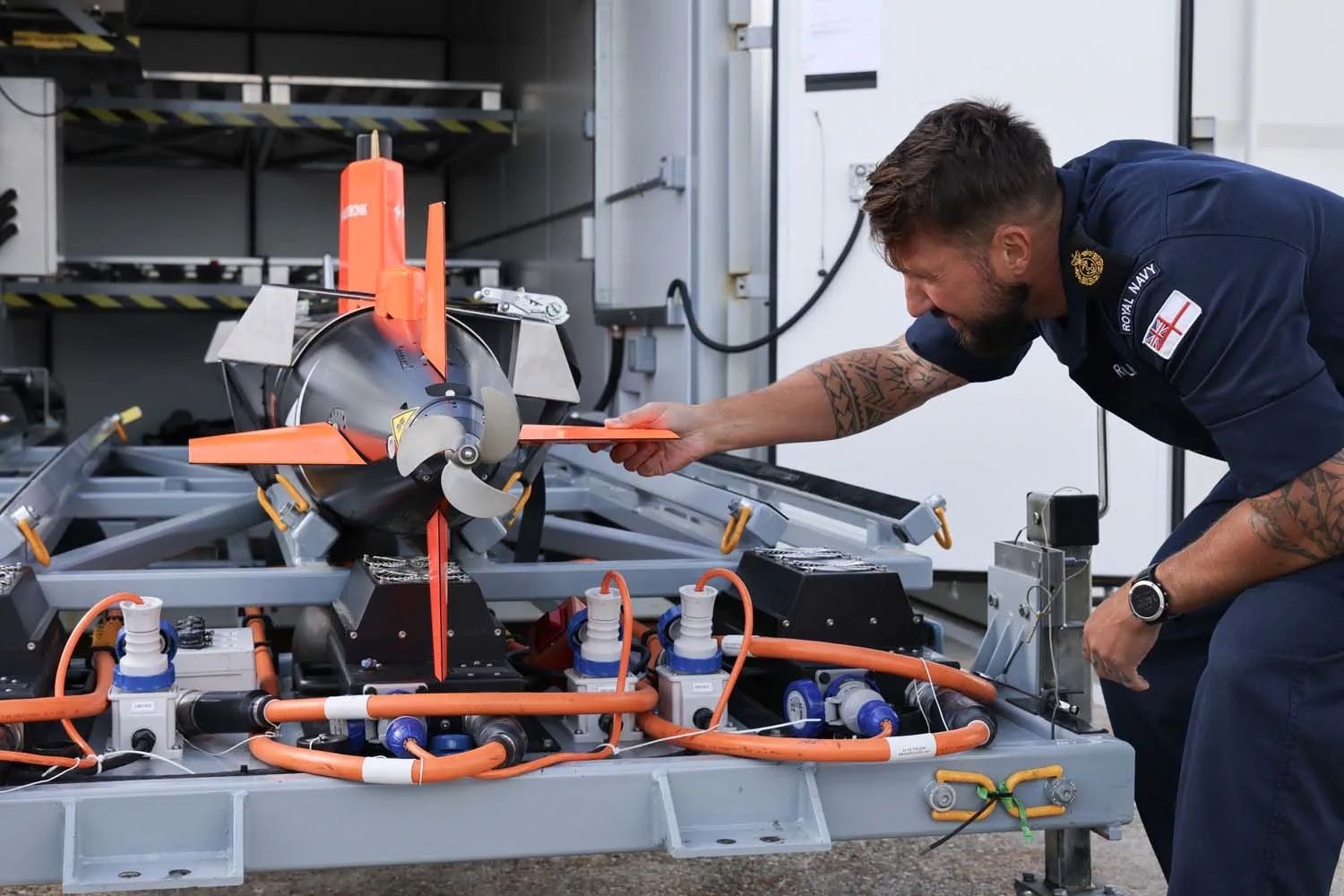
Royal Navy mine warfare specialists have begun frontline-focused training on newly delivered autonomous minehunting systems, marking a practical shift from procurement into operational use within the Mine Hunting Capability programme. The service has taken delivery of two uncrewed surface vessels and three sets of SeaCat uncrewed underwater vehicles, with manufacturer-led instruction now being passed into Royal Navy training pipelines.
At first glance, it looks like a training story. In reality, it is the awkward middle phase of any autonomy programme: the point where hardware exists, software exists, and yet capability only becomes real once sailors can launch, recover, maintain, and exploit the systems without constant vendor support. The course run through the Mine and Threat Exploitation Group’s Operation Conversion Unit covers technical understanding, safe operation, mission planning, deployment, recovery, data exploitation, and routine maintenance.
The Royal Navy says the 12-month training programme will also cover systems including R300 UUV, ARCIMS USV, and SWEEP, with the next course due in May. That gives a sense of the direction of travel. This is not a one-off familiarisation package for a niche piece of kit, but part of a broader transition away from legacy minehunters towards distributed, remotely operated, and increasingly autonomous mine countermeasures.
Programme director Jon Reed-Beviere said the SeaCat course showed “how rapidly the Royal Navy is adapting to autonomous mine countermeasures technology and building the expertise required to operate it safely and effectively.” That is the relevant point. In naval autonomy, the gap between delivery and credible use is often where programmes stall.
The wider MHC backdrop makes that clearer. DE&S says the programme is intended to move the Royal Navy from conventional ship-based mine clearance to autonomous systems, building a force that can identify and deal with sea mines from greater distance and with less exposure to crews. Previous contracts under the wider autonomous minehunting effort have already covered SWEEP systems, the joint UK-France Maritime Mine Counter Measures programme, and the delivery of RFA Stirling Castle as a host ship.
A deeper dive
Autonomous mine countermeasures are not single products. They are stacks of interdependent elements — surface vessels, underwater vehicles, sonar payloads, portable operations centres, launch-and-recovery arrangements, communications links, mission software, and data-analysis tools. When manufacturers hand over that kind of package, they are not simply delivering equipment. They are transferring a working method.
That has real industrial consequences. Training and maintainability now have to be designed in from the start, because a fleet cannot use autonomy effectively if only the vendor understands the software behaviour, fault logic, maintenance intervals, or mission-planning workflow. The production task therefore stretches beyond platform build into technical publications, simulation, software baselines, diagnostics, and support training.
The MHC programme also shows how autonomous naval capability is reshaping the supporting industrial picture. DE&S says its 2020 joint MMCM production contract supported 200 UK jobs through Thales and the wider supply chain, while the 2022 SeaCat contract created 50 highly skilled jobs in the UK and 23 across Europe. That is a reminder that mine warfare is no longer centred only on specialist hulls and onboard crews. A growing share of the value now sits in modular payloads, software integration, remote operations, and sustainment.
For manufacturers, that shifts the pressure point. Reliability matters, but so do software update cycles, interoperability between systems, and the ease with which navies can absorb new payloads or operational concepts without rebuilding the whole package. In other words, the industrial challenge is not only to deliver autonomous vessels, but to keep them relevant, supportable, and intelligible to users who need them in service rather than in perpetual trial.
That is why this training milestone matters. The Royal Navy’s path to a broader autonomous rollout in 2028 will not be bridged by hardware deliveries alone. It will depend on whether the service, and its suppliers, can turn a set of promising systems into a repeatable operating model that crews can trust and sustain. For mine warfare, that is where the transition stops being theoretical.