IN Brief:
- Embraer is integrating Valkyrie Aero’s Gunslinger AI onto the A-29 Super Tucano for counter-UAS missions.
- The move builds on an A-29 concept centred on EO/IR sensing, datalinks, guided rockets, and gun-based engagement.
- It points to a growing market for lower-cost manned counter-drone platforms built from existing aircraft, mission systems, and software upgrades.
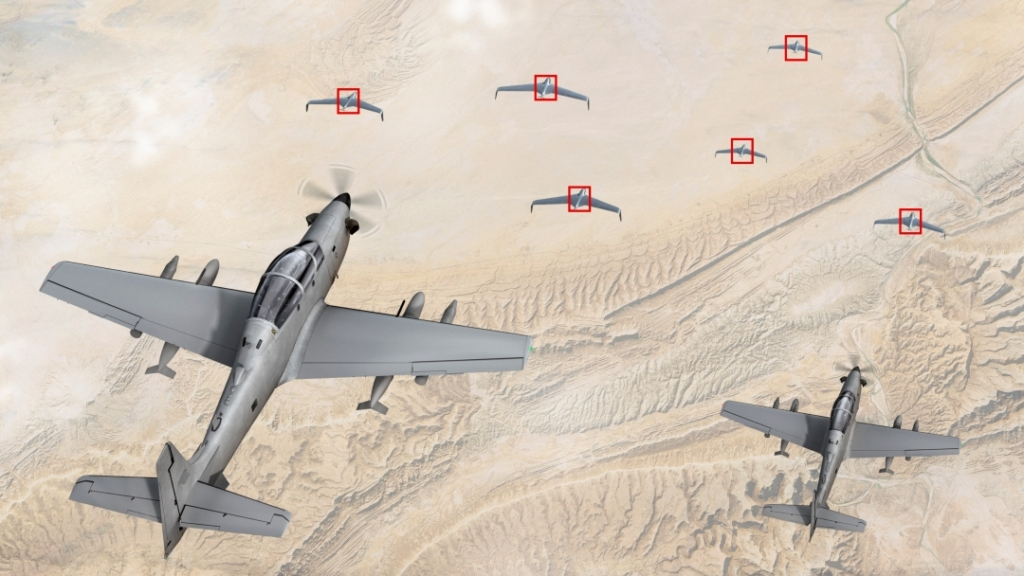
Embraer is pushing the A-29 Super Tucano further into the counter-drone mission, announcing a partnership with Valkyrie Aero to integrate the Gunslinger artificial intelligence suite onto the aircraft. The move extends work already under way to position the turboprop for dedicated counter-UAS operations and strengthens the commercial logic behind the aircraft’s latest evolution.
The Super Tucano has long been marketed on ruggedness, endurance, and relatively low operating cost. Those qualities matter in a counter-drone mission where the economics of using a high-end fast jet can quickly look unattractive against small unmanned targets. Embraer’s proposition is that a lighter manned aircraft, fitted with the right sensors, weapons, and mission software, can offer a scalable answer to a threat set that is expanding faster than many air forces’ budgets.
Gunslinger is intended to improve the aircraft’s ability to detect, classify, track, and engage drones in real time. Embraer had already outlined a counter-UAS concept for the A-29 built around electro-optical and infrared sensing, datalinks, wing-mounted .50 calibre guns, and guided rocket options. Adding an AI layer suggests a push to shorten the time between detection and engagement while preserving the cost advantages that make the platform attractive in the first place.
The move also makes sense from an export and sustainment perspective. Embraer already assembles A-29 aircraft in Jacksonville for US and Foreign Military Sales customers and supports a wider fleet through spares and sustainment activity. A counter-UAS package built around a proven airframe is far easier to market, certify, and support than a clean-sheet aircraft designed specifically for the role.
Retrofit before redesign
That is what gives the announcement industrial weight. The strongest lower-cost defence aerospace offers are often not brand-new aircraft, but modular upgrades that allow manufacturers to extend the usefulness of an established platform. In this case, the value lies in pairing the A-29’s existing airframe and operating profile with mission software, sensor integration, and engagement support that can be rolled out in manageable increments.
For production and engineering teams, that means the effort sits in integration discipline rather than new airframe manufacture alone. Mission computers, software baselines, datalinks, sensor cueing, weapons interfaces, qualification, and training packages all have to align. The success of the offer depends on Embraer making those layers look supportable and repeatable, rather than allowing the upgrade to turn into a bespoke engineering exercise for each customer.
A lower-cost interceptor still needs industrial depth
There is a temptation to describe aircraft of this type as inexpensive answers to a drone problem. The operating economics may compare favourably with more advanced combat aircraft, but the industrial load remains significant. A credible counter-UAS aircraft still requires secure software, reliable sensor fusion, validated targeting logic, trained maintainers, and a support system that can keep availability high in harsh or remote operating conditions.
That matters particularly in export markets looking for scalable air-defence capacity rather than prestige fleets. Buyers need something that can be delivered and sustained without opening a new maintenance burden. Embraer’s wider A-29 proposition has long rested on that practical industrial footing, and the counter-drone mission only makes the supportability case more important.
The A-29’s shift toward a counter-UAS role therefore looks like more than a niche capability addition. It reflects a broader change in defence aviation, where software, sensors, and integration are enabling established aircraft to take on missions that would once have driven demand for entirely new platforms. For aerospace manufacturers, the commercial prize lies in turning those role expansions into industrial packages that can be produced, exported, and sustained at scale.