IN Brief:
- Opus is trying to move beyond a revenue base once almost entirely tied to automotive, with new defence and medical work now on stream.
- Seven new Yizumi moulding machines and an established CNC cell have expanded the Leamington Spa company’s usable production envelope.
- The next stage is less about headline tonnage than about repeatability, documentation, and qualifying for more demanding regulated sectors.
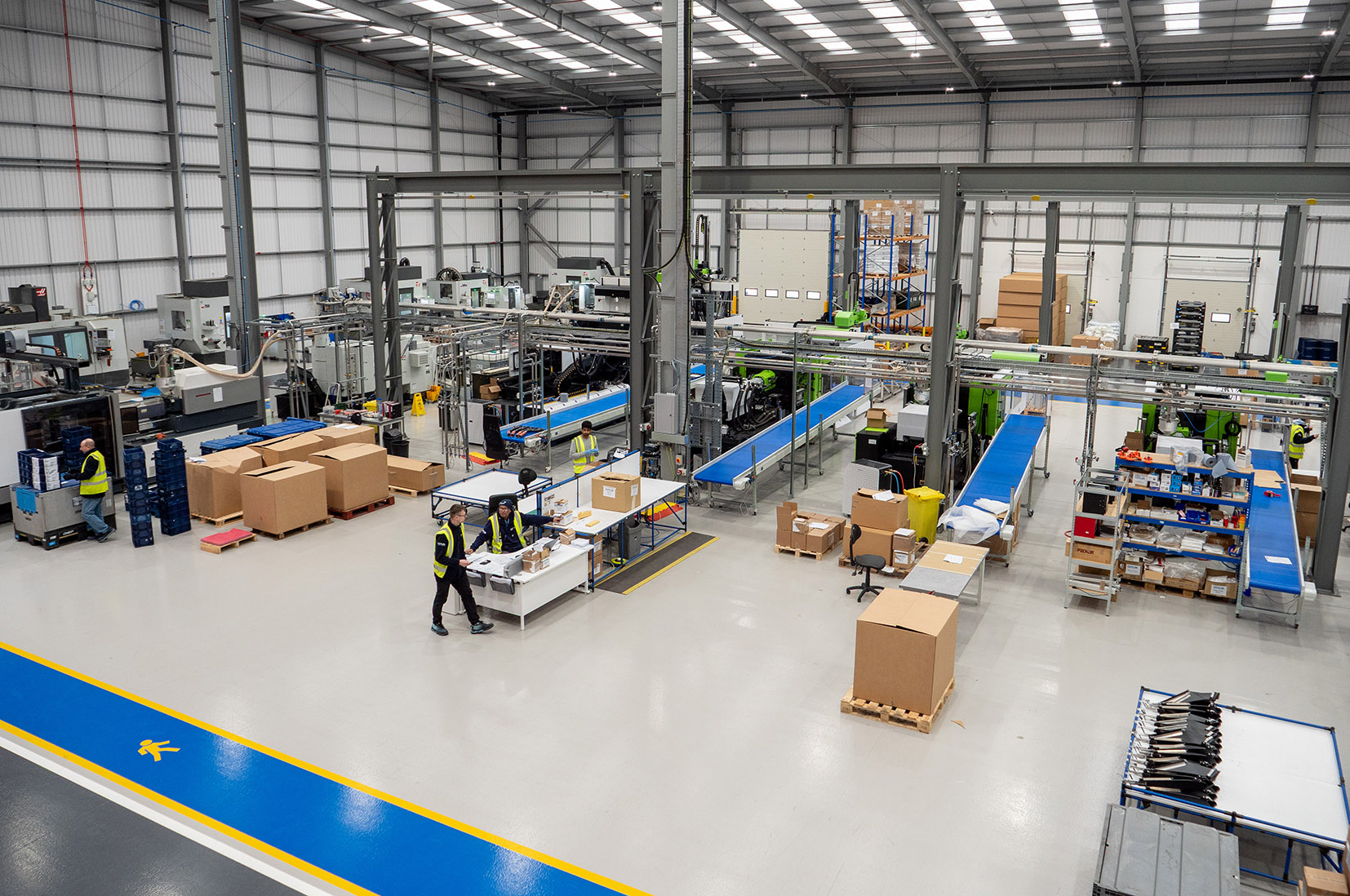
Opus International Products has secured its first defence contracts as part of a wider diversification move that is beginning to shift the company away from an almost total dependence on automotive work. The Warwickshire manufacturer, which provides CNC machining and injection moulding from its 40,000 sq ft Leamington Spa site, has also landed medical business after a £1m investment drive aimed at broadening its production base.
For a business that had been heavily exposed to premium automotive supply, the change is more than a simple sales win. It alters the mix of programmes, part volumes, validation requirements, and customer expectations that sit behind day-to-day factory output. Managing director Suzie Siddall said the company had previously been 99% reliant on the automotive industry, supplying customers including Aston Martin, JLR, and Lotus, before deciding to target more resilient adjacent markets.
The investment case is tangible on the shop floor. Opus has installed seven new Yizumi injection moulding machines, ranging from 30 tonnes to 1,200 tonnes clamp capacity, which gives it room to take on everything from smaller precision parts to larger moulded components and higher-cavity work. Those additions sit alongside a seven-strong CNC machining cell, allowing the business to pitch a broader mix of moulding, machining, development, and design-for-manufacture support.
That matters because defence diversification is rarely just a matter of making the same part for a different customer. The requirement often shifts toward lower-volume, higher-assurance production, where process control, inspection discipline, and the ability to move from prototype to repeat batch manufacture carry more weight than pure throughput. For a supplier coming from premium automotive, that can be an advantage, provided it can translate fast-cycle production habits into the documentation and consistency expected in regulated markets.
Diversification changes the production mix
The attraction of defence and medical work for a company like Opus is that both sectors reward manufacturing competence that sits between concept support and serial production. Injection moulding and CNC machining businesses that can help refine part geometry, manage tooling choices, and hold tight tolerances are often better placed than larger volume-only suppliers when programmes need responsiveness as well as precision.
That is also why aerospace appears to be the next logical target. The crossover is not perfect, but the route is familiar: more complex materials and geometries, more qualification pressure, and greater emphasis on traceability and process stability. Siddall has said the new market approach could deliver £500,000 of business over the next 12 months, which would be a meaningful gain for a company currently turning over about £7.4m.
Capacity is only the first hurdle
The harder part is sustaining the move. Defence customers do not only buy machine availability; they buy confidence in a supplier’s ability to hold process windows, manage change tightly, and keep smaller production runs commercially viable. That tends to put pressure on metrology, scheduling, tooling maintenance, and quality systems at the same time.
Opus already has useful foundations in place, including IATF 16949, ISO 9001, and ISO 14001 credentials, and it has used the Warwickshire Manufacturing Growth Programme to sharpen its market positioning rather than simply add equipment. That combination — more flexible capital equipment backed by a more deliberate route into higher-value sectors — gives the business a better chance of turning two early defence wins into a durable production line.