IN Brief:
- Epirus, General Dynamics Land Systems, and Kodiak AI have unveiled the Leonidas Autonomous Ground Vehicle for counter-UAS missions.
- The platform combines high-power microwave defeat, autonomous driving software, and commercial vehicle integration.
- Its significance lies in how rapidly the defence sector can industrialise modular, mobile counter-drone systems rather than rely on fixed, bespoke architectures.
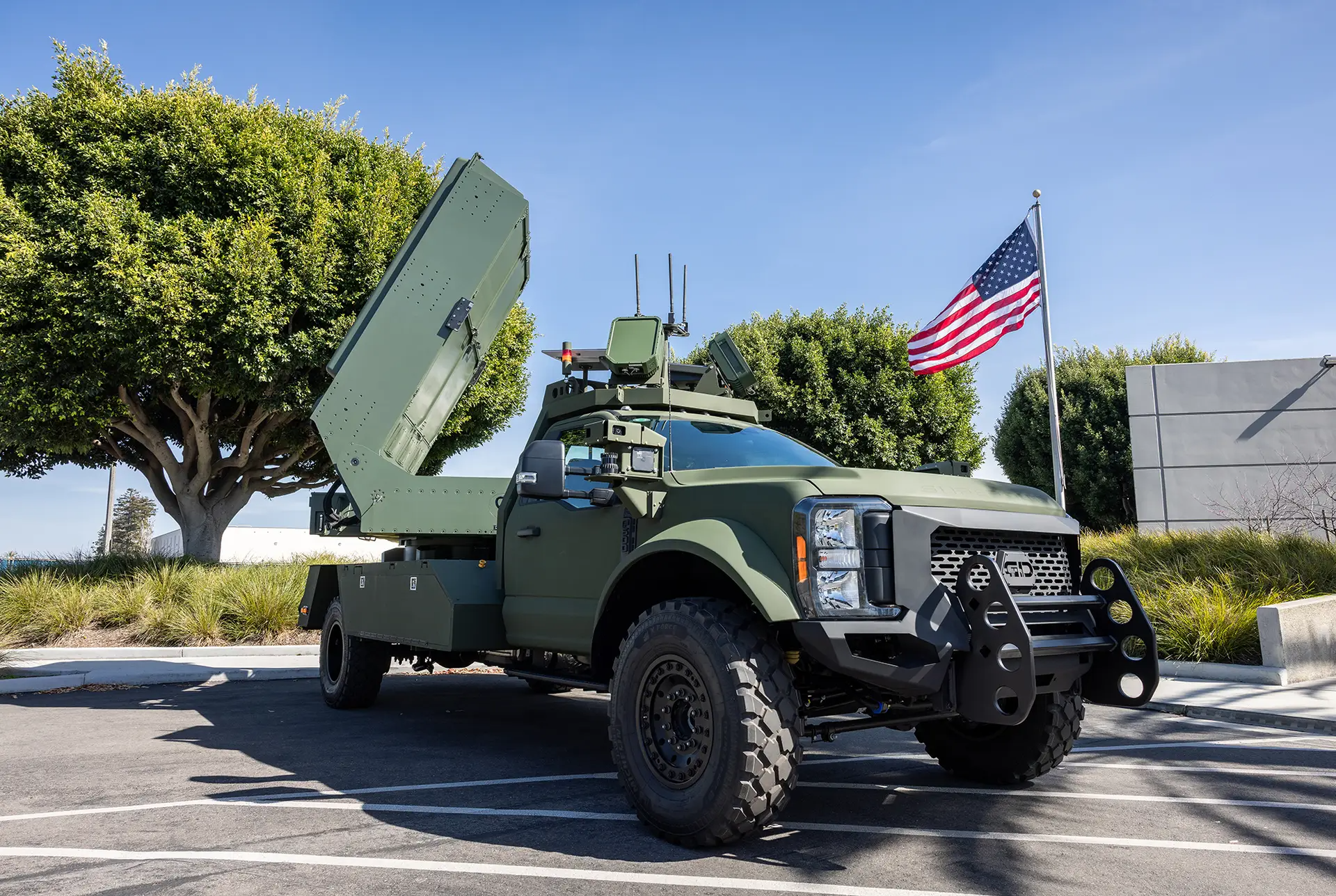
The Leonidas Autonomous Ground Vehicle unveiled by Epirus, General Dynamics Land Systems, and Kodiak AI is the latest sign that counter-UAS is becoming an integration contest as much as a technology one. The system combines Epirus’ Leonidas high-power microwave payload, Kodiak’s autonomous driving system, and GDLS integration work into a mobile platform intended for counter-drone, point-defence, and homeland security roles.
On paper, the concept is well aligned with the threat. Drone attacks are cheaper, faster to iterate, and increasingly more difficult to defeat with one-shot, one-kill economics. That has pushed interest towards non-kinetic effectors, especially those able to cope with saturation attacks and operate without burning through expensive interceptors. Leonidas already has a profile in that discussion because high-power microwave systems promise broad-area electronic defeat rather than serial engagements.
The mobility piece changes the industrial and operational proposition. Fixed-site counter-UAS systems have their place, but mobile platforms can close gaps around bases, ports, airports, and temporary infrastructure with less installed burden. Add autonomous movement, and the platform becomes a way to stretch coverage without tying up more personnel. That is the promise, at least, and it is why the collaboration has gone further than simply mounting an effecter on a truck.
There is also continuity here. Epirus and GDLS had already shown an earlier robotic Leonidas variant based on the TRX platform, and Epirus has recently been highlighting Leonidas’ ability to defeat more complex drone threats, including fiber-optic-guided systems. This latest reveal suggests a progression from specialist directed-energy payload to broader family-of-systems thinking.
The difficult work is system integration at rate
The industrial question is not whether each ingredient has merit. High-power microwave defeat has momentum, autonomous mobility is advancing quickly, and commercial truck platforms are attractive for cost and availability reasons. The harder issue is whether the whole system can be built, qualified, and supported in volumes that make sense for real procurement.
That means managing interfaces rather than admiring them. Power management, thermal behaviour, mission software, autonomy safety cases, electromagnetic compatibility, ruggedisation, and maintenance architecture all become programme-critical once a demonstrator starts to move towards an acquisition pathway. Defence history is full of attractive modular combinations that stumbled when the integration burden became visible.
Leonidas AGV is therefore interesting precisely because it exposes that burden. It treats counter-UAS as a converged manufacturing problem, where vehicle base platform, energy system, effecter, perception stack, software, and command integration all have to be assembled into something supportable. The challenge for the team is to show that this can be done without turning a supposedly lower-cost layer into a bespoke engineering exercise.
Microwave defence only matters if it can be produced
Counter-UAS demand has risen faster than the industry’s ability to standardise answers. Jammers, guns, missiles, lasers, and microwaves all have roles, but procurement is increasingly looking for systems that can be manufactured and scaled as coherent product lines rather than handcrafted responses to individual sites.
That is where Leonidas AGV could matter. If a commercial base vehicle, a modular autonomy stack, and a maturing microwave payload can be combined into a repeatable package, the result is more than a prototype. It becomes a template for industrialised close-in air defence, one that can be adapted for military installations, ports, energy assets, and domestic security missions.
The defence market has already accepted that drones are proliferating faster than traditional interception models can comfortably absorb. The next phase is about production logic: who can build enough mobile counter-UAS systems, with enough commonality, to keep pace. Leonidas AGV is an argument that the answer may lie in faster integration of commercial and defence technologies, provided the factory can keep up with the concept.