IN Brief:
- RML Group will use DPRTE 2026 to present battery, harness, and electronics capabilities with direct relevance to defence platforms.
- The standout products are its immersion-cooled VarEVolt battery and a set of high-density, high-voltage harness solutions for constrained vehicle architectures.
- The industrial shift is clear: defence mobility now depends increasingly on electrified subsystem design, thermal control, and repeatable high-spec assembly.
RML Group’s appearance at DPRTE 2026 may look, at first glance, like a diversified engineering company showing a broad portfolio to the defence market. In practice, the line-up says something more specific about where defence platform design is moving. Batteries, high-voltage harnesses, compact interconnects, and specialist PCB work are no longer edge technologies in military mobility programmes. They are becoming part of the core engineering stack.
The most eye-catching item on the stand is RML’s immersion-cooled VarEVolt battery, a system the company describes as delivering unusually high power density and thermal stability under extreme discharge conditions. That is a performance story, but it is also a packaging story. Defence vehicles, unmanned systems, hybrid powertrains, and specialist mission equipment all face the same blunt constraints: tight space envelopes, harsh duty cycles, and rising onboard electrical demand.
Those pressures are pushing more suppliers to translate high-performance automotive know-how into defence applications. The move is not always straightforward, because military qualification, shock and vibration exposure, environmental sealing, safety assurance, and serviceability all alter the engineering equation. Still, the logic is clear enough. Defence wants more electrical power, more compact assemblies, and more thermal control without accepting a major penalty in size or weight.
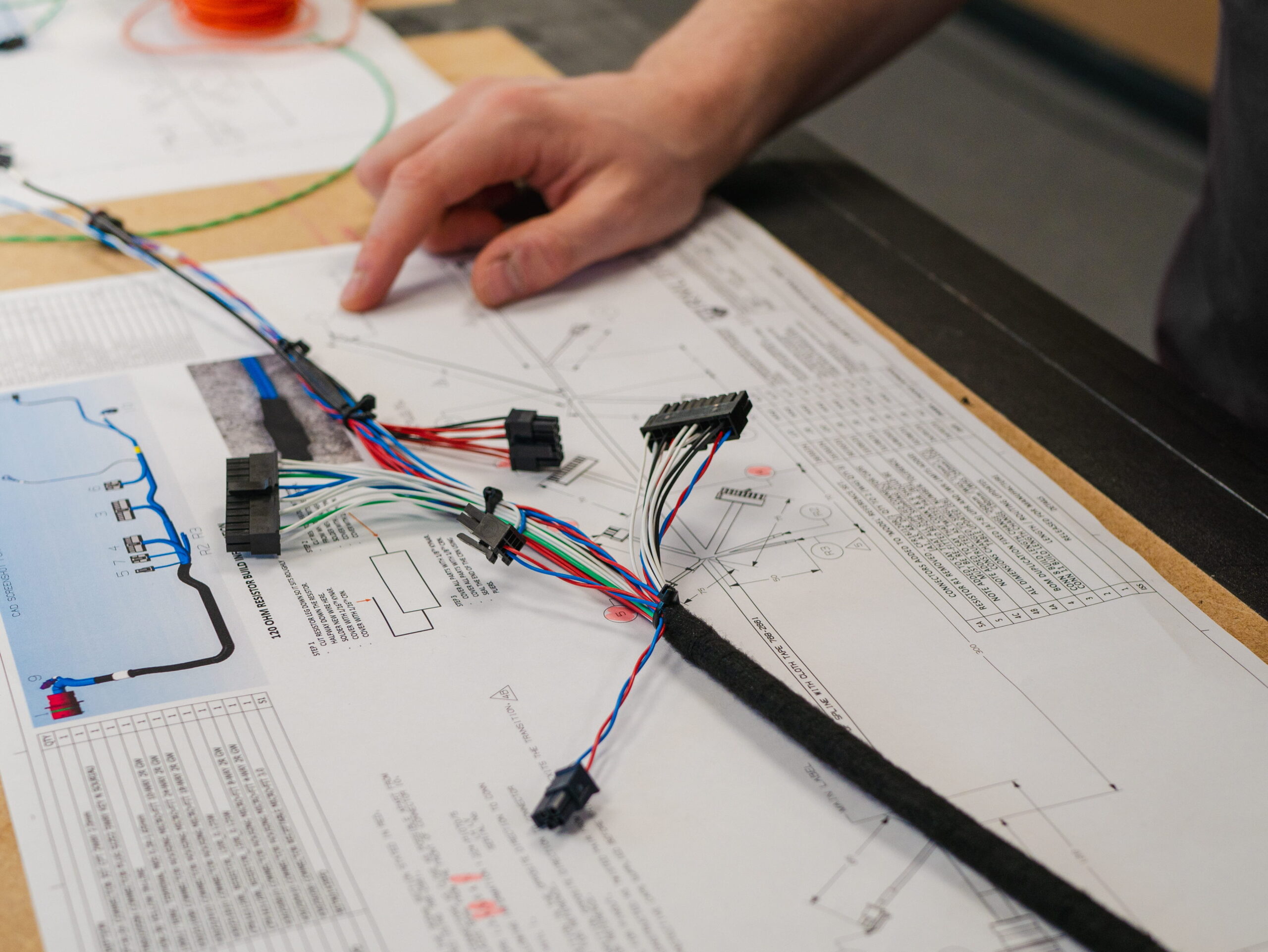
RML’s harness offering fits the same pattern. High-density wiring for space-constrained systems and high-voltage assemblies rated up to 1000V are not glamorous products, but they sit close to the real bottlenecks in electrified platform development. Once a vehicle or subsystem moves beyond conventional electrical loads, harness design becomes a first-order issue affecting safety, manufacturability, maintainability, and EMC performance.
Defence electrification is now an assembly challenge
Battery chemistry tends to dominate public discussion, but the industrial burden usually lands elsewhere. Thermal interfaces, cable routing, connector reliability, insulation performance, tolerance control, and repeatable assembly processes determine whether a promising subsystem can move from prototype to regular production.
That is why RML’s show presence is worth watching through a manufacturing lens. VarEVolt’s value to defence is not simply that it is powerful. It points to how immersion cooling, compact packaging, and high-rate discharge systems might be adapted to military duty cycles where heat rejection and packaging density can be as decisive as stored energy.
The same applies to the company’s harness work. Electrified defence platforms are unforgiving environments for high-voltage routing. Abrasion resistance, environmental sealing, fault isolation, connector integrity, and installation repeatability all matter, especially when space is limited and maintenance access is poor. Suppliers that can industrialise those assemblies to tight tolerances are likely to become more important as vehicle architectures evolve.
DPRTE’s value is in the middle tier of the supply chain
DPRTE has become a useful stage for the less theatrical, more consequential parts of the defence supply chain. Prime platforms still draw the attention, but the real substance often lies in the subsystem providers whose products quietly determine whether electrified architectures are viable at scale.
RML fits that category. Its blend of performance engineering, powertrain development, interconnect design, and electronics capability positions it in the increasingly crowded space between motorsport-grade innovation and defence-ready manufacture. That is a difficult space to occupy because customers want cutting-edge performance without prototype fragility.
The broader message from this year’s stand is that defence electrification is no longer confined to experimental vehicles or future concepts. It is becoming a live industrial requirement, and that pulls batteries, harnesses, and specialist electronics into the centre of procurement conversations. The companies that prosper will be the ones able to turn high-performance engineering into components that can actually be built, tested, and supported in defence numbers.