IN Brief:
- Infosecurity Europe 2026 has named former Ukrainian foreign minister Dmytro Kuleba as a headline keynote speaker on hybrid war and cyber conflict.
- New organiser research says 59% of cybersecurity professionals believe geopolitical tensions are making European cyber collaboration harder.
- For defence suppliers, the significance lies in how cyber resilience now reaches deep into manufacturing networks, OT environments, and cross-border industrial cooperation.
Infosecurity Europe’s decision to put hybrid conflict and geopolitical fragmentation at the heart of its 2026 keynote programme reflects a shift that defence manufacturers already recognise: cyber risk is now inseparable from industrial resilience. The event has named former Ukrainian foreign minister Dmytro Kuleba as a headline speaker, with a session focused on Ukraine’s hybrid war experience and the evolution of the cyber frontline.
That framing lands at a moment when cyber security is becoming harder to separate from procurement, operations, and supply continuity. The organiser’s latest research says 59% of cyber professionals believe geopolitical tensions are making European cyber collaboration more difficult, even as a large majority still supports some degree of coordinated intervention in a major cross-border crisis. That is an awkward combination, but a familiar one. Threats are converging faster than political structures.
For the defence sector, the value of this programme lies less in headline politics than in what it says about industrial exposure. Modern defence manufacturing depends on deeply networked suppliers, software-enabled production, outsourced services, and critical infrastructure that often sits outside the factory gate. A serious cyber incident does not have to strike a weapons platform directly to disrupt output. It can hit logistics providers, engineering data flows, certification records, energy systems, or operational technology environments that keep production moving.
That makes events like Infosecurity Europe more relevant to defence than the venue might first suggest. This is no longer a conversation confined to CISOs and compliance teams. It is increasingly about how organisations preserve production continuity under persistent digital pressure.
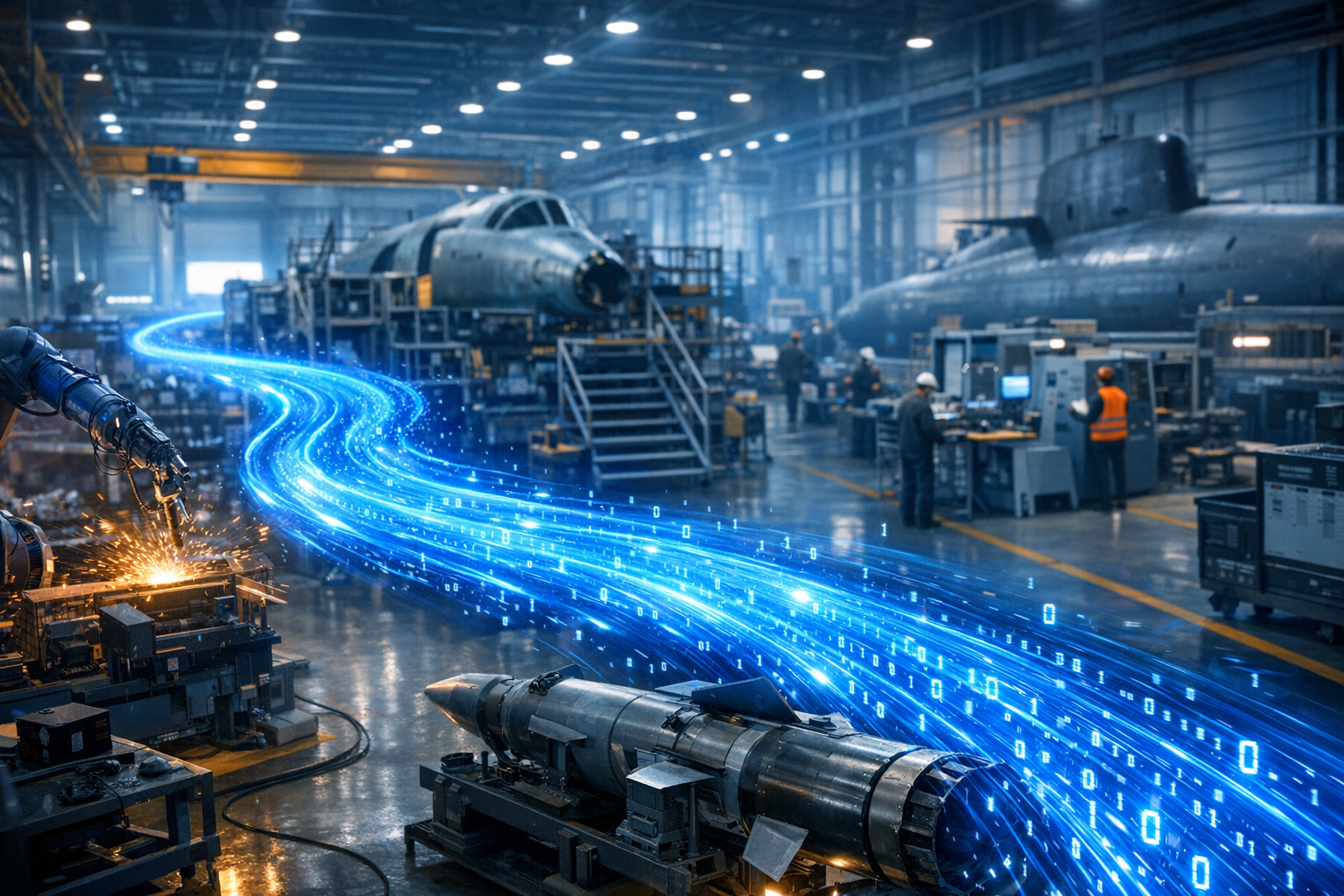
The factory is now part of the battlespace
The most important change in recent years is that cyber resilience has expanded from network defence into operational resilience. Defence companies have been moving in this direction for some time, particularly where OT, robotics, and digitally managed manufacturing are concerned, but geopolitical volatility has accelerated the process.
Broader cyber research in 2026 points the same way. Geopolitics remains a leading driver of cyber risk strategy, while organisations are increasing their focus on threat intelligence and deeper engagement with government agencies and information-sharing groups. That matters to defence manufacturers because their exposure is not abstract. They often sit close to national infrastructure, sovereign capability programmes, export-controlled data, and politically sensitive supply chains.
In practical terms, that means cyber planning has to reach further into the plant. Backup strategies, segmentation between IT and OT, supplier assurance, data sovereignty, cloud choices, and incident recovery planning all become production issues, not just security hygiene.
Collaboration is harder, but more necessary
Infosecurity Europe itself expects more than 13,000 visitors and 300 exhibitors this year, which gives some indication of the scale at which these debates are now taking place. The event’s keynote line-up, including national cyber leadership and speakers with direct experience of wartime disruption, suggests the agenda is moving towards resilience under strain rather than abstract digital transformation.
That is useful for defence suppliers because the sector is caught in a familiar bind. Cross-border collaboration is indispensable for intelligence sharing, standards, and coordinated response, yet geopolitical tension makes that same cooperation harder to sustain. The organiser’s research captures that contradiction neatly.
For manufacturers and systems integrators, the implication is uncomfortable but straightforward. Waiting for a cleaner political environment is not a strategy. Resilience has to be engineered into supply relationships, production systems, and operating models while the fragmentation is already under way. In that respect, the event’s strongest defence relevance is not the keynote drama. It is the reminder that cyber preparedness has become part of industrial preparedness, and that the production line now sits much closer to the frontline than many suppliers used to admit.