
IN Brief:
- RFA Lyme Bay is being fitted to deploy and support uncrewed mine-countermeasure systems.
- The Bay-class ship will act as a mothership with plug-and-play command-and-control capability.
- The move reinforces the Royal Navy’s shift away from legacy mine warfare structures toward modular, autonomous systems.
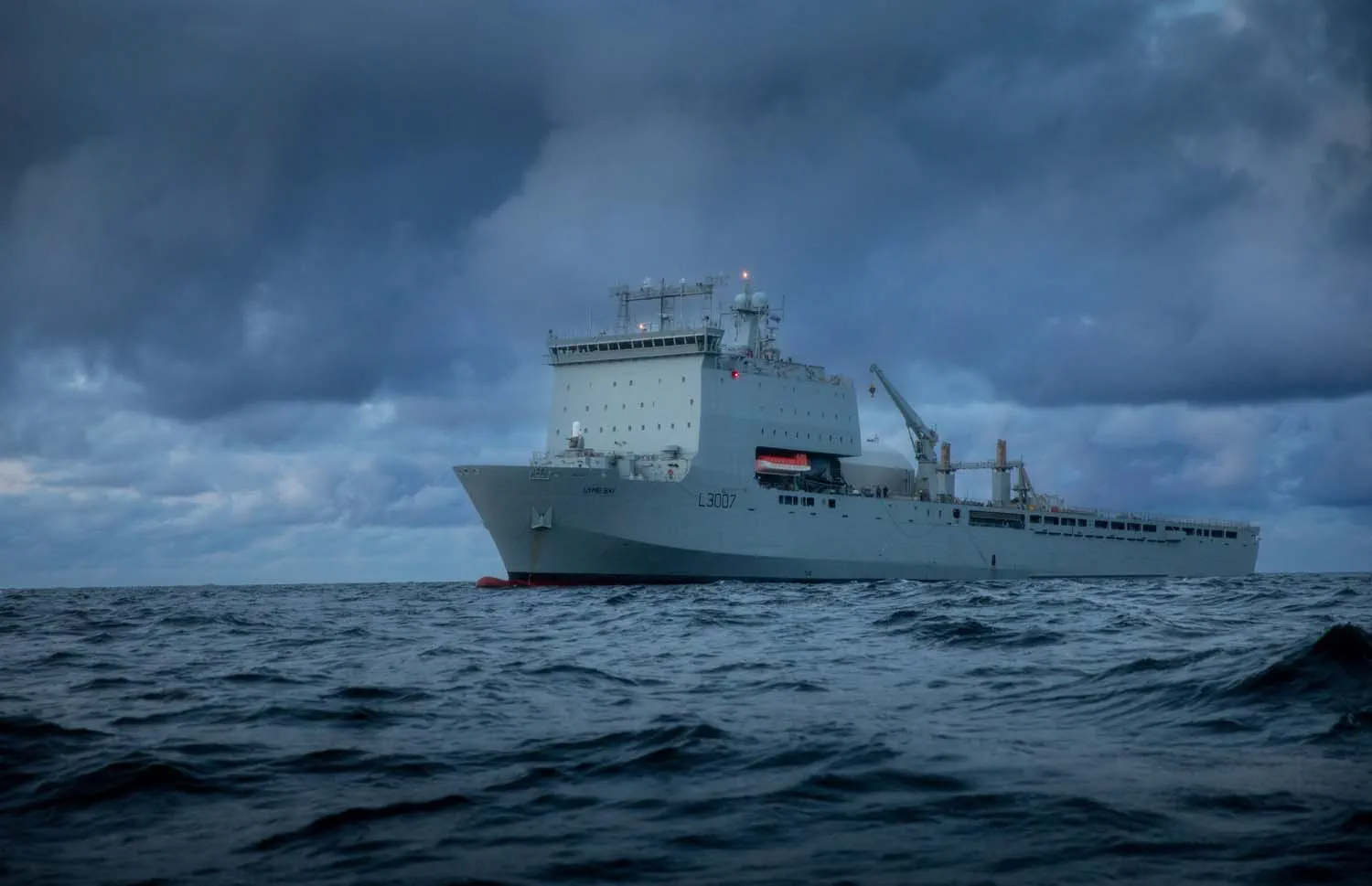
The Royal Navy is preparing RFA Lyme Bay for a new role as a minehunting mothership, converting the Bay-class vessel into a platform able to embark, deploy, recover, and support a mix of autonomous and remotely operated mine-countermeasure systems. The ship is due to be fitted in Gibraltar, where it will also undergo checks ahead of further time at sea.
The change is operationally significant, but its industrial interest sits in the architecture behind it. Mine warfare is moving away from single-purpose crewed vessels and toward a distributed system of boats, underwater vehicles, control stations, launch and recovery equipment, data links, and support packages that can be reconfigured around a host platform. Lyme Bay offers the deck space, storage volume, and support infrastructure to make that model workable.
Rather than replacing one ship with another in like-for-like fashion, the Royal Navy is effectively turning a logistics-capable hull into a command, support, and deployment node for offboard systems. That is a different production problem, and a different sustainment problem, from building a traditional minehunter.
Industrial and systems implications
The value in this transition lies in modularity. A plug-and-play command-and-control package allows the navy to move autonomous mine warfare equipment between platforms and theatres with less bespoke ship modification each time. That favours suppliers able to deliver launch and recovery gear, containerised mission systems, mission-planning software, power distribution, communications integration, and supportable autonomy stacks.
It also creates demand for a more software-led sustainment model. Upgrades to navigation, classification, threat-recognition, and mission-management functions can increasingly be delivered through systems refresh rather than through major hull replacement. For industry, that shifts more of the long-term value into electronics, control systems, and support services.
Conversion and support pressures
Making a large auxiliary useful in this role still requires careful engineering. Storage and handling arrangements, topside integration, communications resilience, operator workflow, and recoverability in difficult sea states all need to be solved in a way that does not overcomplicate the host ship.
Support is the other pressure point. Autonomous mine warfare only works if the embarked systems can be maintained, rearmed where relevant, updated, and turned around at pace. A mothership concept that looks elegant in theory quickly loses value if spare parts, specialist personnel, and control-system reliability cannot keep up with operational demand.

