
IN Brief:
- Airbus Helicopters has delivered the first of 18 NH90 Standard 2 aircraft ordered by France.
- Equipment includes Euroflir 410 D, digital mapping, a third crew position, enlarged windows, and provision for DAS.
- French and Spanish orders could establish a broader common production and support baseline for specialist NH90 fleets.
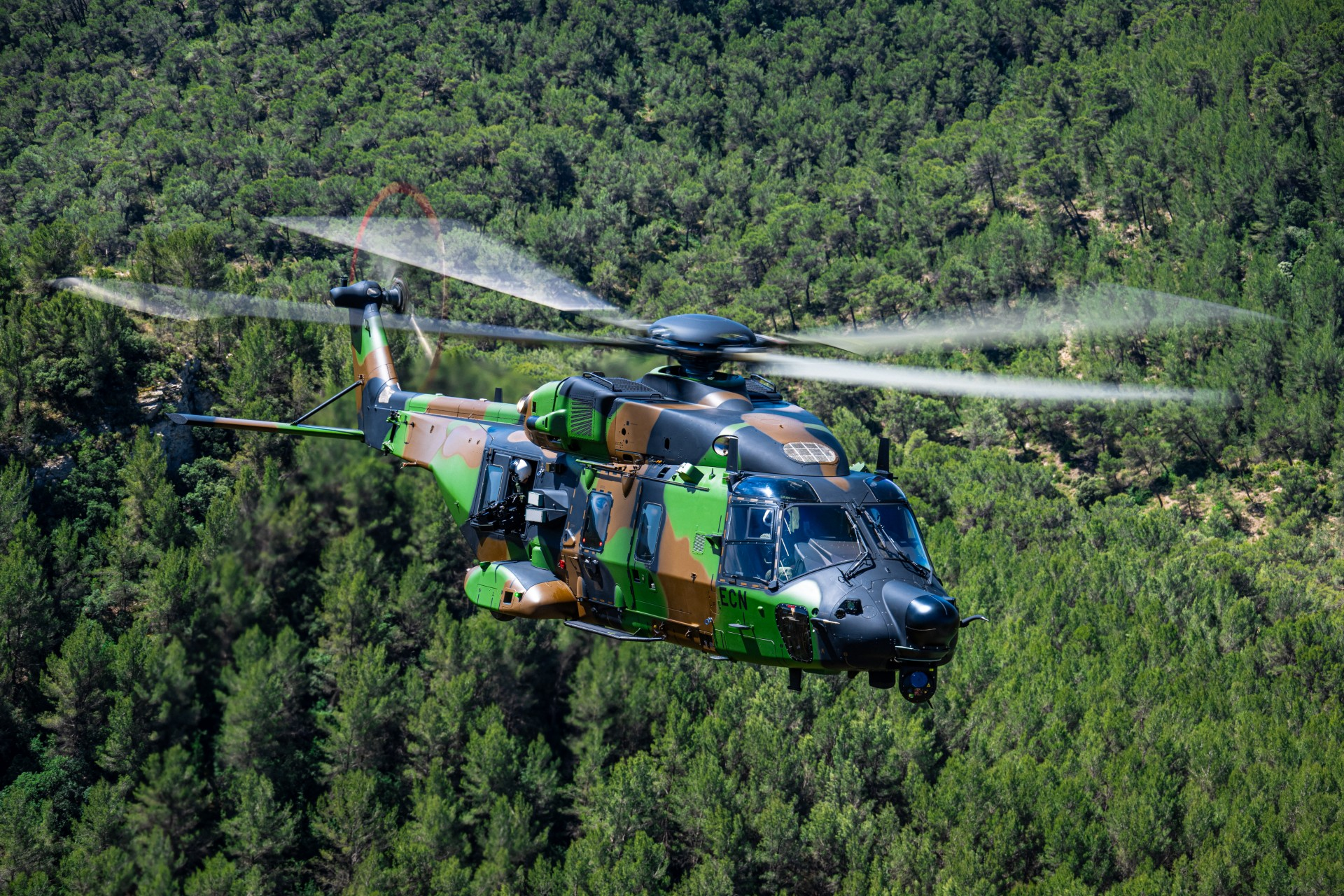
Airbus Helicopters has delivered the first NH90 Standard 2 to France’s Armament General Directorate, moving a special operations configuration ordered in 2020 from development into customer delivery.
France has ordered 18 aircraft, which will be delivered by the middle of 2029 and operated by the French Army Aviation special forces squadron at Pau. Spain joined the programme in December 2025 with an order for 31 NH90s incorporating a similar standard.
Derived from the NH90 Tactical Transport Helicopter, Standard 2 adds equipment and structural changes intended for demanding low level, night, and degraded visibility operations. The configuration includes Safran’s Euroflir 410 D electro optical system, a new digital map generator, a position for a third crew member, and enlarged rear sliding windows capable of accommodating self protection guns.
Provision has also been incorporated for the later installation of a Direct Aperture System. DAS is intended to combine imagery from sensors around the helicopter, improving external visibility in snow, dust, fog, darkness, and other conditions where crews cannot rely upon a clear view through the cockpit.
A fully digital Thales TopOwl helmet will be able to display imagery from DAS and the electro optical system on the visor. Presenting those feeds directly to the crew can improve awareness, although it places demanding requirements upon image alignment, head tracking, processing speed, latency, and the human machine interface.
The development was ordered through the NATO Helicopter Management Agency and carried out by NHIndustries and its partner companies. Airbus Helicopters owns 62.5% of the joint venture, Leonardo 32%, and GKN Fokker 5.5%, distributing design, manufacturing, systems, and support activity across several European organisations.
Standard 2 combines equipment from multiple suppliers with changes to the helicopter structure, making configuration control central to production. Enlarged windows affect frames, doors, seals, fittings, loads, and protection, while crew served weapons introduce recoil, ammunition, restraints, communications, and certification requirements.
Electro optical equipment brings a separate installation burden. The turret requires a rigid mounting point, clear fields of view, electrical power, cooling, data connections, and protection against vibration, after which its imagery must be integrated with navigation, mission, and helmet display information.
DAS provision must accommodate equipment that remains under development. Cable routes, processing capacity, structural attachment points, power, cooling, and software interfaces need to be established early enough to avoid major disruption when the full system becomes available.
Designing those provisions in advance can reduce retrofit cost, although future changes to sensor dimensions, data rates, processing hardware, or cooling demand may erode the original margin. Engineers must therefore preserve enough physical and electrical capacity without imposing unnecessary weight on every aircraft.
The first delivered helicopter will generate production learning that must flow quickly into later units. Installation hours, access problems, supplier tolerances, software discrepancies, test failures, and rework need to be recorded and incorporated before subsequent aircraft reach the same stage.
NH90’s multinational structure provides industrial scale, but it has also produced many national equipment standards. Radios, defensive aids, sensors, weapons, interiors, mission systems, and certification requirements vary between customers, increasing the number of configurations that manufacturers and maintenance organisations must support.
Shared French and Spanish special operations features could limit some of that fragmentation. Larger batches offer equipment suppliers more stable demand, while common test evidence, training material, spare parts, and repair procedures can reduce recurring cost.
Those savings will disappear if small national differences multiply inside apparently common equipment. A different connector, mounting bracket, processor, software branch, or approval route can create a separate support item, so digital records must trace every aircraft, component, modification, and software load.
Production scheduling must also coordinate specialist equipment with comparatively low annual volumes. Helmet displays, stabilised electro optical systems, mission computers, transparencies, defensive equipment, and customised interior parts come from suppliers whose capacity cannot always be increased quickly.
New capability must enter service alongside continuing work to improve NH90 availability. Maintenance access, technical data, spares, repair turnaround, software support, and diagnostic equipment will determine how many aircraft remain available for training and operations.
Standard 2 provides an opportunity to address supportability within the delivered configuration. Line replaceable unit access, built in testing, common components, controlled publications, and reliable spares provision should remain part of the production baseline rather than following as separate administrative work.
France’s first aircraft confirms that Standard 2 has entered delivery, while the remaining French and Spanish orders provide enough scale to test whether the configuration can mature into a shared specialist standard. Stable interfaces and disciplined commonality will determine whether the new equipment strengthens the wider NH90 support system or adds another costly branch to its configuration tree.
