IN Brief:
- Leonardo DRS will supply 100-Series permanent-magnet propulsion motors and matched variable-frequency drives.
- Doosan Enerbility and Leonardo DRS will integrate electrical and mechanical equipment from prime movers to propellers.
- KDDX is planned as South Korea's first indigenously designed and built destroyer programme.
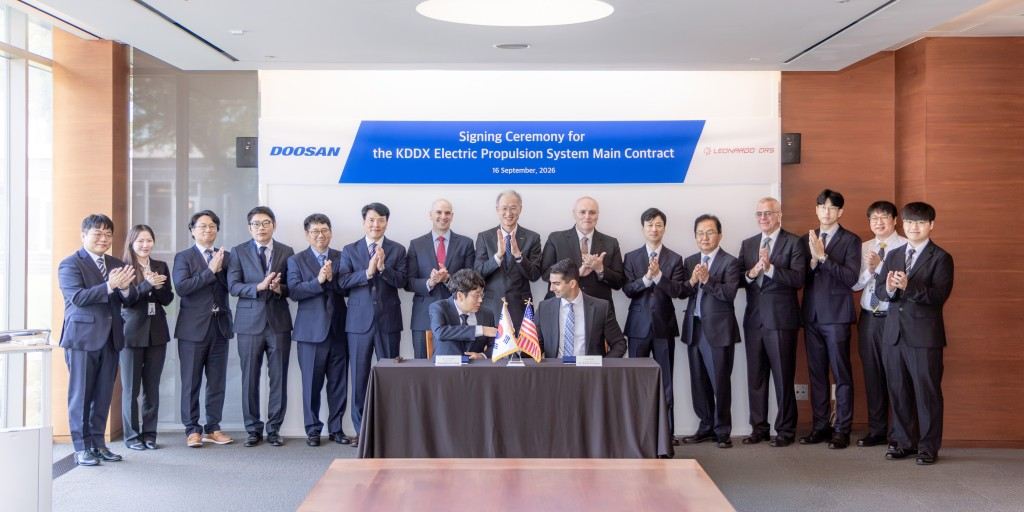
Leonardo DRS has secured a contract from Doosan Enerbility to provide the electric propulsion system for South Korea’s KDDX destroyer programme, giving the Republic of Korea Navy’s next-generation surface combatant an integrated full-electric drive built around permanent-magnet motors and variable-frequency drives.
The award covers Leonardo DRS 100-Series permanent-magnet propulsion motors and matched compact variable-frequency drives. Doosan Enerbility and Leonardo DRS will work across the wider integrated power and propulsion system, incorporating electrical and mechanical equipment from the ship’s prime movers through to its propellers.
KDDX is planned as a class of at least six next-generation guided-missile destroyers, with Hanwha Ocean building the lead ship. The programme is intended to become South Korea’s first indigenously designed and built destroyer effort, placing propulsion integration alongside combat systems, sensors, weapons, and ship construction within a largely national programme.
The propulsion selection follows the programme’s move into detailed design and lead-ship production planning. Hanwha Ocean has already advanced production preparations for KDDX, while the Leonardo DRS award defines one of the most substantial machinery packages that will have to be integrated below decks.
Full-electric drive changes the relationship between propulsion and shipboard power generation. Mechanical energy from the ship’s prime movers is converted into electrical power, which can then be distributed to propulsion motors and other onboard systems rather than passing directly through a conventional mechanical transmission.
The architecture can create greater flexibility in machinery arrangement and power management, but it also increases the engineering demands placed on generation, distribution, conversion equipment, cooling, protection, and control. Propulsion is no longer an isolated machinery function when the same electrical architecture also supports increasingly power-hungry sensors and mission systems.
Leonardo DRS says its permanent-magnet motor technology is designed to produce high torque density within a compact package, reducing size and weight relative to conventional electric machines. Matched variable-frequency drives provide speed and torque control while limiting machinery-space requirements.
Those characteristics have practical value on a modern destroyer. Large radar arrays, electronic-warfare equipment, communications systems, combat-management hardware, and future high-power payloads all compete for electrical capacity, cooling, and internal volume. The propulsion plant therefore has to deliver predictable performance without constraining the electrical growth margin required elsewhere on the ship.
The KDDX selection extends an established relationship between Leonardo DRS and the Republic of Korea Navy. The company has previously supplied hybrid-electric-drive technology for 20 FFX Batch II, III, and IV anti-submarine-warfare frigates, giving the new destroyer programme a propulsion supplier with experience inside the Korean naval environment.
Moving from hybrid-electric arrangements on frigates to full-electric drive on a destroyer remains a considerable integration step. KDDX will carry larger propulsion loads and a more demanding combat-system architecture, while its electrical machinery has to meet requirements for power quality, shock, vibration, and naval operating conditions.
Doosan Enerbility will occupy a central position between the propulsion supplier and the wider ship programme. Generator characteristics, switchboards, conversion equipment, propulsion motors, shafts, propellers, control software, and protection systems form one connected network; alterations in one area can change cable sizes, cooling requirements, compartment arrangements, or control logic elsewhere.
That interdependence is particularly significant on a first-of-class ship. The lead KDDX will establish physical interfaces, installation sequences, machinery arrangements, and test procedures expected to form the baseline for later vessels. Late propulsion changes would therefore risk affecting more than one hull.
Electric propulsion also makes software and control engineering a larger part of the machinery plant. Variable-frequency drives govern motor speed and torque, while protection and monitoring systems must respond correctly to changing loads and electrical faults. The propulsion system consequently depends on power electronics and control logic as heavily as on rotating machinery.
South Korea is combining that foreign propulsion technology with an indigenous destroyer programme, creating a systems-integration task rather than an entirely domestic component chain. Korean industry will have to incorporate the selected motors and drives into a nationally controlled ship architecture while retaining responsibility for platform integration, support, and future upgrades.
The next stages will centre on detailed engineering, manufacture, factory acceptance, installation, and ship-level testing. Doosan and Leonardo DRS must turn the selected architecture into equipment that fits the lead ship’s machinery spaces, survives naval qualification, and performs correctly once connected to the wider electrical plant.
KDDX will ultimately test whether South Korea can combine domestic ship design and combat systems with a full-electric propulsion architecture in a repeatable destroyer production programme. The propulsion contract settles one major equipment choice; integration of the electrical plant into the lead ship will determine how successfully that choice transfers into the planned class.