IN Brief:
- The Indian Air Force received two Tejas FOC twin-seat trainers and three HTT-40 basic trainers.
- The Tejas aircraft complete deliveries under the existing FOC trainer contract.
- Four Dhruv NG helicopters were handed to Pawan Hans for civil operations.
Hindustan Aeronautics Limited (HAL) has handed over two LCA Tejas Final Operational Clearance twin-seat trainers and three HTT-40 basic trainers to the Indian Air Force, alongside four Dhruv NG helicopters for civil operator Pawan Hans, bringing three aircraft programmes together at a ceremony in Bengaluru.
The two Tejas trainers complete HAL’s deliveries under the FOC contract. They will support the Indian Air Force’s training requirement while retaining the core systems and combat capability of the frontline aircraft, allowing pilots to progress into operational conversion on an indigenous fighter type rather than moving between unrelated platform architectures.
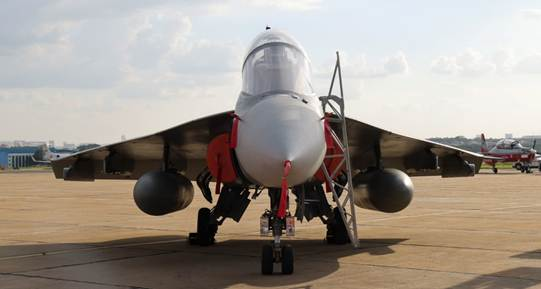
The three HTT-40 aircraft occupy an earlier point in the training pipeline. HAL developed the turboprop trainer for primary flying instruction, including general handling, aerobatics, instrument flying, navigation, night flying, and close formation work. The aircraft combines tandem seating with a modern cockpit and avionics suite and uses Honeywell’s TPE331-12B turboprop engine.
HAL lists a maximum permissible speed of 450 km/h, a service ceiling of 6 km, and a range of 1,009 km for the HTT-40. The aircraft is intended to reduce dependence on imported types for basic military training and provide the Indian Air Force with a domestically supported platform before pilots move to more advanced jet instruction.
Four Dhruv NG helicopters were handed to Pawan Hans during the same event. The civil configuration uses updated avionics, enhanced systems, and a more powerful engine, and is intended for passenger transport, emergency medical services, and offshore logistics. Its delivery gives HAL a commercial application for rotary-wing engineering developed across a programme with a long military lineage.
Defence Minister Rajnath Singh linked the handover to India’s wider aerospace policy, saying: “Our aim is to make India capable, self-reliant, and globally competitive in meeting its aerospace requirements.” The completed aircraft provide a measurable industrial marker behind that policy, having passed through manufacturing, systems integration, ground test, flight test, acceptance, and customer handover.
Managing the three programmes in parallel places different demands on HAL’s production system. Tejas manufacture depends on tight structural tolerances, avionics integration, and configuration control; the HTT-40 must combine predictable handling with maintainability and training economics; and the Dhruv NG has to meet civil operating and certification requirements alongside commercial expectations around availability.
The Tejas handover closes a defined production obligation while HAL continues work on the larger Mk1A programme. Its LCA Tejas Division is the lead manufacturing centre for the aircraft and has been expanding production capacity through additional facilities. The company is also establishing further LCA Mk1A production activity at Nashik, increasing the number of sites involved in fighter output.
HTT-40 production is being developed across the same broader industrial base. HAL’s Nashik division has been establishing infrastructure for the basic trainer, while Bangalore retains assembly, integration, and testing capability for the type. Splitting activity across existing aerospace sites can add capacity, but it also increases the importance of common manufacturing standards, configuration management, and supply-chain coordination.
A shortage of basic trainers can restrict the number of pilots entering later stages of the training system even when frontline aircraft are available. Domestic production gives the customer closer access to spares, engineering support, and future modification work, provided output and through-life support remain consistent.
The Dhruv NG delivery adds another test of industrial maturity. Civil operators work to utilisation, dispatch reliability, maintenance economics, certification, and continuing-airworthiness requirements that differ in important respects from military fleet management. Pawan Hans therefore gives the type an operating environment in which commercial support performance will be visible alongside technical capability.
HAL’s 2025-26 financial reporting showed manufacturing revenue growth supported by helicopter and engine deliveries, while delays in Tejas Mk1A and HTT-40 programmes remained an operating issue. The latest handover does not remove those schedule pressures, but it demonstrates completed output across fighter training, basic training, and civil rotary-wing lines within the same production year.
Future performance will be measured by delivery cadence rather than individual handover ceremonies. HAL now has to sustain fighter, trainer, and helicopter output while maintaining quality, certification, and support across military and civil customers. Closing the Tejas FOC trainer contract removes one defined commitment; the larger production challenge is keeping the follow-on programmes moving without allowing training or operational requirements to outrun supply.