IN Brief:
- Pakistan's Ministry of Defence placed a limited order for unmanned aerial systems and associated support.
- Powerus has disclosed no quantity, contract value, platform mix, or delivery schedule.
- The separate memorandum creates no obligation for Pakistan to make further purchases.
Powerus has received a limited procurement order from Pakistan’s Ministry of Defence covering unmanned aerial systems and associated support, alongside a separate memorandum establishing a framework for possible wider cooperation in unmanned and autonomous defence technologies.
The company has not disclosed the value, quantity, platform mix, or delivery schedule associated with the order. The confirmed procurement is therefore narrower than the wider cooperation framework: Pakistan has ordered unmanned aerial systems and support, but Powerus has not identified which aircraft will be delivered or how large the initial batch will be.
The memorandum of understanding is separate from that procurement and does not constitute an additional order. Powerus states that it creates no purchase obligation and does not require either side to proceed with further activity. Any later programme would require definitive agreements and would remain subject to applicable US laws, regulations, and government approvals.
The announcement followed a 16 September meeting at General Headquarters in Rawalpindi involving a Powerus delegation led by co-founder Brett Velicovich and Pakistan’s senior military leadership. Discussions covered defence technology and potential cooperation in procurement, production, and capacity building.
Powerus describes its portfolio as spanning autonomous air and maritime systems, heavy-lift platforms, mission systems, training, support, and US-based manufacturing. That portfolio gives the cooperation framework a broad potential scope, but the company has not said that every capability forms part of the current order.
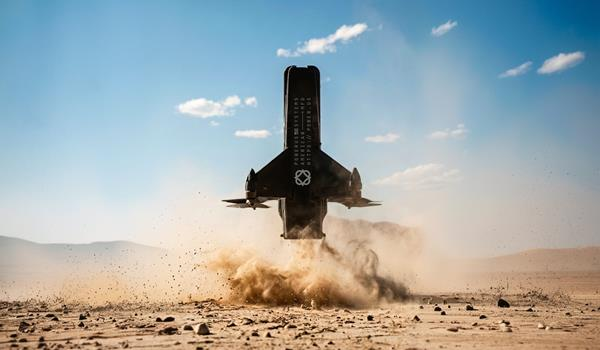
The photograph released with the announcement shows the Guardian-2 interceptor. Powerus has not identified Guardian-2 as the system purchased by Pakistan, so the image cannot be treated as evidence of the ordered platform type.
The distinction is relevant because unmanned-system procurement increasingly extends beyond the aircraft itself. Ground equipment, datalinks, control systems, sensors, software, training, spares, maintenance arrangements, and mission support can represent a substantial part of the programme required to turn delivered airframes into an operational capability.
The reference to associated support therefore adds substance even without a disclosed contract value. Uncrewed aircraft require recurring access to propulsion components or batteries, structural parts, communications equipment, payload support, software updates, and trained technicians. Those elements affect availability after delivery more directly than the announcement of an airframe order alone.
Any expansion under the memorandum would also have to pass US export-control requirements. Powerus explicitly identifies potential authorisations under US export-control law and notes that approvals could be delayed, limited, conditioned, or denied. The cooperation document should therefore be read as a framework for possible activity rather than evidence that a larger autonomous-systems programme has already been authorised.
The same limits apply to production and capacity-building discussions. Local assembly, maintenance, component manufacture, training, or other industrial work could form part of a future agreement, but none has been confirmed under the present announcement. The only disclosed procurement remains the limited unmanned aerial systems order and associated support.
That separation between the order and the memorandum is important commercially. A customer can evaluate delivered equipment and support before committing to a larger programme, while the supplier has to prove that it can manufacture, export, deliver, and sustain the initial systems under the conditions attached to an international defence sale.
The support relationship will be particularly relevant if Pakistan subsequently pursues a wider family of autonomous systems. Aircraft, maritime platforms, mission systems, and counter-UAS equipment can share software, communications, training, or logistics elements, but commonality is useful only when the underlying support arrangements remain manageable across different systems.
Powerus must first complete the initial procurement under undisclosed commercial terms. The company identifies possible risks around export licensing, customer funding and priorities, supply chains, production, and logistics, all of which sit between an announced order and accepted equipment.
The order gives Powerus an additional international defence customer while the company expands its autonomous-systems business. Its wider commercial value will depend on successful delivery and support rather than the breadth of a non-binding memorandum.
For now, the contractual position is comparatively simple: Pakistan’s Ministry of Defence has placed a limited order, Powerus is due to provide unmanned aerial systems and associated support, and both sides have created a mechanism for discussing additional cooperation. Any larger procurement or industrial programme will require another substantive agreement.