IN Brief:
- Programme Euston will procure three floating docks for submarine maintenance at HM Naval Base Clyde through a competition restricted to UK industry.
- The facilities will support inspections, upgrades, repairs, and other out of water engineering for current and future nuclear powered submarines.
- The programme sits within a £15.1 billion decade-long transformation of Clyde infrastructure and maintenance capacity.
Britain will restrict the competition for three new Royal Navy submarine floating docks at HM Naval Base Clyde to UK bidders, placing the construction element of Programme Euston inside the domestic shipbuilding and defence industrial base.
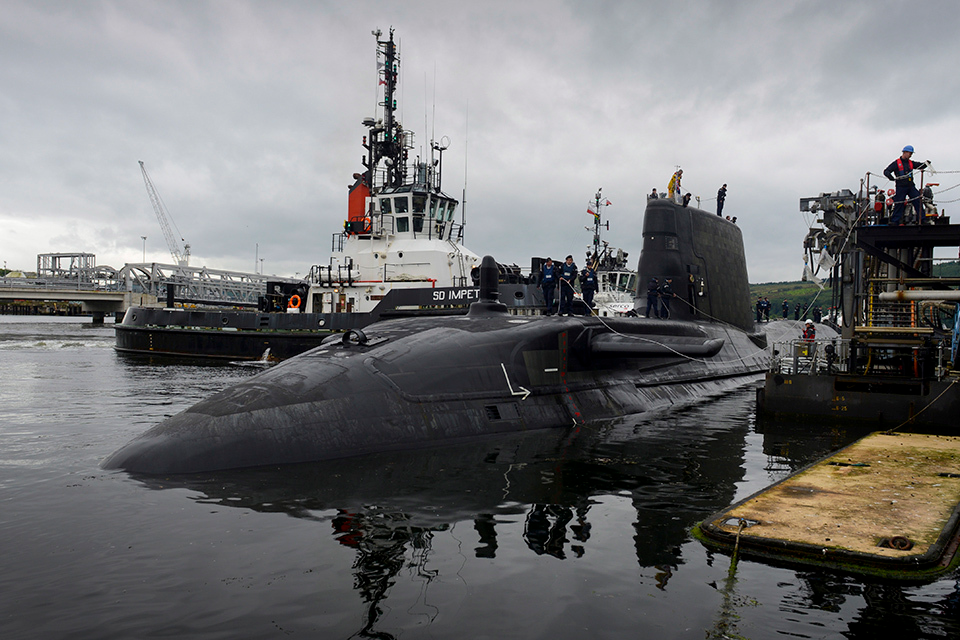
The docks are intended to provide out of water engineering capacity for the Royal Navy’s current and future nuclear powered submarines, supporting inspection, maintenance, upgrade, and repair work at Faslane. The government has cited national security and sovereign industrial capability in deciding to restrict the competition to UK industry, turning an infrastructure requirement into a protected domestic manufacturing programme.
Programme Euston forms part of the wider Clyde Transformation Programme, a long term upgrade of the naval base and the Defence Nuclear Enterprise. Parliamentary material published in July placed planned investment at HMNB Clyde at £15.1 billion over the next decade, covering dock infrastructure, training, and accommodation as well as the three floating docks, associated shoreside works, and a separate offsite engineering facility intended to increase maintenance capacity.
The programme is also the Royal Navy’s response to its Additional Fleet Time Docking Capability requirement. Earlier Ministry of Defence information said the aim was to establish resilient out of water engineering capacity at Clyde by the early 2030s. Detailed delivery arrangements and schedules were still being developed during the summer, so the decision to restrict the competition settles an important industrial question without yet fixing every part of the construction timetable or contract structure.
Design work was already under way before the latest announcement. In January, the Ministry of Defence said it intended to place a manufacturing contract after the technical specification had been completed and the procurement process concluded. Considerable engineering work therefore remains between the commitment to build in Britain and the start of fabrication, including dock design, nuclear site interfaces, shoreside systems, assurance requirements, and the commercial division of work between the successful bidder and its suppliers.
Floating docks for nuclear submarine maintenance are not simply large steel structures. They must support controlled docking loads, connect safely with shore power and services, provide access for maintenance teams and equipment, and operate within the security and safety requirements of a nuclear naval base. Mechanical, electrical, structural, and control engineering therefore sit alongside the heavy fabrication work normally associated with shipyards.
The three-dock requirement also adds redundancy to a support system in which maintenance availability is shaped by the condition and scheduling of a small number of specialised facilities. Each dock will still depend on shoreside utilities, access arrangements, lifting and handling equipment, and nuclear safety controls, so additional hull capacity cannot be separated from the surrounding base infrastructure. Programme Euston therefore links shipyard fabrication with civil engineering and systems integration work at Clyde over a period extending well beyond the initial dock build.
The wider Clyde programme shows how broad that requirement can become. Recent framework activity around HMNB Clyde has included marine engineering, civil and structural design, electrical systems, control and instrumentation, building services, safety cases, human factors, and specialist assessment. Programme Euston will sit inside the same infrastructure environment, so the floating dock contract will depend on interfaces with facilities and systems being modernised in parallel rather than being delivered as an isolated maritime asset.
Restricting the competition to UK bidders also puts capacity and workshare under closer scrutiny. Government answers to Parliament in 2025 said a detailed assessment of UK market capability would take place as Programme Euston requirements developed. More recent statements have described the domestic shipbuilding sector as well placed to participate, but the final choice of yard, supply chain structure, fabrication approach, and allocation of work has not yet been announced.
Employment effects remain similarly unresolved. Ministers have said jobs and training should increase around the programme, but the number of UK posts and apprenticeships can only be assessed once procurement is complete. The eventual regional impact will depend on where fabrication, systems integration, and shoreside engineering are placed, and on how much work flows through subcontractors around the country.
Maintenance resilience is the immediate requirement across the submarine enterprise. Clyde is the home of the UK’s nuclear deterrent submarines and supports attack submarines as the fleet develops, while future classes will place additional demands on engineering capacity. Additional docking infrastructure is intended to reduce dependence on a limited number of existing facilities and provide a more durable maintenance route into the 2030s and beyond.
The competition will now determine how that policy is translated into hardware. Britain has decided that the docks must be built domestically; technical specifications, bidder capability, contract award, and construction performance will determine whether Programme Euston delivers the maintenance capacity required at Faslane.