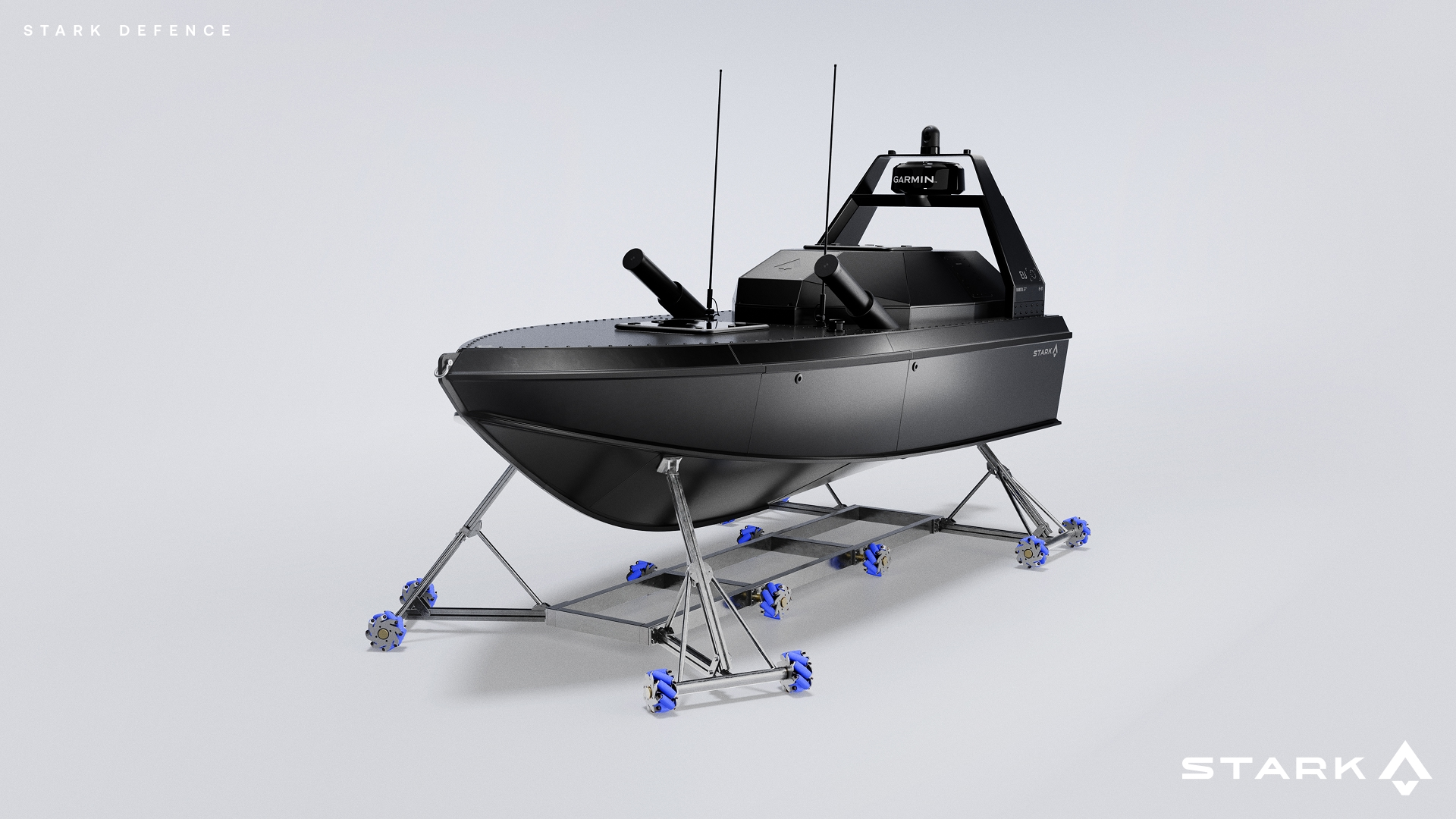
IN Brief:
- Vanta 12 is a 12-metre uncrewed surface vessel designed for surveillance, strike, electronic warfare, and other modular maritime missions.
- STARK has demonstrated Cascade loitering munitions from the platform and is working with MBDA around surface launched Sea Venom integration.
- The vessel has been designed for scalable production and participated in NATO's REPMUS 26 maritime systems exercise.
STARK has launched Vanta 12, a 12-metre uncrewed surface vessel developed in south west England to combine persistent maritime surveillance with modular strike, electronic warfare, and intelligence payloads.
The platform extends the company’s Vanta family into a substantially larger vessel intended to operate alongside conventional naval forces rather than provide only short range remote surveillance. STARK describes Vanta 12 as capable of covering up to 1,200 nautical miles, reaching more than 40 knots, and remaining at sea for extended periods, giving operators a means of distributing sensors and effectors across wider maritime areas without putting crews aboard every hull.
Its payload architecture is the more important departure from smaller uncrewed boats. Vanta 12 has been presented with provision for missiles, loitering munitions, electronic warfare equipment, intelligence, surveillance and reconnaissance sensors, and other mission systems. STARK has demonstrated the launch of its Cascade loitering munition from the vessel, with up to ten carried in the configuration shown publicly.
A separate collaboration with MBDA centres on Sea Venom, the lightweight anti-ship missile already operated from Royal Navy Wildcat helicopters. MBDA is developing a surface launched variant, and the companies have used Vanta 12 to demonstrate how the weapon could be integrated with an autonomous maritime platform. The work remains a development and integration activity rather than evidence that a surface launched Sea Venom configuration has entered operational service.
Vanta 12 has also taken part in REPMUS 26 in Portugal, NATO’s large scale experimentation event for robotic and autonomous maritime systems. The exercise places uncrewed vessels into mixed operations with conventional platforms, providing a more representative environment for testing navigation, communications, mission behaviour, and command integration than a standalone demonstration.
Those functions become more demanding as an autonomous vessel moves from sensing towards carrying weapons. Navigation has to remain reliable around other ships, communications must survive degraded conditions, and targeting information has to move between sensors, commanders, and effectors without weakening positive control. Weapons integration therefore adds considerably more than physical launcher space to an uncrewed boat.
STARK’s Minerva command and control software provides a common digital layer across its autonomous systems. The existing Vanta architecture combines visual, infrared, and radar sensing with autonomous navigation and integration into wider maritime networks. Vanta 12 adds the internal volume, power, and endurance required for more substantial mission equipment, but it also increases the systems engineering burden because surveillance sensors, communications, electronic warfare equipment, vessel control, and weapons all have to operate through a coherent architecture.
The company has tied that modular approach closely to production. Vanta 12 has been designed for repeatable manufacture rather than very small batches of bespoke naval craft. STARK’s maritime operation is based in south west England, while its wider UK presence includes a manufacturing facility in Swindon. The company is headquartered in Berlin and operates across several European countries, giving the Vanta programme a multinational development base but a direct British manufacturing component.
The launch follows other rapid integration work elsewhere in STARK’s portfolio. Earlier testing of its Gambit loitering munition paired a compact uncrewed aircraft with an established TDW warhead and safety system. Vanta 12 applies a similar integration philosophy at sea, combining STARK’s autonomy and platform engineering with effectors developed by established weapons manufacturers.
The industrial proposition depends on controlling configuration as much as reducing crew numbers. Conventional warships concentrate sensors, weapons, communications, propulsion, and people into a small number of expensive hulls designed for long service lives. An uncrewed system can distribute some of those functions across more vessels, but the cost advantage narrows if every hull acquires the sensor and weapon fit of a crewed combatant. Modular payloads offer a route to manufacturing a common platform while fitting only the equipment required for a particular role.
Long endurance operations bring a separate reliability challenge. A vessel expected to remain at sea for weeks needs propulsion, power generation, navigation, and communications systems capable of operating without engineers aboard to deal with routine faults. Autonomous navigation also has to cope with poor visibility, congested waters, and changing sea conditions, while remote command links must remain usable under electronic disruption.
Vanta 12 therefore sits between small remotely operated craft intended mainly for sensing and larger autonomous vessels intended to reproduce a broader warship mission set. Its 12-metre hull provides room for substantial payloads while preserving STARK’s stated objective of serial manufacture and distributed deployment.
The next useful milestones will come from repeatable trials rather than additional configurations. Surface launched Sea Venom integration, sustained operation in representative sea states, communications resilience, and production rate will show whether Vanta 12 can move from a flexible demonstrator into the scalable naval system STARK is proposing.