IN Brief:
- France’s DGA has qualified the vertical take-off and landing U010 Aliaca following land and maritime tests in May and June 2026, allowing entry into Navy service under SMDM.
- The aircraft replaces catapult launch and net recovery with vertical operations while retaining common ground-control software, autopilot, and data-link technology across the Aliaca family.
- Two VTOL systems were delivered in September; eight of the 34 ordered two-aircraft systems will adopt the new variant for French naval support and overseas missions.
Airbus Helicopters has secured French defence qualification for the vertical take-off and landing version of its U010 Aliaca tactical uncrewed aerial system, clearing the configuration for service under the French Navy’s SMDM programme. The Direction générale de l’armement (DGA) granted qualification following a series of land and maritime tests carried out with the Navy during May and June 2026. Airbus confirmed the milestone on 3 November, after the first two VTOL systems were delivered in September.
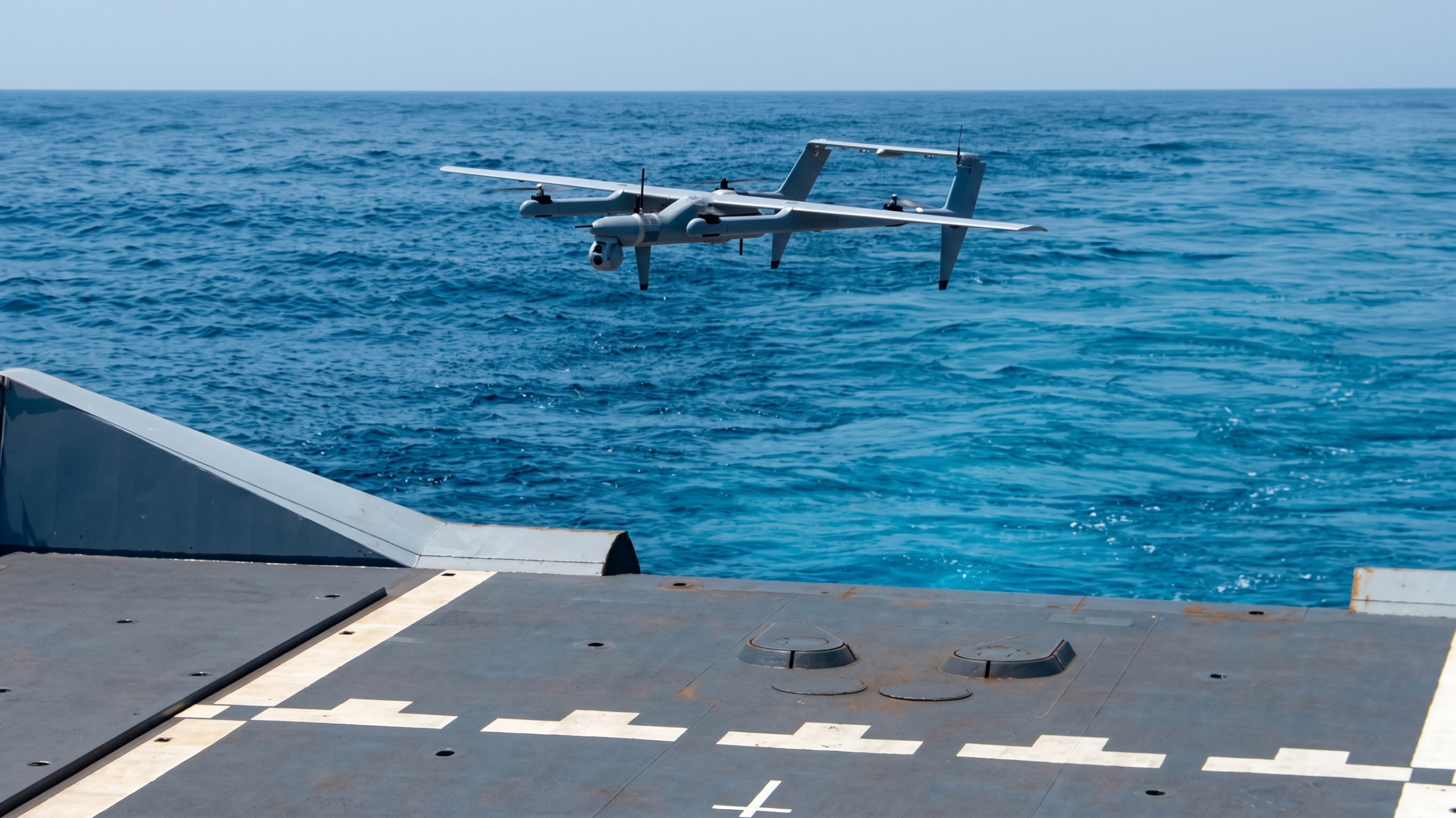
The new configuration removes a practical obstacle to operating a small surveillance aircraft from ships without a dedicated launch-and-recovery installation. Earlier Aliaca aircraft used a catapult for take-off and a net for recovery, equipment that occupies space and needs to be prepared on deck. A VTOL aircraft can launch and land vertically without that arrangement. Airbus says the change makes deployment possible from support vessels that were not originally designed to operate drones, while still requiring appropriate deck procedures and operating conditions.
The fixed-wing Aliaca has served with the French Navy under SMDM since 2022, principally on patrol vessels and surveillance frigates, and Airbus records its use in English Channel search-and-rescue missions from 2023. Its surveillance payload extends a ship’s observation beyond the direct view available from the bridge, providing imagery and contact information for maritime security work. That established surveillance role provides the operational basis for the VTOL development, which extends Aliaca deployment to a wider range of naval support vessels.
The DGA has ordered 34 Aliaca systems in total, each comprising two aircraft. In its 3 November qualification notice, Airbus specifies that eight of these systems will use the VTOL configuration. The first two VTOL systems were delivered in September, before the latest public qualification announcement. Their delivery and the DGA’s approval are separate milestones; Airbus has not stated that all eight systems are deployed on their intended host vessels or that every vessel has completed its integration work.
Airbus developed the vertical-flight variant with a redesigned wing and modified fuselage while preserving core systems already used by the fleet. Common autopilot, data-link, sensor-integration, and ground-control software reduce the number of interfaces and procedures that crews must learn anew. Retaining that architecture also helps keep mission planning and payload management consistent between fixed-wing and VTOL aircraft, even as their launch and recovery processes differ.
A standard Aliaca system comprises two aircraft and a ground control station. Airbus describes two ruggedised laptops, normally split between flight and payload control, with provision for one operator to handle both functions when appropriate. Missions can be programmed in advance, and take-off and landing are automated. This arrangement preserves a familiar command environment for the Navy while the air vehicle’s vertical manoeuvres and flight-control requirements are handled through the revised platform.
Vertical take-off and landing changes the engineering demands on a fixed-wing surveillance aircraft. The vehicle must produce controlled lift at very low forward speed and transition to efficient wing-borne flight once airborne, while retaining sufficient energy for the mission and its recovery phase. Those competing requirements influence propulsion, structure, mass distribution, and control software. The 3 November release does not publish a new endurance or range figure for the qualified VTOL variant, so performance figures quoted for the wider Aliaca family should not be treated as its acceptance-test results.
Airbus’s wider Aliaca documentation describes a 25kg maximum take-off mass and electric and hybrid propulsion options, with differing payload, range, and endurance profiles. The specifications are presented for the product family and do not establish the precise payload or endurance achieved by the naval VTOL configuration in the May–June trials. The DGA qualification establishes the new configuration’s eligibility for French Navy service, with detailed trial performance remaining within the programme.
The DGA’s assessment followed tests on land and at sea in May and June, in cooperation with the French Navy. Shipboard trials expose equipment to practical constraints including moving decks, salt exposure, restricted operating space, and electromagnetic conditions around naval systems. Airbus’s October programme account also describes trials from a metropolitan support and assistance vessel, a class not initially designed for drone operations. Neither account provides a full test matrix or precise sea-state limits, leaving the approved operating envelope to the programme authorities.
Aliaca’s principal tasks remain intelligence, surveillance, reconnaissance, maritime security, and search and rescue. Airbus describes electro-optical and infrared imaging, together with automatic identification system capabilities, across the family. Those tools can help a ship examine contacts and correlate visual observations with reported vessel information, where the relevant payload is fitted. The qualification adds shipboard surveillance options, with no new weapons capability described in the company’s announcement.
The VTOL variant is planned for metropolitan support and assistance vessels, known as BSAM, and overseas support and assistance vessels, designated BSAOM. Airbus’s October account envisaged BSAM deployment beginning in late 2026 and BSAOM deployments following in 2027. The November qualification notice identifies New Caledonia, French Polynesia, Réunion, and Martinique among the overseas locations from which the systems will support maritime security. Their distributed operating areas place particular value on a small aircraft that can be launched from ships with limited aviation facilities.
The DGA qualification completes a development and test stage for the VTOL configuration within the existing 34-system SMDM order. France can now bring the approved configuration into service as vessel integration, crew preparation, and acceptance arrangements progress. Airbus has confirmed eight VTOL systems in the overall order and the delivery of the first two in September; subsequent assignments and in-service performance will depend on the Navy’s deployment programme.