IN Brief:
- IVAS has given way to a more modular SBMC model centred on displays, body-worn compute, sensors, and tactical networking.
- The technical challenge now sits in optics, power, weight, thermal management, and software integration — not headset spectacle.
- Smaller, narrower systems look far more likely to reach credible field use than all-in-one soldier visors.
For much of the past decade, the promise of soldier-worn mixed reality was sold in sweeping terms: a single device that would collapse night vision, thermal imaging, navigation, targeting data, mission command, and training overlays into one view.
The operational logic was born of the fact that dismounted troops are being asked to move through denser sensor environments, manage information from multiple feeds, and act faster inside compressed decision cycles. However, the difficulty was that the hardware ambition ran ahead of what could be worn, powered, cooled, and trusted on a helmet line already carrying too much.
That tension sat at the heart of the US Army’s Integrated Visual Augmentation System. IVAS began as a HoloLens-derived programme intended to combine situational awareness, navigation, low-light vision, training, and mission-command functions in a single head-mounted system. It was, in procurement terms, an exceptionally large bet, with the 2021 contract carrying a ceiling of roughly $21.9 billion. The attraction was obvious enough: a headset that could place fused information directly into the user’s view, link into the wider tactical network, and eventually support control of unmanned systems from the tactical edge.
What followed was less a rejection of the concept than a rather public demonstration of its engineering limits. The Pentagon’s Director, Operational Test and Evaluation found that soldiers using IVAS 1.0 during the 2022 assessment hit fewer targets, engaged more slowly, and reported symptoms including headaches, eyestrain, nausea, neck strain, and balance issues. That mattered because it showed the central problem was not software ambition alone. It was systems integration in the bluntest sense: too much mass at the head, too much visual intrusion, too much power and compute demand too close to the face, and too little tolerance for what prolonged wear does to perception and comfort.
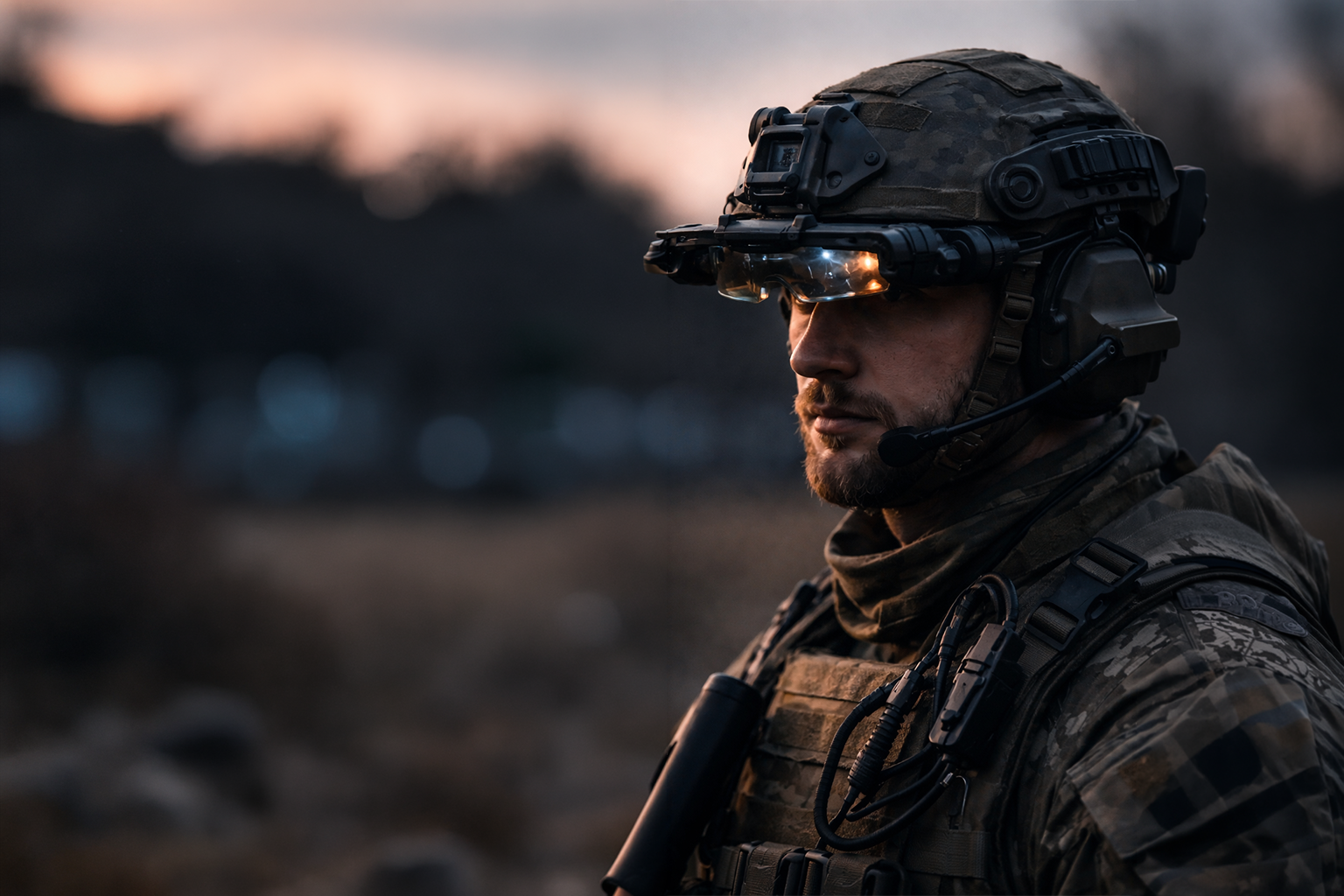
The redesign work that followed is where the subject becomes more interesting. In describing IVAS 1.2, the Army pointed to a lower-profile heads-up display, a distributed counterweight, a hinged helmet mount, improved low-light sensing, reduced power demand, and software reliability improvements. Those are not cosmetic refinements. They amount to a quiet but important shift in design philosophy, away from the idea of the headset as the entire capability, and towards the headset as only one visible element within a wider soldier system. The display remains critical, but it is no longer expected to carry the full burden of the architecture on its own.
That same shift has become clearer in the past 12 months. Anduril announced in February 2025 that it would take over development and production of the IVAS programme from Microsoft, and by September the Army had moved into a Soldier-Borne Mission Command, or SBMC, competition involving teams led by Anduril and Rivet. The new effort produced something more modular than the original vision: a fused digital awareness system built around heads-up displays, body-worn compute, night-vision capability, tactical networking, and software services, with backwards compatibility to ATAK-based architectures. The centre of gravity had plainly moved from one ambitious goggle to a distributed stack of optics, sensors, compute, radios, and applications.
Optics still sit at the centre of the requirement, but the industry challenge now is to decide what deserves to sit in the user’s field of view at all. Low-light fusion, route cues, friendly-force awareness, sensor alerts, and unmanned-system tasking may all be useful, but only if the display preserves peripheral awareness, keeps latency under control, and remains readable under movement, stress, dust, glare, and low temperatures.
A narrower display concept, as it turns out, actually reflects a far more considered approach to device design. It accounts for the fact that cognitive load, not only processing power, governs whether such a system is worth wearing.
The same is true of compute and power distribution. Moving processing away from the face and into body-worn compute has obvious benefits in weight, heat, and balance, but it also opens up harder industrial questions around cabling, connectors, battery endurance, sealing, electromagnetic compatibility, and graceful degradation when bandwidth or power drops away.
Army material on IVAS has long described links to tactical cloud packages, edge compute, and the Integrated Tactical Network. That architecture is attractive, but it raises the bar for software optimisation and subsystem discipline. A soldier display that depends on perfect power housekeeping and uninterrupted data flow is not a field capability. It is a test range capability that has wandered into procurement.
The healthier view of the post-IVAS market, then, is not that mixed reality is fading, but that it is finally being treated as a manufacturable system rather than a theatrical object. Once the requirement is broken into optics, sensors, compute, power, mounting, networking, and software integration, the supply chain becomes broader, upgrade paths become more manageable, and disappointment in one subsystem no longer condemns the entire concept.
The likely outcome is much more grounded than the early rhetoric suggested: smaller displays, tighter mission focus, harder engineering around weight and power, and a system that earns its place incrementally. After several years of exaggerated expectation, that looks like progress of a more durable kind.