IN Brief:
- FalconWorks and SURVICE Engineering have set a framework for joint work across small and tactical UAS, beyond pure logistics roles.
- The partnership builds on the Malloy T-150 platform, fielded in US service as TRV-150, and pushes toward more configurable payload and mission options.
- Manufacturing advantage will sit with designs that tolerate low-cost repetition while meeting defence-grade integration and airworthiness demands.
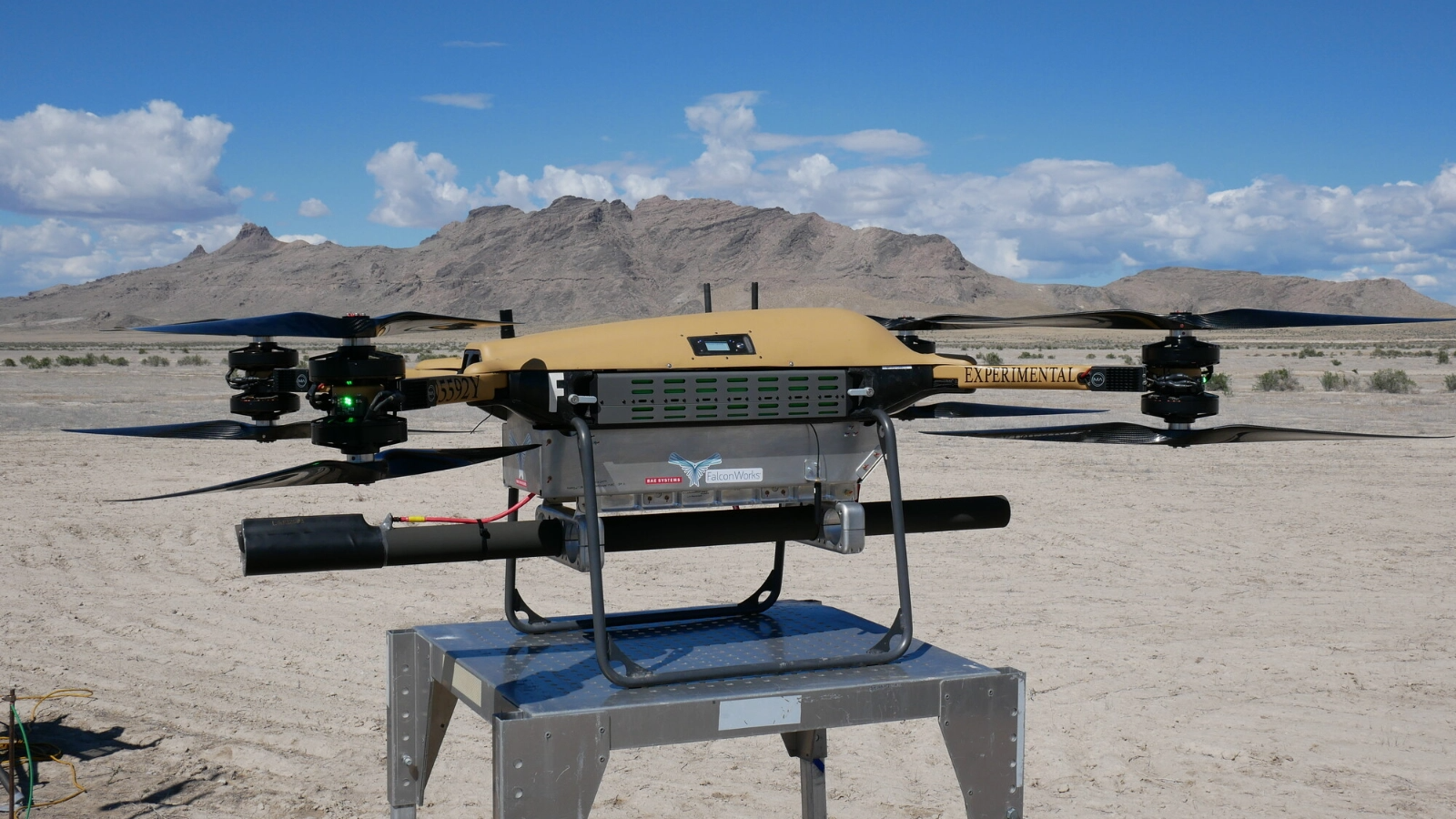
BAE Systems’ FalconWorks unit and US-based SURVICE Engineering have signed a framework agreement to collaborate on uncrewed air system development and manufacturing, broadening a relationship built around Malloy Aeronautics’ T-150 all-electric logistics platform. That aircraft is already in US military service via SURVICE as the TRV-150, supporting resupply missions and proving that small UAS can carry useful mass without dragging operators into exposed ground routes.
The new agreement extends the scope beyond logistics into a wider portfolio of small and tactical UAS, a category that is now splitting into two camps: exquisite aircraft built for contested airspace, and cheaper systems that trade performance for scale and replaceability. FalconWorks has been explicit about chasing the latter as well as the former, with uncrewed systems increasingly expected to operate alongside crewed aircraft in mixed formations.
Anthony Gregory, Business Development Director at BAE Systems FalconWorks, said: “UAS are increasingly important to defence and security, conducting a variety of roles.” SURVICE, meanwhile, has pointed to additional TRV-150 use cases demonstrated with US forces, including mine clearing, obscurant deployment, and weaponisation, all of which pull a “cargo drone” closer to a modular mission aircraft.
For UK and US industry, the deal is a reminder that tactical UAS programmes are becoming manufacturing problems as much as design challenges. A platform can be tactically credible and still fail if it cannot be built quickly, reworked in service, and sustained with predictable parts pipelines.
Designing for low-cost, repeatable builds
Small UAS scale depends on manufacturability: airframes that can be assembled with minimal touch labour, wiring architectures that support fast fault-finding, and payload interfaces that avoid bespoke integration every time a customer asks for a new mission kit.
Electric multirotors look simple until production ramps. Consistency across motors, power electronics, and rotor systems directly affects lift margins and endurance, while software configuration control becomes a production discipline when fleets are updated in cycles rather than one aircraft at a time.
A partnership structure can help here, separating rapid R&D iterations from the slower work of industrialisation. The winners are typically the designs that accept change without forcing a factory reset.
Battery, motor, and payload supply pressures
The supply-chain constraints are increasingly familiar: batteries, high-quality electric motors, and compact sensors compete with adjacent civil markets, while export controls and security requirements narrow the field of “approved” electronics and datalinks.
Weaponisation, even at the demonstrator level, adds further industrial burden. Safety cases, arming and fuzing separation, and repeatable mechanical interfaces push the aircraft toward more formal production controls, which can collide with the sector’s instinct for rapid iteration.
If FalconWorks and SURVICE can turn a proven logistics platform lineage into a scalable tactical family, the manufacturing play is clear: a predictable build standard, a managed configuration baseline, and a supply chain that does not fracture when demand spikes.