IN Brief:
- TKMS and IAI delivered BlueWhale to the German Navy at Eckernförde.
- ATLAS ELEKTRONIK integrated an advanced anti-submarine warfare towed sonar.
- The programme tightens links between autonomy software, sensors, and naval production.
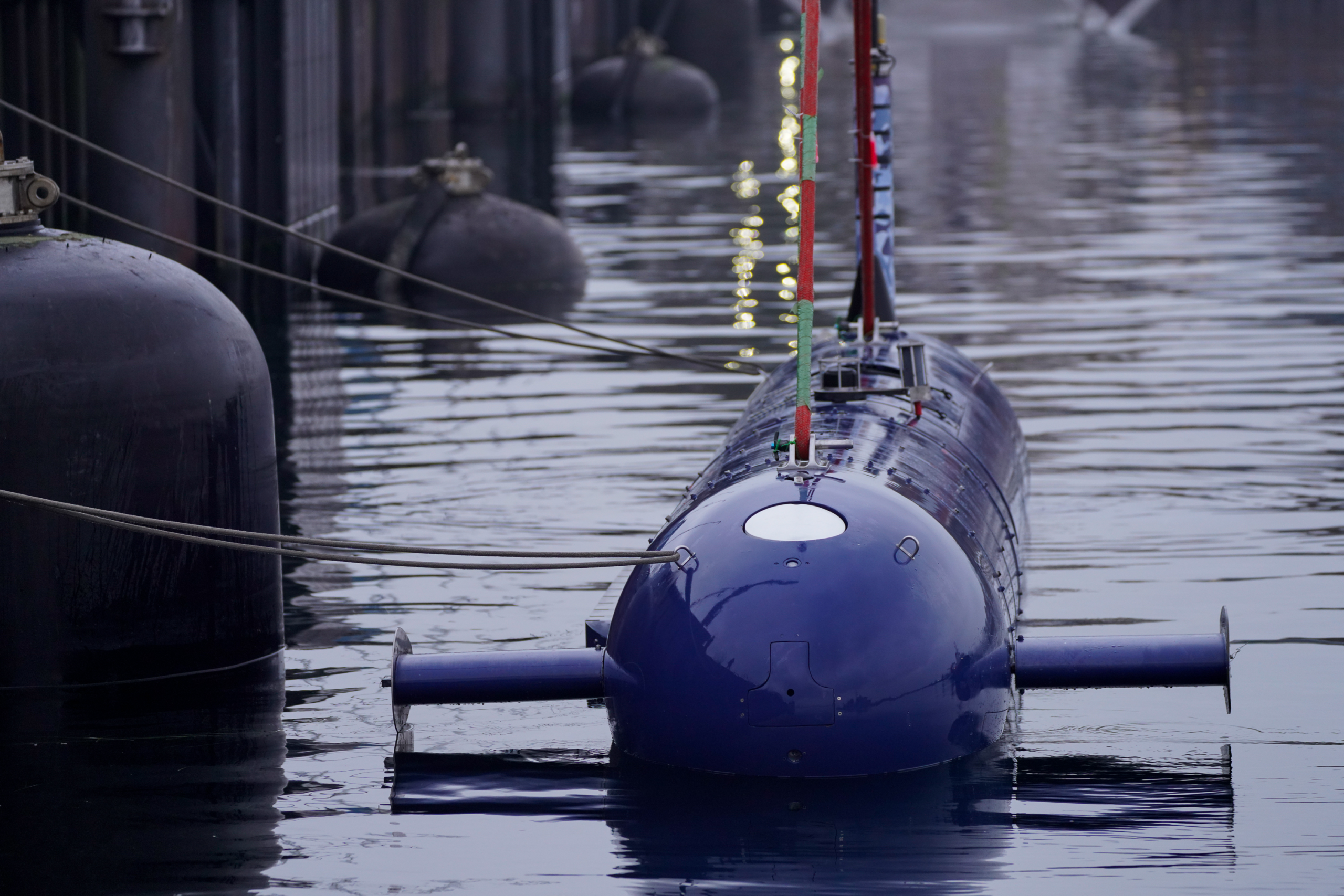
Thyssenkrupp Marine Systems (TKMS) and Israel Aerospace Industries (IAI) have delivered the BlueWhale large autonomous underwater vehicle to the German Navy, handing over the platform at the Eckernförde naval base on February 25.
TKMS and IAI described BlueWhale as a fully autonomous large underwater vehicle combining reconnaissance, sensor technology, and data fusion in a single system. While IAI developed the vehicle, TKMS and its ATLAS ELEKTRONIK segment integrated an advanced anti-submarine warfare towed sonar, creating a joint platform intended to extend the Navy’s underwater sensing reach.
Michael Ozegowski, Executive Vice President of TKMS ATLAS ELEKTRONIK, said the company is expanding its autonomous capabilities and highlighted “the rapid introduction of new technologies” as a shared goal with the Navy. Boaz Levy, CEO and President of IAI, said the delivery demonstrates close cooperation and “the degree of mutual trust” between Israel and Germany.
TKMS said the delivery follows intensive Baltic Sea testing, with BlueWhale designed to detect targets above and below the surface, collect acoustic information, and locate sea mines.
Sonar integration drives industrial complexity
Large AUVs do not behave like simple drone platforms once a serious sonar payload is involved. A towed sonar imposes integration demands that ripple through hull structure, power budgeting, towing dynamics, and acoustic isolation. Each of those factors has manufacturing consequences — from tighter assembly tolerances to additional acceptance testing aimed at proving the sensor package performs as specified once it is installed, not just when it is on a bench.
The programme’s emphasis on unmanned anti-submarine warfare also pushes the industrial requirement towards repeatability. A single demonstrator can be hand-finished; an operational capability needs stable processes, controlled materials, and supplier consistency across electronics, tether components, and subsea connectors.
TKMS positioned BlueWhale as an “extended sensor arm” for manned platforms, with prospective integration into wider naval networks under a uniform software and data architecture. That framing puts software configuration management and secure update mechanisms as an integral part of the deliverable.
For industry, the sustainment model becomes part of production planning: spare parts provisioning, sensor calibration workflows, depot-level test equipment, and battery or propulsion maintenance routines all need to be defined early if the Navy wants availability rather than a platform that spends its life waiting for specialist intervention.