IN Brief:
- Hensoldt says its TRML-4D manufacturing capacity has increased fivefold in three years and is planned to double again over two years.
- The company expects a sustained capacity step change by mid-2027, followed by further expansion towards 2029.
- Its 2030 and 2035 revenue figures are ambitions, not confirmed sales or committed procurement orders.
Hensoldt plans to double its TRML-4D radar production capacity again over the next two years, extending a manufacturing expansion that has already increased capacity fivefold in three years. The German defence electronics group disclosed the latest target at its Capital Markets Day in London on 10 November, alongside plans to enlarge its wider production system through the second half of the decade.
Hensoldt says it has added approximately 49,000 square metres of infrastructure since 2023, with another 46,000 square metres due to be added from 2027. Its programme includes another air-defence radar site, scheduled to begin series production in the second quarter of 2027, and an optronics service centre. The group expects a sustained increase in overall capacity by mid-2027, followed by further expansion through 2029. These are factory and capacity plans, not confirmed radar shipment volumes.
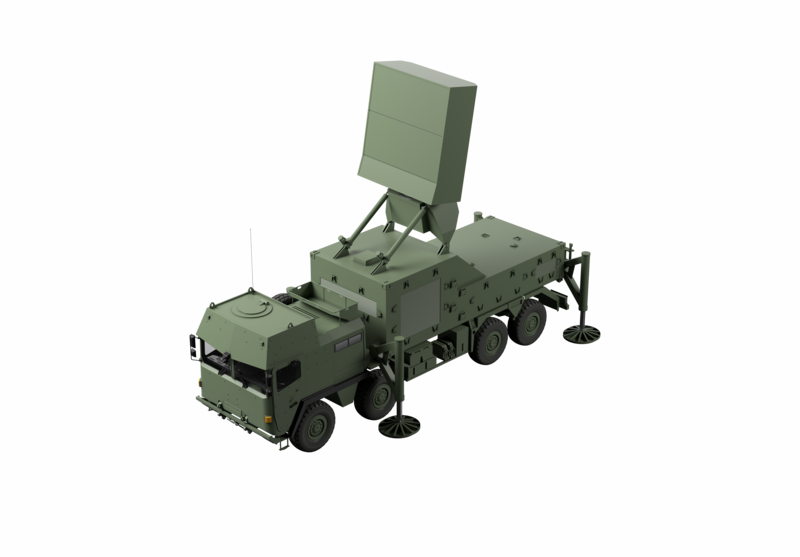
Hensoldt identified the TRML-4D as a central example of the changes already under way. The radar is used for ground-based air surveillance and target acquisition, including within air-defence architectures that must detect and follow aircraft, drones, and missiles. It employs an active electronically scanned array, which can direct radar beams electronically and support multiple surveillance and tracking tasks without relying entirely on a mechanically swept antenna.
Hensoldt specifies an instrumented range of 250 kilometres, an instrumented altitude of 30 kilometres, and parallel tracking of approximately 1,500 targets for TRML-4D. These describe the radar’s published design capability rather than performance achieved by the new factories. The system can be transported on suitable truck platforms using 20-foot ISO container fittings, so manufacturing and delivery cover electronics, supporting structures, software, and deployable mechanical equipment.
Expanding radar output requires coordinated work across several manufacturing processes. An active array contains numerous transmit and receive components, control electronics, power distribution, signal processing equipment, and supporting structures. These assemblies must be fabricated, tested, calibrated, and integrated into systems that remain reliable under military environmental conditions. A larger final-assembly facility alone will not remove bottlenecks if specialised parts, calibration stations, or qualified personnel cannot increase throughput at a similar pace.
Electronic testing is particularly relevant because the system must operate as a single sensor after individual modules have passed their own checks. Array alignment, signal paths, electromagnetic compatibility, software configuration, and fault-monitoring functions all affect the quality and repeatability of the finished product. The manufacturer has not published cycle-time reductions, line-by-line equipment investments, or details of the yield improvements it expects from the latest expansion.
At the end of September 2026, Hensoldt reported an order backlog of approximately €10.4 billion, reflecting demand across air-defence radars, aircraft systems, and other defence electronics. That contracted work provides a basis for production planning, although delivery schedules, component availability, and contractual milestones determine how backlog turns into revenue. The group’s much larger prospective sales pipeline is not equivalent to signed orders.
The company has also revised its financial expectations. It confirmed an ambition of €6 billion in annual revenue by 2030 and introduced a €10 billion ambition for 2035. Annual revenue growth of 15–20% is expected from 2027, with growth above 20% envisaged towards the end of the decade. The industrial capacity expansion is intended to support those objectives, although the company has not said how much of the incremental revenue will come specifically from TRML-4D radar production.
Service provision is also becoming a larger part of Hensoldt’s plans. The company expects maintenance, upgrades, and other support work to account for around a quarter of long-term revenue as the installed equipment base grows. Each radar delivered creates recurring requirements for spare parts, maintenance documentation, trained technicians, and software support, so the expansion must accommodate sustainment alongside new production.
The programme also reflects a shift in European defence procurement towards larger quantities of equipment and more predictable supply. Hensoldt’s TRML-4D has already been selected for several air-defence programmes, and its product family has a defined role in tracking targets for weapons systems. Scaling a proven sensor can be more direct than developing a new product, but production changes still require configuration discipline and assurance that successive batches meet the same operational requirements.
The second quarter of 2027 is the next stated production milestone for the additional air-defence radar site. Its contribution to actual deliveries will depend on qualification of the facility, calibration and test throughput, supplier readiness, and configuration control across successive radar batches. Hensoldt has set out the floor space and capacity targets, but has not specified the annual number of TRML-4D units those investments will ultimately produce.