IN Brief:
- HII has expanded its Romulus USV assembly plans at Breaux Brothers Enterprises in Louisiana.
- The new HYPR initiative brings robotic welding, automated material handling, and digital quality assurance into the build model.
- The aim is to lower cost, improve schedule predictability, and support serial production across multiple vessel variants.
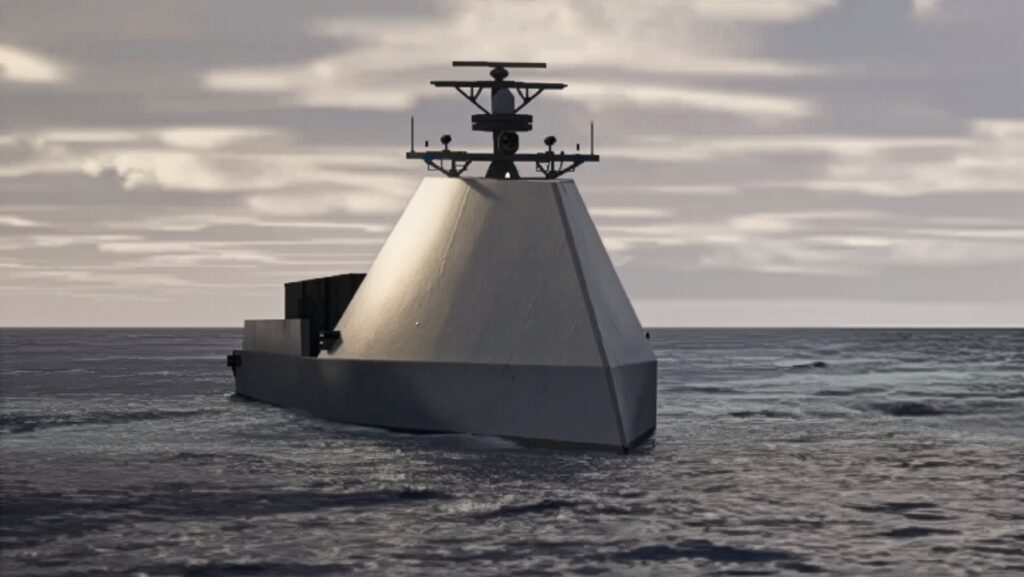
HII has set out a broader industrial plan for its Romulus unmanned surface vessel family, centred on an expanded assembly facility in New Iberia, Louisiana, and a new High-Yield Production Robotics initiative designed to move USV construction onto a more repeatable, scalable footing. The company is pitching the combination as a production system, not simply as an unmanned-boat workshop.
That distinction matters. USV demand has outgrown the prototype era, but many builders are still trapped in low-rate, labour-intensive processes better suited to development craft than to fleet-scale procurement. HII’s answer is to bring assembly-line logic, stronger tooling discipline, and digitally managed quality into a family of autonomous vessels that can span a wide size range and multiple mission sets.
Romulus has been positioned for roles including intelligence collection, mine countermeasures, strike, and unmanned system deployment. That mission breadth only becomes commercially useful if the production base can handle multiple configurations without treating each hull as a near-custom job.
Production system implications
HYPR is the sharper industrial signal here. Robotic welding, automated material handling, and digitally enabled quality assurance are all familiar concepts in other manufacturing sectors, but shipbuilding has been slower to absorb them at meaningful scale. HII is trying to apply those methods to autonomous maritime production before the market fully hardens around a rival model.
A common manufacturing approach across boats from roughly 20 ft to 190 ft also suggests a deliberate attempt to standardise workflows, tooling, and structural processes. If that works, it cuts labour hours per hull, reduces rework, and raises throughput without sacrificing configuration flexibility.
Scaling and integration pressures
There is still a gap between a modernised assembly concept and a proven high-rate naval production line. Larger USV variants place more strain on structural automation, subsystem installation, and acceptance testing, while autonomy hardware and software add another layer of integration risk.
The key question is whether HII can turn Romulus into a genuine family-production model rather than a showcase for industrial ambition. If it can, the USV market may begin to look less like boutique boatbuilding and more like a contest over who can industrialise autonomy first.