IN Brief:
- Malta is adding a fourth Aerodata-converted King Air, extending a standardised maritime surveillance fleet for border control, law enforcement, and search-and-rescue work.
- The aircraft will combine upgraded radar, sensor integration, AeroMission software, and AI-supported vessel detection and classification.
- For industry, the programme underlines sustained demand for special-mission aircraft conversion, systems integration, training infrastructure, and ground-network interoperability.
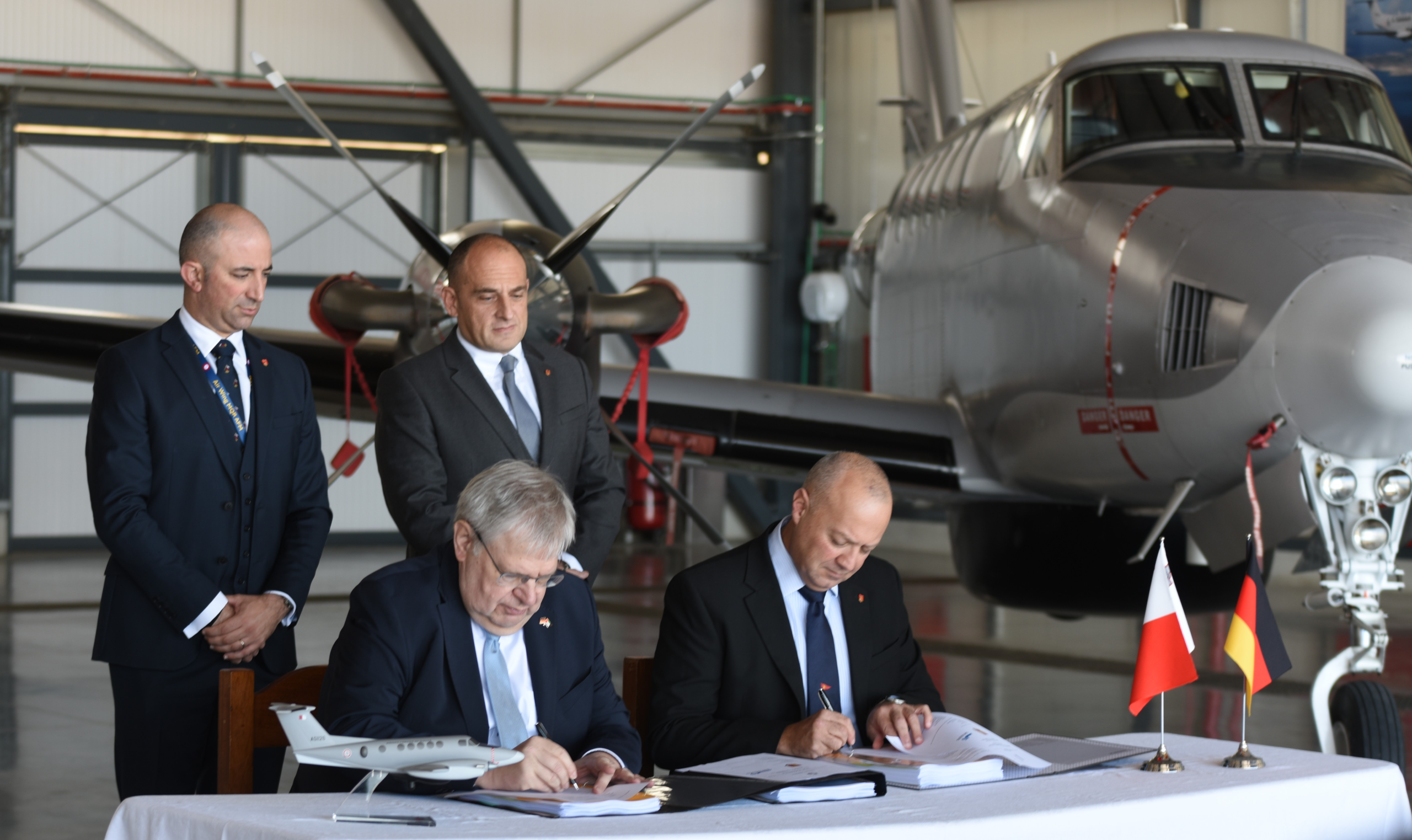
Malta is expanding its maritime surveillance capacity with a fourth King Air special-mission aircraft from Aerodata AG, extending a fleet the Armed Forces of Malta has been standardising for more than a decade. Delivery is scheduled for the end of 2027, with the aircraft intended for border control, maritime surveillance, law-enforcement tasks, and search-and-rescue operations across the central Mediterranean.
The contract is more than an airframe buy. Aerodata is again acting as prime contractor, converting a Beechcraft King Air into a maritime patrol aircraft at Braunschweig and integrating a performance-enhanced radar, updated sensor technology, and the latest version of its AeroMission mission-management system. The company says the package will include AI-supported automatic vessel detection and classification, using data fusion to reduce operator workload and speed up target recognition.
For Malta, the logic is straightforward. Smaller air arms rarely have the budget, manpower, or support depth for a mixed surveillance fleet, so common platforms matter. A fourth aircraft aligned to the existing three King Airs should simplify crew conversion, mission planning, spare holdings, software support, and maintenance practice at a time when central Mediterranean surveillance demand remains high.
The order also follows Aerodata’s recent mid-life upgrade work on Malta’s third patrol aircraft. That upgrade added new sensor capability, a full crew training station, and a ground information management system for storing, analysing, and visualising mission data. Taken together, the recent work suggests Malta is building out a broader surveillance architecture rather than simply adding another aircraft to the line.
Conversion work moves beyond the airframe
Special mission turboprops are relatively modest aircraft until the mission kit starts accumulating. Radar integration, operator consoles, mission computers, datalinks, power management, cooling, wiring looms, antenna placement, and electromagnetic compatibility work quickly turn a straightforward platform into a dense systems-engineering programme. In that sense, the industrial value increasingly sits in the integration burden rather than the bare metal.
That is especially true when AI functions are being introduced into the mission stack. Aerodata says the vessel-detection and classification capability is being developed with Data Machine Intelligence, and that the pair first showed a prototype at Paris Air Show 2025. Moving from prototype to operational deployment on a compressed timeline is ambitious by defence standards, placing pressure on verification, interface testing, and human-machine workflow design as much as on software development itself.
The industrial case for Malta’s King Air standardisation is nearly as strong as the operational one. A small fleet built around one platform and one mission-system family reduces the number of training paths, certification events, spare lines, and maintenance procedures that must be carried through life. For a compact force structure, that matters more than brochure numbers.
The link to Aerodata’s Prometheon information-management system sharpens the point. Once airborne sensor feeds, ground systems, and command-and-control tools are tied together, the programme extends beyond aircraft conversion into simulator support, software baselining, interface control, and recurring upgrades. That is where long-term support work sits for special-mission aircraft suppliers, and where smaller defence customers increasingly expect turnkey industrial backing rather than a one-off delivery.
By the time this aircraft enters service in late 2027, the more important question will not be whether Malta bought another patrol aircraft. It will be whether the country has assembled a surveillance fleet, training pipeline, and data backbone that can sustain operational tempo without dragging support complexity out of proportion. On current evidence, that is where this programme is heading.