IN Brief:
- Saab and Cohere have signed an MoU covering AI collaboration in support of the GlobalEye AEW&C platform.
- The work is focused on mission support, maintenance tools, and information processing in secure on-premises aerospace environments.
- The industrial question is whether commercial AI can be absorbed into airborne defence production without creating new certification and support burdens.
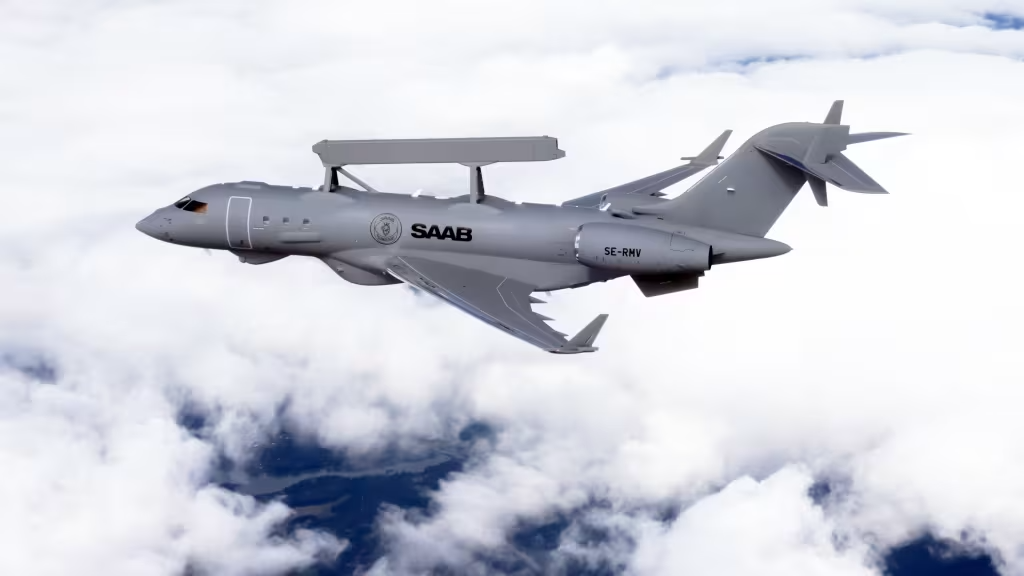
Saab’s new agreement with Canadian AI company Cohere is a defence-industrial move before it becomes an operational one. The memorandum of understanding covers artificial intelligence collaboration in support of GlobalEye, Saab’s airborne early warning and control platform, with initial work aimed at data-driven mission support, maintenance tools, and information processing inside secure aerospace environments.
That is a more grounded proposition than the broader rhetoric around military AI often suggests. GlobalEye is already a technically dense system built around Saab’s Erieye ER radar, mission systems, and a modified Bombardier Global 6000/6500 airframe. Any attempt to introduce AI into that environment is not a matter of dropping software into an aircraft and calling it transformation. It is a systems engineering exercise that touches certification, integration, operator trust, data handling, and long-term support.
Saab has linked the agreement directly to its GlobalEye opportunity in Canada, but the company has also made clear that the technologies developed could support existing and future international operators. That matters because GlobalEye is no longer just a single product offer. It is becoming a production and support ecosystem, with airframe supply, modification capacity, sensor integration, mission software, and sustainment all needing to align across markets.
The industrial appeal of AI in that setting is obvious enough. AEW&C aircraft live on information advantage. Faster processing, better filtering of complex sensor inputs, stronger mission support tools, and maintenance systems that can identify faults or inefficiencies earlier all have direct value. The catch is that defence aircraft are not enterprise IT estates. Secure, on-premises deployment, traceable performance, and compatibility with mission assurance demands matter more than novelty.
AI on military aircraft is an integration job
The GlobalEye programme already illustrates how much industrial depth sits behind an airborne surveillance platform. Saab’s own production model depends on a Canadian-built Bombardier platform, extensive aircraft modification work, advanced radar and sensor integration, and specialist capacity in multiple countries. The company has also been expanding its modification base to meet rising demand.
Adding AI into that stack will create new work far beyond model development. It will require data pipelines that are usable in classified or restricted environments, human-machine interfaces that crews can trust under time pressure, validation methods suitable for aerospace programmes, and support structures that can manage software updates without undermining availability. In other words, the engineering burden shifts from can the model do this to can the programme support this safely and repeatedly.
For defence manufacturers, that is the useful part of the story. The future market for AI in defence aerospace will belong less to the most theatrical demonstrations than to the companies that can embed it inside long-life platforms without creating fresh sustainment headaches.
The supply chain is becoming part of the software stack
Saab has presented the Cohere partnership as part of a wider industrial collaboration model in Canada, and that deserves attention in its own right. Defence AI is often discussed as though it sits above manufacturing. In practice, it is becoming another layer of the industrial base, dependent on where platforms are modified, where data can legally sit, who owns the integration environment, and which suppliers are trusted inside sovereign programmes.
That is particularly relevant for platforms like GlobalEye, where demand is tied to national capability, industrial participation, and lifecycle support. A credible AI layer will need to fit those same procurement realities. It has to work within secure environments, support domestic industry commitments, and remain maintainable over decades rather than funding cycles.
Saab’s agreement with Cohere is therefore less about flashy autonomy than about production discipline. If the collaboration succeeds, it will show that commercial AI can be adapted to a certified, secure, mission-critical aircraft environment without breaking the industrial logic of the programme. That is a harder task than a product demo, and a more useful one for the defence market.