IN Brief:
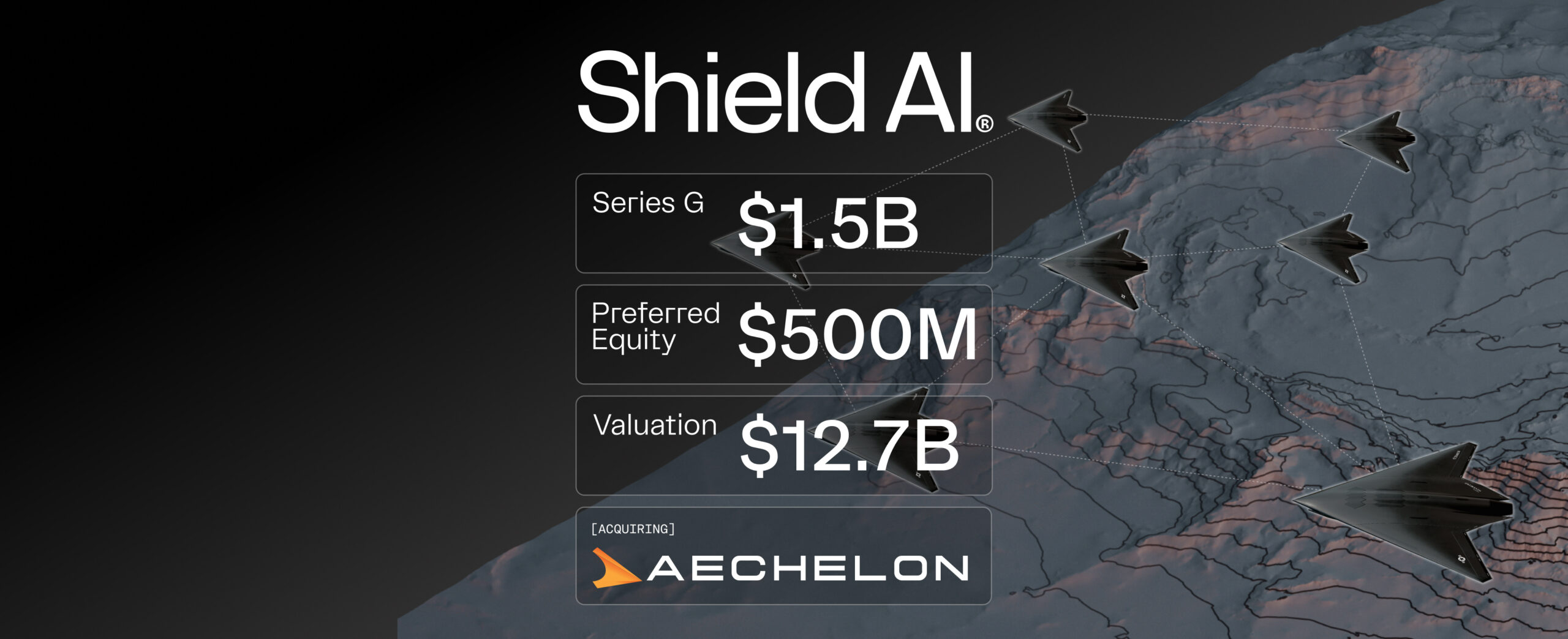
- Shield AI has secured $2 billion of financing at a $12.7 billion valuation and plans to acquire simulation specialist Aechelon.
- The company says part of the proceeds will support X-BAT development and expand Hivemind, its autonomy software stack.
- The move shows how defence production is shifting toward software, simulation, and AI tooling as core industrial capabilities.
Shield AI’s latest funding round is large even by defence-tech standards, but the more interesting part is where the money is meant to go. The company said it is raising $1.5 billion in Series G funding alongside $500 million in preferred equity financing at a $12.7 billion post-money valuation, with part of the proceeds earmarked for the acquisition of simulation software company Aechelon and for phases of X-BAT development.
That combination makes this more than a capital-markets story. Shield AI is trying to assemble a fuller autonomy production stack — mission software, synthetic training environments, physics-based sensor modelling, and aircraft development — at a time when armed forces are increasingly treating software-defined autonomy as a fieldable capability rather than an R&D adjunct.
Aechelon’s business is central to that logic. Its high-fidelity simulation and synthetic reality tools are already used to train pilots and test advanced aircraft and autonomous systems, including work tied to the Pentagon’s Joint Simulation Environment. By bringing that capability inside the company, Shield AI is effectively buying more control over how its Hivemind autonomy software is trained, validated, iterated, and integrated.
Gary Steele, chief executive of Shield AI, said the Aechelon acquisition would accelerate Hivemind’s development, particularly in simulation environments such as the Joint Simulation Environment, and help advance the company’s Hivemind Foundation Model for Defense. That tracks with the wider direction of airpower programmes, where the bottleneck is increasingly no longer only metal-cutting or airframe assembly, but the speed at which autonomy software can be developed, tested, and trusted.
Simulation becomes production infrastructure
Shield AI said Hivemind has already piloted 26 classes of vehicles, including F-16s, jet-powered UAVs, helicopters, drone boats, and ground vehicles. The company was also recently selected by the US Air Force as a mission autonomy provider for Collaborative Combat Aircraft and is flight-testing Hivemind on Anduril’s YFQ-44A.
Those milestones point to a change in industrial emphasis. In a software-led autonomy market, simulation is not just a training aid sitting beside production — it becomes part of production infrastructure itself. It is where behaviours are refined, edge cases are exposed, safety envelopes are explored, and software baselines are matured before they are pushed into test assets and operational platforms.
Software is now part of the airframe supply chain
The Air Force’s own CCA architecture work has leaned into that model by separating mission autonomy from the hardware platform and validating a more open, modular approach. That widens the industrial aperture for companies such as Shield AI because autonomy can now be procured, upgraded, and integrated more like a subsystem layer than a feature locked to a single airframe prime.
For defence manufacturing, the implication is significant. The next production race in military aviation will not be defined only by who can build more aircraft structures, propulsion units, or payload bays. It will also be shaped by who can industrialise autonomy software, simulation, verification, and integration at scale — and Shield AI’s latest raise is a clear bet that those digital layers are now central to the defence industrial base.