IN Brief:
- Blue Origin is scaling its national security organisation around Space Force launch demand.
- New Glenn certification and Blue Ring space logistics sit at the centre.
- The near-term pressure is delivery tempo rather than concept demos.
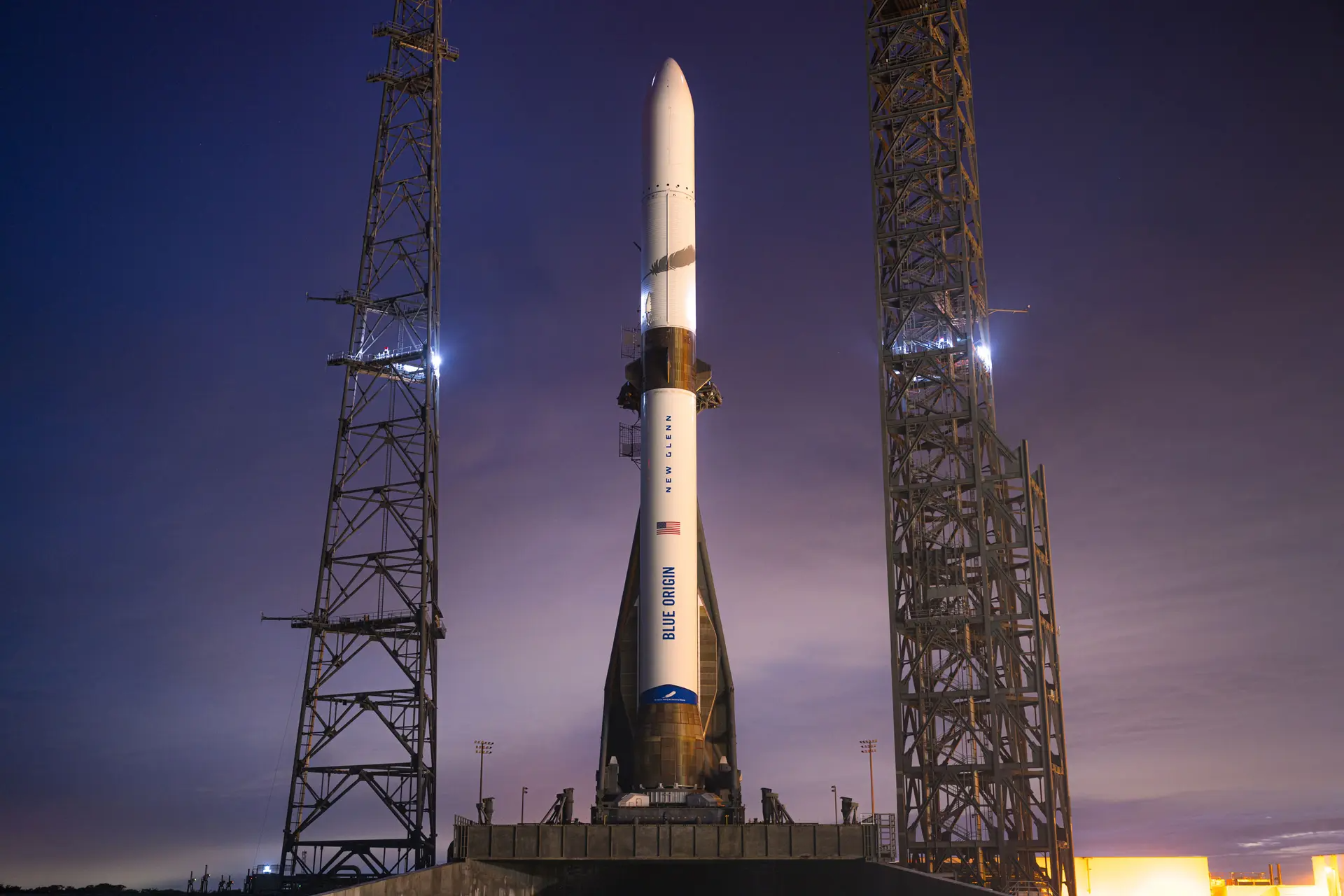
Blue Origin has named former United Launch Alliance chief executive Tory Bruno as president of its National Security Group, with the company putting experienced programme leadership behind two linked priorities: certifying New Glenn for National Security Space Launch (NSSL) missions, and turning Blue Ring into an operational orbital logistics product.
The appointment lands in the middle of a certification cycle that is becoming as much an industrial test as a flight one. The U.S. Space Force’s Space Systems Command (SSC) has been running New Glenn through its new entrant process, which combines flight performance data with deeper government insight into design and qualification testing, depending on how many certification flights a launch provider elects to fly.
Blue Origin was selected in April 2025 as the third Lane 2 heavy-lift provider under NSSL Phase 3. Lane 2 is reserved for the highest-assurance missions, with long integration timelines and mission assurance expectations that reach deep into manufacturing processes, configuration control, and traceability. SSC has previously set out that launches tied to Phase 3 awards are expected to run across FY27 to FY32 once mission assignment and integration cycles complete.
Alongside New Glenn, Blue Origin is positioning Blue Ring as the “in-space” half of the offer for defence and intelligence customers that want more flexible orbit delivery, hosting, and repositioning options than a single launch can provide. Blue Origin describes Blue Ring as a hybrid solar-electric and chemical propulsion spacecraft, designed to host and deploy payloads across multiple orbits, with a delta-v range stated at 3,000–4,000 m/s and payload accommodation that can exceed 4,000 kg depending on configuration.
Launch certification is also a factory audit
For New Glenn, certification is not simply a question of whether two flights go to plan. National security launch assurance requires stable production, repeatable processes, and disciplined quality systems across structures, avionics, propulsion, and ground support equipment. That includes how parts are accepted, how non-conformances are handled, and how configuration changes are governed when production lessons start to arrive faster than formal review cycles can comfortably absorb.
Heavy-lift vehicles amplify this pressure because the bill of materials is vast, and the interfaces are unforgiving. As government insight increases, suppliers can find themselves pulled into a tighter documentation regime, with more detailed evidence expected for test coverage, materials pedigree, and process control than is typical for commercial-only programmes.
Blue Ring turns “space mobility” into a production line
Blue Ring’s industrial challenge is different: repeatability at spacecraft scale, and at a cost point low enough that customers use it routinely rather than occasionally. That pushes design teams towards modular subsystems, standardised harnessing, and integration flows that can be executed without bespoke tooling for every mission. It also puts a premium on supply chain resilience for power electronics, propulsion components, and radiation-tolerant computing — the sort of parts that do not politely follow consumer electronics lead times.
With Bruno now fronting the national security push, Blue Origin is effectively tying launch certification, spacecraft production readiness, and customer delivery discipline into one operating agenda. The NSSL timeline is not waiting for anyone’s internal re-org to settle.