IN Brief:
- U.S. Marine Corps NMESIS anti-ship missile launchers have been deployed in northern Philippines during Balikatan 2026.
- The systems support maritime strike, coastal defence, and sea-denial activity around the Luzon Strait.
- The deployment highlights the engineering demand for mobile launchers that can be airlifted, dispersed, and integrated into joint targeting networks.
U.S. Marine Corps NMESIS anti-ship missile launchers have deployed to northern Philippines during Exercise Balikatan 2026, adding a mobile sea-denial element to joint training around the Luzon Strait.
The Navy-Marine Expeditionary Ship Interdiction System is operated by the 3rd Littoral Combat Team, 3rd Marine Littoral Regiment, and carries the Naval Strike Missile on a remotely operated ground launcher. During Balikatan, the systems were staged at Cagayan North International Airport.
Balikatan 2026 runs from 20 April to 8 May across the Philippine archipelago and includes the Philippines, United States, Australia, Japan, France, Canada, and New Zealand. The exercise covers conventional warfare, command-and-control activity, logistics, communications, and realistic simulations.
NMESIS has appeared in previous U.S.-Philippine exercises, but its repeated use in northern Luzon shows how mobile anti-ship systems are becoming a standing feature of littoral deterrence planning. The region’s geography places a premium on launchers that can be moved quickly, concealed, connected into wider sensor networks, and withdrawn before becoming fixed targets.
Launcher mobility
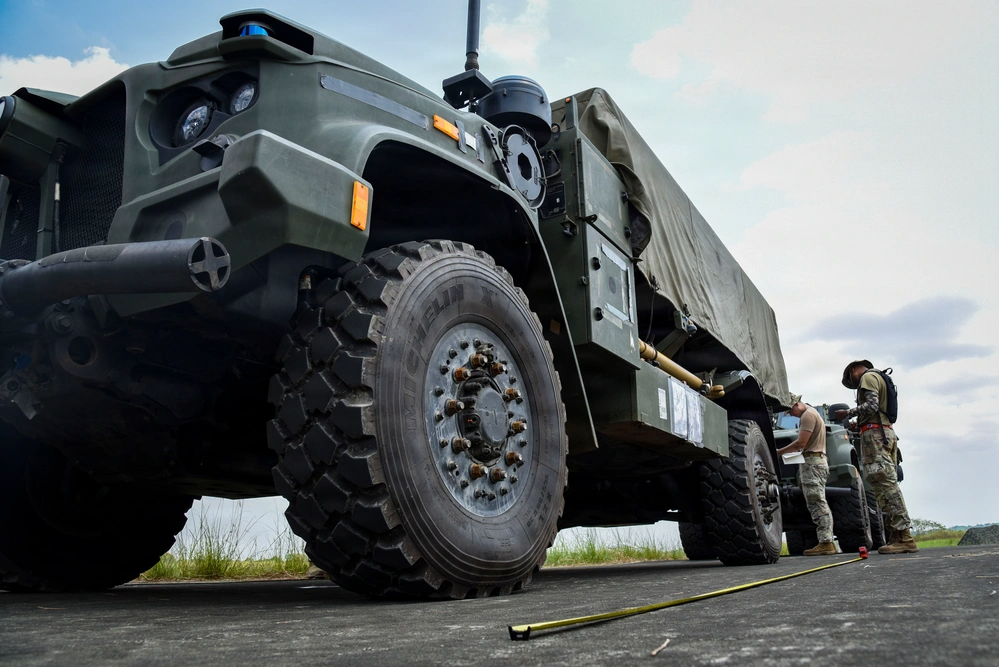
Vehicle preparation, airlift compatibility, staging, and deployment procedures are central to the system’s usefulness in island-chain operations. A launcher intended for dispersed maritime strike must fit within airlift envelopes, tolerate rough handling, interface with tactical communications, and support rapid emplacement by small teams.
That places design pressure on vehicle architecture, power management, environmental hardening, stabilisation, launcher electronics, and remote-control systems. The missile provides the strike effect, but the launcher determines how easily that strike effect can be positioned across dispersed terrain.
Missile supply and regional demand
The Naval Strike Missile gives NMESIS a mature weapon at the sharp end, while the wider production chain includes launch vehicles, fire-control electronics, communications equipment, spares, training systems, and recurring missile supply.
Regional interest in coastal defence is growing as more Indo-Pacific countries invest in distributed maritime strike capabilities. Balikatan is putting those requirements into a live operating environment, where system design is tested against distance, weather, communications, and logistics rather than range performance alone.