IN Brief:
- The Pentagon has launched framework agreements with Anduril, CoAspire, Leidos, and Zone 5 for low-cost containerised cruise missiles.
- The programme aims to procure more than 10,000 missiles across selected portfolios over three years, starting in 2027.
- The production challenge will be turning lower-cost missile designs into rate manufacture while maintaining quality assurance, storage safety, and supply-chain resilience.
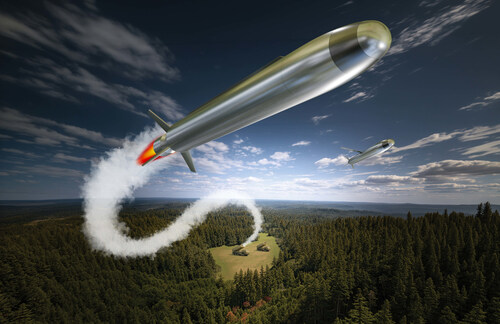
The Pentagon has moved to acquire low-cost containerised cruise missiles at scale, establishing framework agreements with Anduril, CoAspire, Leidos, and Zone 5 under a procurement model built around affordable long-range strike capacity.
The Low-Cost Containerized Munitions programme is designed to buy more than 10,000 cruise missiles across selected portfolios over three years, beginning in 2027. Test missiles from participating vendors are due to begin in 2026, with firm fixed material-unit costs covering the 2027–2029 period. By setting price expectations before full-rate orders, the US government is pushing suppliers to combine speed, cost control, and production readiness earlier in the acquisition cycle.
The supplier mix reflects a deliberate widening of the missile industrial base. Alongside established defence contractors, the programme brings in companies associated with faster development cycles, private investment, and modular systems design. The Pentagon is seeking larger inventories without relying solely on the traditional pattern of long development programmes, small production runs, and expensive replenishment.
Leidos’ role gives an indication of the programme’s industrial character. Its LCCM work draws on the AGM-190A Small Cruise Missile family and includes plans to expand workforce and facilities in Huntsville, Alabama, and McEwen, Tennessee. The company is targeting an initial 3,000 missiles under the framework, with a larger airframe than the AGM-190A, increased fuel capacity, greater range, a weapons open systems architecture, and modular design features. Maritime and air-launched variants are also being examined.
The containerised approach could reshape how certain strike weapons are stored, transported, and launched. Instead of tying every missile to a specialised launcher or platform integration pathway, containerised munitions can be packaged around standardised handling and launch concepts. That creates potential flexibility across ground and maritime environments, while also shifting part of the industrial burden into canister design, safety certification, environmental protection, launch interfaces, and storage-life management.
Manufacturing low-cost cruise missiles in large numbers will place pressure across a broad supplier network. Engines, fuel systems, guidance units, airframes, actuators, seekers, datalinks, warheads, batteries, connectors, launch containers, and test equipment all need to be available at predictable cost and quality. Lower unit cost cannot mean weaker production discipline. A missile designed for mass must still survive storage, transport, environmental exposure, launch stresses, and acceptance testing.
The programme reflects a wider move toward larger strike inventories and more distributed launch options. IN Defence has recently covered related developments in Pakistan unveils Fatah-3 supersonic cruise missile and France tests FLP-t 150 long-range munition. Those systems differ in range, speed, and strategic setting, but they point to the same pressure on defence industries: governments want more stand-off weapons, more launch flexibility, and faster replenishment.
For US suppliers, the framework may reward companies with private capital, modular designs, production facilities, and supplier networks already positioned for expansion. It may also expose familiar missile-sector bottlenecks. Energetics, propulsion components, guidance electronics, environmental test capacity, skilled labour, and qualified subcontractors remain constrained across several weapons programmes. The strain will not sit only with prime contractors. It will reach electronics manufacturers, machining houses, composite suppliers, software teams, warhead integrators, motor producers, and range operators.
Fixed material-unit pricing brings discipline, but it also assumes stable designs and reliable supply chains. Any significant requirement change, component shortage, qualification failure, or inflation pressure could complicate the programme’s cost model. The Pentagon will also need to prevent a broad supplier push from becoming an inventory of incompatible systems that are difficult to train, store, certify, and maintain. Competition can accelerate development, but the resulting weapons still need common handling procedures, clear support arrangements, and coherent integration paths.
Operational demand is pushing procurement in this direction. A future high-end conflict would consume large numbers of strike weapons, and expensive missiles alone cannot provide depth at the required scale. Lower-cost cruise missiles would sit beneath the most advanced weapons, giving commanders additional mass, deception potential, and distributed firepower. Containerised deployment could also create uncertainty for an adversary by multiplying possible launch locations and reducing dependence on a small number of specialised platforms.
The production test will be decisive. Affordable missile mass depends on repeatable assembly, disciplined supplier management, certified storage and launch containers, reliable electronics, and enough testing capacity to keep quality high without slowing output. The LCCM programme is not only a procurement competition. It is a direct test of whether the US missile industrial base can build a lower-cost strike category at the quantities now being discussed.