IN Brief:
- The Royal Australian Navy has contracted PteroDynamics to supply its P4 Transwing VTOL UAS for autonomous maritime distributed logistics.
- The P4 combines vertical take-off with fixed-wing cruise, giving naval users a compact aircraft for ship-to-shore and ship-to-ship resupply.
- The contract creates an export reference point for a UAS family that will rely on repeatable airframe production, maritime ruggedisation, training, and through-life support.
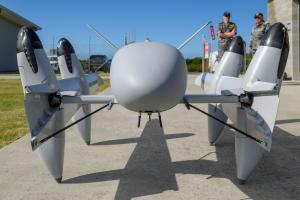
The Royal Australian Navy will introduce PteroDynamics’ Transwing P4 vertical take-off and landing UAS into its maritime logistics activity, adding a compact autonomous aircraft to the expanding market for uncrewed ship-to-shore and ship-to-ship resupply.
The contract covers delivery of P4 systems, training, and support, with options for the larger P5 aircraft from 2027. Demonstration activity in Australia during 2025 saw the P4 flown over land and water, giving the navy a direct view of how the aircraft could operate in maritime distributed logistics. The order also gives the Transwing family its first international defence sale, an important export reference as Indo-Pacific forces examine how autonomous aircraft can ease pressure on helicopters, landing craft, and crewed logistics routes.
With a maximum take-off weight of around 41 kg and a payload capacity of about 6.8 kg, the P4 sits in a useful class for urgent, low-volume naval movement. Its payload envelope is suited to small spares, medical items, electronics, mission components, and other high-priority cargo that would otherwise require a boat transfer, aircraft tasking, or delay until the next scheduled logistics movement. The larger P5, available as a future option, is designed for a maximum take-off weight of around 145 kg, a payload of about 23 kg, and a range of up to 400 nautical miles.
The aircraft’s folding Transwing configuration gives it a distinct operational profile. It takes off vertically, transitions into fixed-wing cruise, and combines deck-friendly launch and recovery with the endurance advantages of wingborne flight. For naval users, that configuration is less about novelty than footprint. Hangar volume, deck safety, handling procedures, storage, and recovery reliability often shape maritime aviation decisions as much as range or payload.
Australia’s geography places a premium on distributed logistics, particularly as allied navies adapt to longer operating distances and more dispersed force structures across the Indo-Pacific. Small autonomous aircraft cannot replace replenishment ships, helicopters, or larger uncrewed systems, but they add a flexible layer between man-portable movement and full-scale crewed aviation. In practical terms, that means a ship needing a small but urgent part does not always have to wait for a larger logistics asset to be available.
Production quality will determine how quickly that operational promise becomes routine fleet use. Maritime UAS manufacturing is not simply airframe assembly. The aircraft must tolerate salt, spray, shipboard vibration, repeated folding-wing operation, deck handling, electromagnetic environments, storage constraints, and recovery attempts in imperfect conditions. Hinges, actuators, flight-control software, corrosion protection, batteries, motors, sensors, and communications equipment all become reliability drivers once the aircraft moves from demonstration flights into naval service.
The contract also sits within a wider Australian effort to build a more capable and distributed maritime force. IN Defence recently covered Australia’s selection of SeaRAM for its future Mogami-class frigates in SeaRAM selected for Australia’s Mogami frigates, a larger combat-system decision that reflects the same fleet-modernisation environment. The P4 occupies a much smaller part of that structure, but it is aimed at a persistent problem: keeping dispersed naval assets supplied without overusing high-value platforms.
For manufacturers, naval logistics UAS demand brings a different production rhythm from traditional defence aerospace. Buyers will expect lower unit costs, rapid delivery, iterative upgrades, and flexible payload integration, while still requiring defence-grade reliability, training material, cyber resilience, documentation, and maintainability. The support package around the aircraft may become as important as the platform itself, covering operator training, spares, software updates, field repair, batteries, ground control equipment, and shipboard procedures.
The larger P5 option gives the Royal Australian Navy a potential growth path if early P4 operations prove useful. Scaling from a smaller demonstrator-class logistics aircraft into a heavier-lift system will require additional certification, more demanding propulsion and power systems, and a broader sustainment model. It could also give PteroDynamics a route into more complex naval missions, including higher-volume resupply, distributed stores movement, and possibly specialist payload carriage.
The order strengthens the case for autonomous logistics as a core naval capability rather than an experimental sideline. Fleet endurance depends on a large number of small movements that rarely attract attention until they fail. If compact VTOL aircraft can perform those movements reliably, navies gain flexibility while manufacturers gain a new production category between commercial drones and high-end military UAS.