IN Brief:
- The Philippine Army is evaluating Japan’s Type 16 Maneuver Combat Vehicle as a mobile direct-fire platform for archipelagic operations.
- The 26-tonne wheeled vehicle offers 105 mm firepower with lower infrastructure and sustainment demands than heavier tracked armour.
- A future procurement would test Japan’s defence export model, local sustainment planning, and the wider market for lighter armoured fire-support vehicles.
The Philippine Army is evaluating Japan’s Type 16 Maneuver Combat Vehicle during Balikatan 2026, bringing wheeled direct-fire armour into Manila’s search for land systems suited to archipelagic defence.
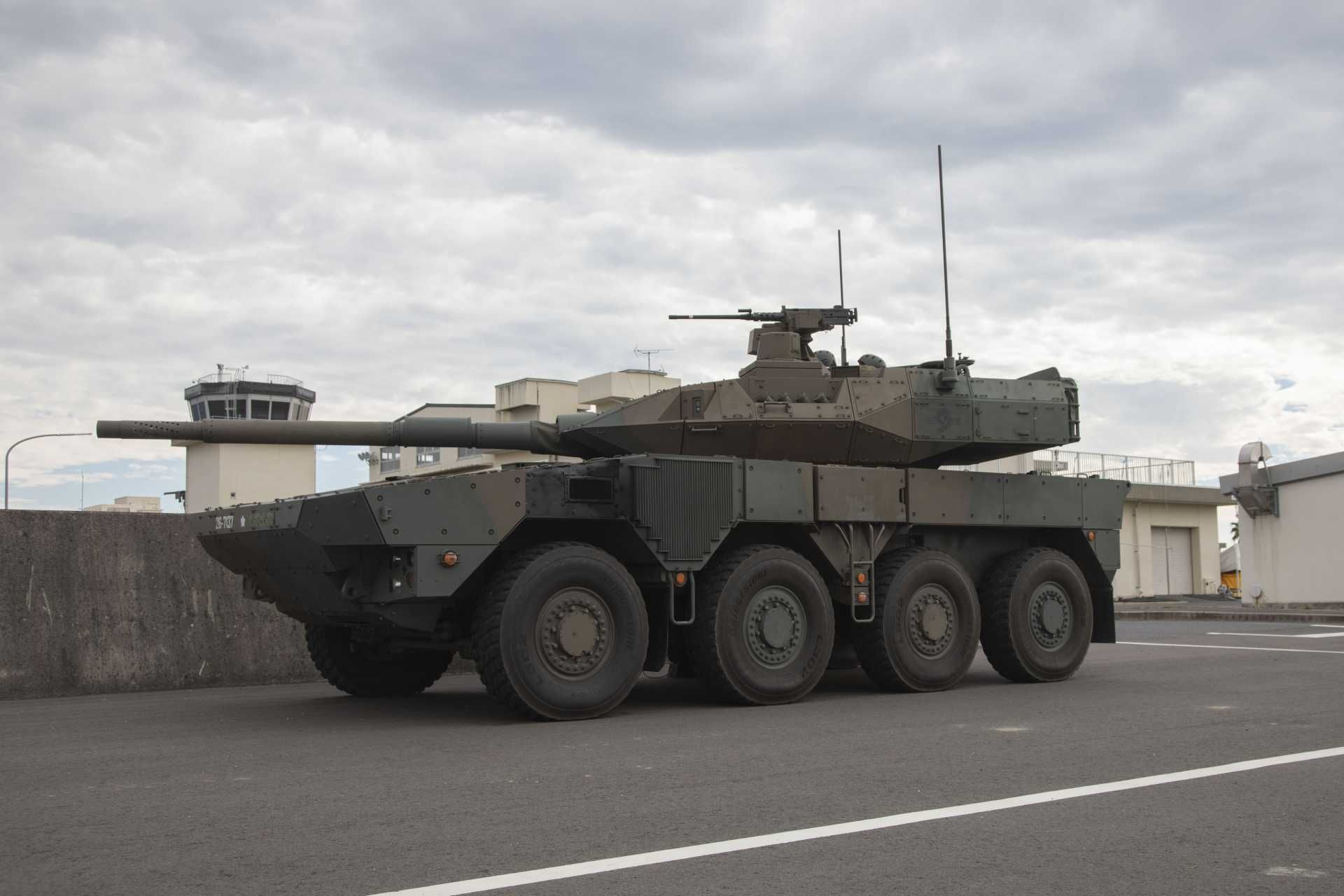
Built by Mitsubishi Heavy Industries, the Type 16 is a 26-tonne, 8×8 armoured vehicle armed with a 105 mm gun. It was developed for rapid road movement, fast deployment, and lower sustainment demands than a main battle tank. Those characteristics fit the Philippines’ operating geography, where ports, bridges, ferries, coastal roads, and island infrastructure shape armoured vehicle choices as sharply as protection levels or firepower.
For Southeast Asian land forces, heavy armour can deliver shock effect and battlefield resilience, but it also brings a demanding logistical footprint. Tracked main battle tanks require transporters, recovery vehicles, reinforced infrastructure, higher fuel consumption, and extensive workshop capacity. A wheeled direct-fire vehicle offers a different balance, combining mobile fire support with lower weight and greater freedom of movement across existing road networks.
The Type 16’s main armament is a Japan Steel Works 105 mm L/52 rifled cannon, supported by fire-control and recoil technologies linked to Japan’s Type 10 tank development. The vehicle uses a four-person crew and manual loading, with hydropneumatic suspension designed to support firing stability and mobility. Its road speed of around 100 km/h and range of approximately 400 km make it more deployable across road-heavy environments than heavier tracked alternatives.
The evaluation is likely to place heavy emphasis on the details that decide armoured vehicle usefulness in tropical conditions. Cooling, powerpack reliability, crew endurance, electronics performance, suspension durability, tyre wear, and ease of field maintenance will all carry weight. Earlier Japanese experience led to improvement work on thermal management, and Philippine conditions will test whether the vehicle can operate consistently in heat, humidity, and remote deployment settings.
Manila has been building a more capable armoured force while managing the constraints of terrain, budget, and sustainment capacity. A Type 16 purchase would not replicate the heavy armour model used by continental armies. It would create a mobile fire-support layer able to move between islands, reinforce threatened areas, and operate where heavier systems would be difficult to transport or recover.
Japan’s role adds another dimension. Although Japanese defence exports have become more active, every substantial overseas opportunity still tests the country’s ability to provide a complete package beyond the vehicle. A Philippine programme would require training systems, technical documentation, spares, maintenance support, weapons handling, ammunition supply, communications integration, and a long-term repair model. The vehicle’s usefulness would depend as much on the sustainment architecture as on its performance during exercises.
Land-systems procurement across NATO-aligned and partner countries is increasingly being judged through this whole-life lens. IN Defence recently covered a similar sustainment logic in Estonia adds three Chunmoo rocket launchers, where additional firepower carries value only when ammunition supply, maintenance, training, and integration can keep pace. The Philippine Type 16 evaluation follows the same pattern. Procurement decisions are moving away from platform comparison alone and toward industrial support credibility.
For armoured vehicle manufacturers, demand for wheeled fire-support systems reflects a more fragmented operating environment. Many forces need direct firepower, but they do not always have the infrastructure, doctrine, or budget to field heavy tracked fleets at scale. This creates room for vehicles that combine credible weapons, modular protection, reliable automotive systems, and manageable support requirements. Manufacturers able to offer local maintenance, regional parts availability, and adaptable mission systems will have an advantage over those selling the vehicle as a standalone product.
A Philippine adoption of the Type 16 would also give Japan a valuable defence-industrial reference in Southeast Asia. The region is becoming more willing to diversify suppliers as governments balance US, European, South Korean, Japanese, and domestic industrial options. For Japan, a successful export and sustainment model would strengthen its credibility in a market where long-term support, political reliability, and financing can carry as much weight as technical performance.
The Type 16 may remain an evaluated option rather than a selected platform, but the assessment captures a clear procurement direction. Archipelagic defence is creating demand for land systems that move quickly, fit existing infrastructure, and provide enough firepower without importing the full burden of heavy armour. For the Philippines, that balance is central. For manufacturers, it is a sign that lighter, deployable, supportable firepower is becoming a more competitive category.