IN Brief:
- Dstl has developed Assured Intent Messaging for networked find-and-strike operations.
- A March trial in Texas connected sensors, uncrewed platforms, target-designation tools, and missiles.
- The government-owned standard will be made available to industry in mid-May.
Dstl has developed Assured Intent Messaging, a government-owned digital standard designed to connect sensors, uncrewed platforms, target-designation tools, and weapons across a common messaging framework.
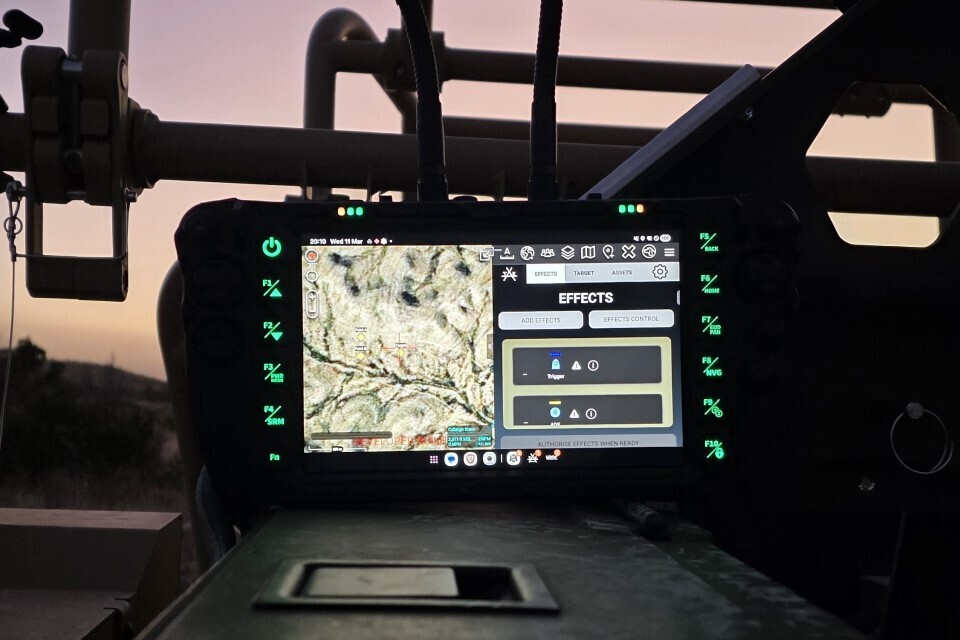
AIM was tested during a live trial in Texas in March 2026, where a single operator controlled multiple in-service and experimental systems. The trial brought together sensors, uncrewed platforms, targeting equipment, and ground-launched missiles using standardised digital messages.
Ten industry supplier teams took part in the demonstration. The standard will be published in mid-May and made available to industry as a common language for networked find-and-strike systems.
AIM is built around compact messages suited to low-bandwidth and contested communications environments. The design uses a publish-and-subscribe model, allowing systems to receive only the information they need rather than carrying unnecessary network traffic.
Sensor-to-effector integration
Modern strike systems depend on fast, reliable connections between detection, identification, targeting, decision, and effect. Those chains often involve equipment from different suppliers, with different data formats and interface assumptions. Without common standards, integration can become a programme bottleneck.
AIM gives suppliers a defined route to connect systems without creating bespoke interfaces for every platform pairing. That can reduce integration cost, shorten trials cycles, and improve the ability to add new sensors, uncrewed systems, or effectors after a system has entered service.
The low-bandwidth design is also important for battlefield networks. Systems operating under jamming, congestion, or intermittent communications need to transmit short, relevant messages and avoid unnecessary data loads.
Open architecture and production routes
A government-owned standard gives the UK a way to shape industry behaviour without forcing every supplier into a single proprietary system. Suppliers can build AIM compatibility into products while still competing on sensors, autonomy, weapons, control interfaces, and platform performance.
That changes the production brief for future systems. Hardware and software teams will need to treat interoperability as a core design requirement from the start, rather than a late integration task. The result should be equipment that can enter wider command-and-control architectures more quickly, with less rework during acceptance and trials.