IN Brief:
- Anduril is leading a team for the US Space Force Space-Based Interceptor programme.
- Partners include Impulse Space, Inversion, K2 Space, Sandia National Laboratories, and Voyager Technologies.
- The work supports Golden Dome ambitions for an orbital missile-defence layer.
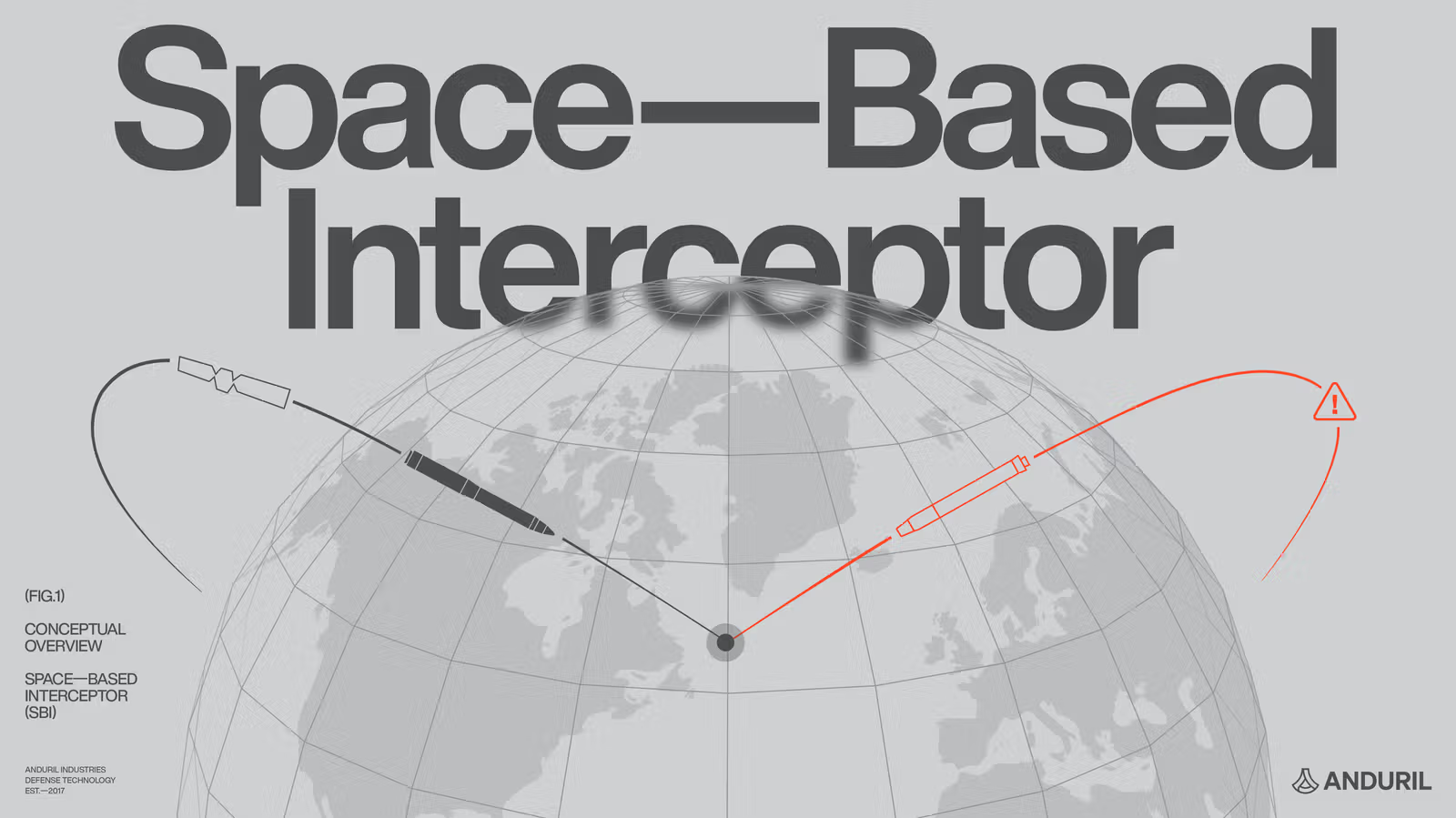
Anduril is leading a partner team for the US Space Force Space-Based Interceptor programme, part of the Golden Dome missile-defence architecture.
The team includes Impulse Space, Inversion, K2 Space, Sandia National Laboratories, and Voyager Technologies. The group brings together commercial space manufacturing, orbital mobility, re-entry technology, systems engineering, autonomy, and national laboratory expertise.
The Space-Based Interceptor effort is intended to develop an orbital layer capable of engaging missile threats earlier in flight. Such a system would sit above existing ground and sea-based missile defence layers, adding interceptors in space to a wider network of sensors, battle management, and effectors.
The approach is technically demanding. Space-based interceptors must survive launch, operate in orbit, receive engagement data, manoeuvre accurately, and execute intercepts against fast-moving threats.
Manufacturing the orbital layer
A deployable space interceptor architecture would require production beyond small prototype quantities. Spacecraft buses, propulsion modules, seekers, communications hardware, thermal systems, guidance electronics, ground equipment, launch integration, and software updates all have to be designed for repeatable production.
The manufacturing model will need to combine commercial-space pace with strategic missile-defence assurance. Hardware must be affordable enough for constellation deployment and reliable enough for national defence missions. Testing has to cover launch loads, orbital operations, command links, autonomy, and kill-chain performance.
That production challenge gives commercial space companies a prominent role. The sector has experience building spacecraft more quickly than traditional defence programmes, while defence primes and national laboratories bring test discipline, mission assurance, and classified-system experience.
Integration and test burden
The interceptor is only one part of the system. Sensors must detect and track a launch, battle-management software must assign the target, communications links must pass data to the interceptor, and the vehicle must manoeuvre in time to engage.
That puts integration and test at the centre of the programme. The architecture will require repeated digital testing, hardware-in-the-loop activity, flight demonstrations, and on-orbit validation before any operational constellation can be fielded.
Anduril’s leadership role shows how software-led defence companies are moving into strategic mission areas once dominated by traditional primes. The production test will be whether that model can deliver orbital interceptors at the scale, cost, and reliability demanded by missile defence.