IN Brief:
- Ranger is designed for deployment through a standard 21-inch submarine torpedo tube.
- Sea trials verified its unfolding structures, electric drive, sensors, and surface operation.
- Operational adoption will require submarine certification, launch safety, payload standards, and repeatable manufacture.
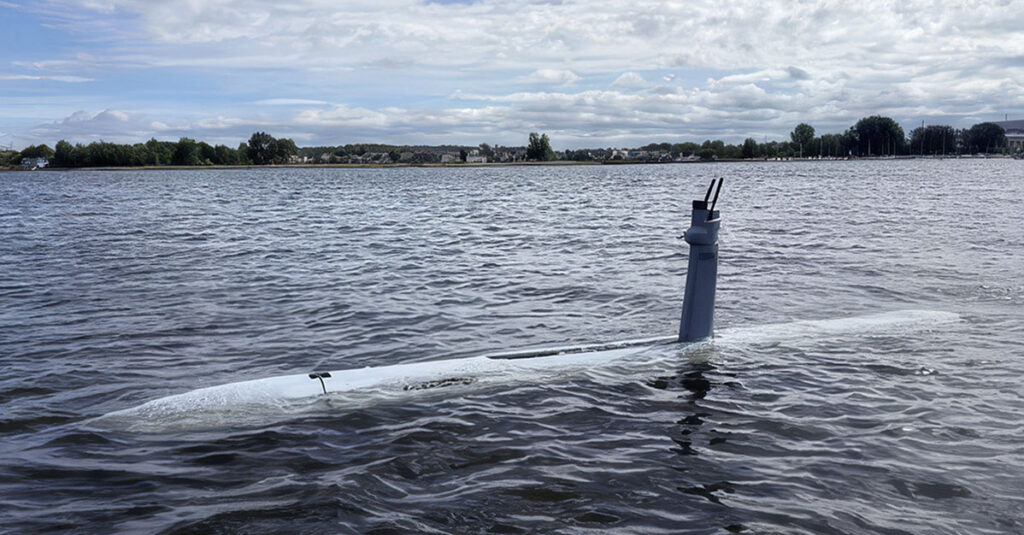
German companies GABLER and FLANQ have completed the surface phase of sea-acceptance testing for Ranger, an autonomous vessel designed for launch through a submarine’s standard 21-inch torpedo tube.
The 4.5-metre vehicle was tested in northern Germany after development work intended to prove that a useful uncrewed surface vessel could be packaged within the dimensions and handling limits of existing submarine launch equipment. Ranger incorporates a folding keel, deployable sensor mast, electric propulsion, autonomous control, and a configurable payload section.
Its initial role centres on covert intelligence, surveillance, and reconnaissance, allowing a submarine to place a surface sensor away from the host vessel without exposing the boat or deploying personnel outside the pressure hull. A one-way attack version, known as Strike, is also planned.
Using an existing torpedo tube avoids the need for a new external launch installation, although the approach transfers substantial complexity into the vehicle. Structures, antennas, control mechanisms, batteries, propulsion, sensors, and payloads must fit within a narrow cylindrical envelope before deploying reliably in the water.
Folding equipment must remain locked during loading, storage, and launch, withstand acceleration and hydrodynamic forces, and then unfold without fouling. Once deployed, the keel and mast need sufficient stiffness for navigation and sensor operation, despite being engineered around compact storage.
Vehicle and submarine form one system
A torpedo-tube-launched vessel cannot be certified independently of the submarine. Dimensions, mass distribution, seals, battery safety, pressure resistance, electromagnetic emissions, and launch loads all need to remain compatible with the host platform’s weapon-handling and control architecture.
Naval acceptance will consequently extend beyond successful surface operation. Evidence will be needed for storage, loading, fire safety, inadvertent activation, pressure, shock, tube behaviour, discharge systems, and emergency procedures.
Communication planning carries additional difficulty. An ISR vehicle must transmit useful information without providing an adversary with a straightforward path back to the launching submarine. Low-probability-of-intercept links, delayed transmission, relay assets, and autonomous mission execution could all reduce that exposure.
GABLER contributes specialist knowledge of submarine mast and deployment systems, while FLANQ provides the autonomous vehicle. Their partnership reflects a broader feature of naval robotics: a smaller technology company may develop the craft, but access to a submarine requires an integrator familiar with naval safety, certification, and platform constraints.
Payload architecture will determine Ranger’s commercial range. Surveillance missions require stable sensors, quiet propulsion, secure communication, dependable navigation, and sufficient electrical endurance. An attack version adds guidance, target identification, mission authorisation, warhead safety, and stricter handling controls.
A common hull, battery, propulsion system, and control architecture could support several payloads, reducing non-recurring engineering and manufacturing cost. Conversely, customer-specific sensors, encryption, datalinks, and weapons could turn each order into a separate integration programme.
Controlled mechanical, electrical, and software interfaces will therefore be necessary if Ranger is to remain a product family. Modular claims carry little industrial value when every payload requires new structural work, rewritten control software, and a separate host-submarine certification campaign.
Delivery architecture has become an increasingly important part of uncrewed naval design. Kraken Technology Group’s air-dropped USV concept for the A400M similarly integrates launch conditions into the vehicle from the beginning rather than treating transport as a later addition.
Submarine launch offers stealth and access but limits sensor size, energy storage, endurance, and payload. Ranger is unlikely to replace larger surface drones; its utility comes from placing a focused capability where a conventionally launched craft could not arrive discreetly.
Manufacture will need to follow a different model from submarine construction. Lightweight structures, modular electronics, electric drivetrains, and repeatable assembly can control costs, but components still need naval environmental qualification and secure sourcing.
Batteries and electronics are likely to evolve far more quickly than the host submarine. Stable launch interfaces and safety envelopes would allow later generations of vehicle to use the same tube architecture without repeating the entire integration programme.
Maintenance requirements will also shape deployment. A craft stored aboard a submarine must remain ready after long periods without extensive technician access. Batteries, seals, actuators, software, and sensors will require monitoring and test procedures compatible with limited onboard space.
The completed surface trials confirm that the packaging concept can unfold and operate in the water. Submarine launch trials, safety evidence, payload qualification, command integration, and serial production remain more demanding stages.
Ranger’s future will depend on whether its partners can convert a compact demonstrator into a certified, maintainable, and affordable system whose payloads evolve faster than the submarines carrying it.