IN Brief:
- Frankenberg Technologies, Greenjets, and Cambridge Aerospace will share £3.16 million of development funding.
- The UK is leading an initial phase before the programme expands across five European partners.
- Production rate, launcher integration, component availability, storage, and cost per engagement will shape follow-on procurement.
The UK has awarded £3.16 million of contracts to Frankenberg Technologies, Greenjets, and Cambridge Aerospace to develop low-cost interceptors for use against uncrewed aircraft.
The awards open the national phase of the Low-Cost Air Defence Effector programme, bringing together the UK, Poland, France, Italy, and Germany. Demonstrations are expected later in 2026 before the work expands into a multinational stage intended to identify systems suitable for wider procurement and higher-rate manufacture.
Development will be distributed across Cambridge, Milton Keynes, Bristol, and Stevenage, giving smaller propulsion, missile, aerospace, and technology companies a direct role in a market historically dominated by large air-defence primes.
Conventional surface-to-air missiles remain necessary against aircraft, cruise missiles, and sophisticated uncrewed systems, but their cost and production rate make them an inefficient answer to every small attack drone. Lower-cost interceptors must reduce that imbalance without sacrificing reliability, safety, or enough performance to engage representative threats.
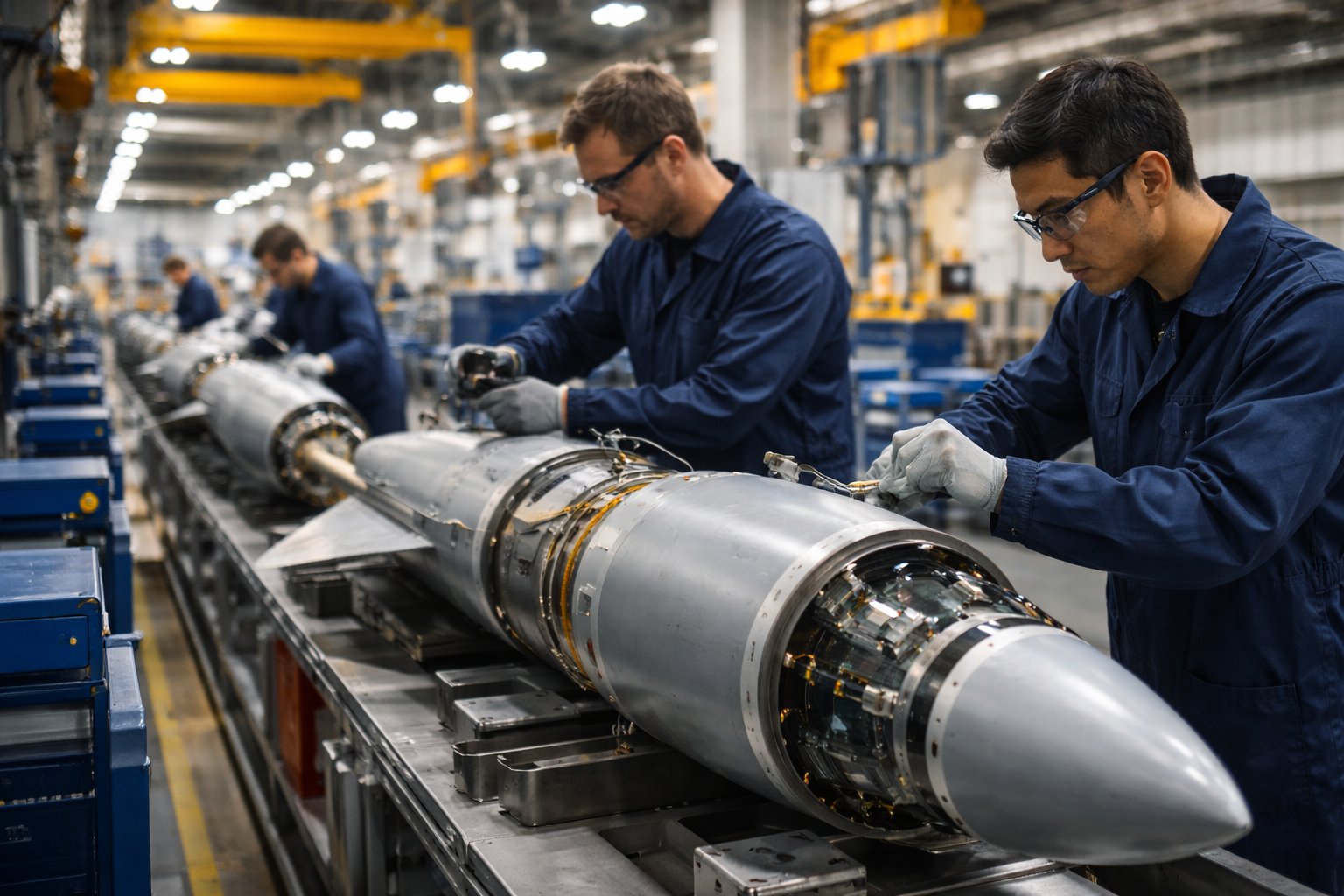
Although the initial contracts remain modest, the programme will test whether affordable concepts can progress beyond prototype work. Designs will need to support rapid assembly, straightforward storage, automated testing, launcher compatibility, and repeatable output rather than relying on labour-intensive processes suited only to demonstration batches.
Cost is set before production begins
Affordable missile manufacture cannot be achieved by applying a smaller margin to an existing design. Propulsion, guidance, seekers, datalinks, control surfaces, fuzing, warheads, structures, and test procedures all need to be selected with volume production in mind.
A sophisticated seeker can dominate unit cost, while specialised energetics, imported electronics, hand-finished structures, or lengthy acceptance tests can restrict output. Some functions may therefore be transferred to the wider air-defence network through ground-based radar, external command guidance, or shared target data.
That approach creates dependencies elsewhere. An inexpensive interceptor still requires an accurate track, secure engagement commands, identification safeguards, launch equipment, and an acceptable probability of kill. Reducing the air vehicle’s price while demanding a bespoke radar and launcher would merely move cost into another part of the system.
High expenditure rates further alter the industrial model. Traditional air-defence missiles are commonly purchased in relatively small peacetime batches and held for years. Countering mass drone attacks requires stockpiles that may be depleted rapidly and replenished continuously, increasing the importance of shelf life, storage density, transport, reload speed, and automated inspection.
The three selected businesses may widen Britain’s industrial base, although smaller companies often encounter financing pressure between demonstration and production. Tooling, secure facilities, explosives licences, quality systems, long-lead inventory, environmental test equipment, and production engineers must be funded before substantial revenue begins.
Multinational demand could provide the scale needed to justify that investment. Five countries using compatible requirements would support larger orders, common component purchases, and more stable production planning. Separate national configurations, certification processes, and workshare negotiations could dilute those benefits unless interfaces are agreed early.
NATO’s development of a counter-drone procurement marketplace is intended to aggregate demand and accelerate access to fieldable systems. LCADE addresses an earlier stage by creating effectors capable of reaching such procurement channels without the manufacturing burden of traditional missile programmes.
European interceptor partnerships are forming rapidly, with the Bliksem–EXO arrangement among those attempting to combine drone design, propulsion, sensors, and defence integration. A crowded prototype market can stimulate innovation, but it can also fragment limited engineering talent, test-range access, and investment before governments select production candidates.
Demonstrations later in 2026 should therefore measure more than successful engagements. Assembly hours, component count, test duration, software loading, storage conditions, launcher turnaround, operator workload, and the ability to substitute constrained parts will reveal whether a design can support operational demand.
Manufacturing tolerances deserve particular attention. An interceptor built cheaply but inconsistently may require extensive acceptance testing, eroding both cost and throughput. Designs that permit automated assembly and test will be better placed to reach scale than those relying on skilled manual adjustment.
A controlled upgrade route will also be necessary. Attack drones continue to change in speed, altitude, navigation method, electronic resilience, and coordinated behaviour. Closed software and fixed electronics could leave an interceptor obsolete while its production line is still expanding.
The first flight trials will establish whether the three designs can reach and engage suitable targets. Follow-on decisions will determine whether Britain and its partners consolidate the field, place orders large enough to support industrialisation, and accept common standards across launchers and command systems.
Affordable mass will come from manufacturing policy as much as weapon design. Stable demand, controlled requirements, available components, automated testing, and timely contracts will decide whether the selected interceptors become stocked weapons or remain technically successful demonstrations.