IN Brief:
- Indonesia has contracted for 12 M-346 F Block 20 aircraft, with deliveries scheduled to begin in 2030.
- The configuration adds an AESA radar, Link 16, electronic countermeasures, new weapons, and an updated cockpit.
- Domestic participation will cover maintenance, overhaul, training, support infrastructure, and aerospace skills development.
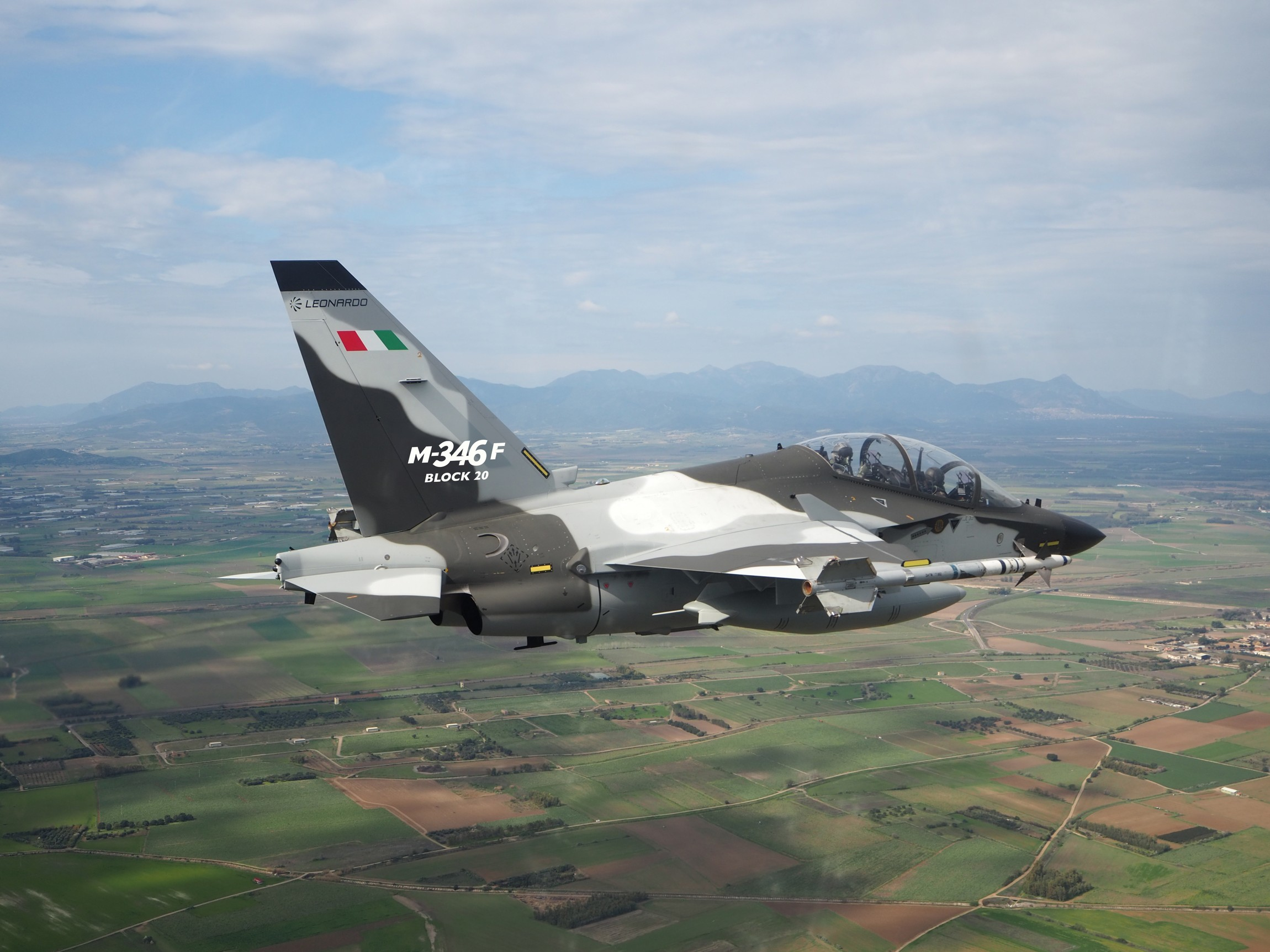
Indonesia has contracted for 12 Leonardo M-346 F Block 20 aircraft, turning an earlier letter of intent into a long-term training, combat-air, and aerospace-support programme.
Deliveries are due to begin in 2030, while the agreement with PT ESystem Solutions includes the localisation of maintenance, overhaul, training, and human-capital capabilities. Indonesia will become the twenty-third operator of the M-346 family and the first Asian customer for the Block 20 standard.
Equipped with a large-area cockpit display, an active electronically scanned array radar, Link 16, electronic countermeasures, and an expanded weapons fit, the aircraft occupies the increasingly busy space between an advanced jet trainer and a light multirole combat platform. It can prepare pilots for frontline fighters while undertaking air-to-air and air-to-surface missions that would otherwise consume flying hours on more expensive aircraft.
Behind the 12 completed airframes sits a much larger collection of equipment and services. Indonesia will require mission-planning systems, simulators, instructor stations, secure data links, ground-support equipment, spares, test sets, technical documentation, and a maintenance organisation capable of supporting both conventional aircraft systems and a growing digital mission suite.
Live, virtual, and constructive training will place particular demands on systems integration. Aircraft flying real sorties must interact with simulators and computer-generated threats, while the cockpit, mission software, weapons models, and threat libraries remain aligned across each part of the training environment.
A radar or weapons upgrade cannot be treated as an isolated aircraft modification. Changes may affect cockpit symbology, simulator models, electrical loads, cooling requirements, mission-planning software, flight-test schedules, maintenance instructions, and the training syllabus used by pilots and ground crews.
Indonesia’s domestic support organisation will therefore need stronger configuration control than a conventional training fleet might have required. Each aircraft, simulator, software release, test set, and technical publication must remain on an approved baseline, particularly once local modifications and new weapons begin entering service.
The workload beyond delivery
Although complete aircraft production will remain centred within Leonardo’s established manufacturing system, Indonesia can absorb a substantial portion of the programme’s recurring work. Maintenance, repair, overhaul, component inspection, simulator operation, software loading, technical instruction, and fleet management will continue long after the final aircraft leaves the assembly line.
Establishing that capability requires more than a new hangar. Indonesian operators will need calibrated tooling, controlled stores, approved repair processes, qualified technicians, secure information systems, and access to engineering data sufficient to identify defects and return equipment to service.
A 12-aircraft fleet creates an awkward balance between resilience and cost. Holding too many replacement units ties up capital in parts that may remain unused, while a thin inventory can ground aircraft when an avionics module, landing-gear component, or engine accessory enters a long repair cycle.
Pool arrangements with Leonardo and other operators may reduce the stock held in Indonesia, although reliance on overseas repair routes introduces transport, customs, export-control, and supplier lead-time risks. Performance-based support can improve availability only when the customer retains adequate visibility over component condition, stock levels, and repair priorities.
Combining training and operational roles will complicate fleet planning further. Training organisations favour regular sortie generation and stable aircraft configurations; combat fleets carry additional weapons, electronic-warfare, software-security, and readiness requirements that can interrupt predictable flying schedules.
Careful separation of training and operational configurations may preserve output, but too many sub-variants would fragment the small fleet. Common mission computers, software interfaces, support equipment, and replaceable modules will be needed to prevent each aircraft from becoming a different maintenance proposition.
The programme also arrives as advanced trainers are being drawn into wider combat-air experimentation. Leonardo has already connected the M-346 with Baykar’s KIZILELMA during crewed-uncrewed flight trials, extending the platform’s role beyond conventional pilot instruction.
Training aircraft may increasingly be expected to reproduce missions involving autonomous teammates, distributed sensors, contested communications, electronic attack, and collaborative weapons. Those capabilities shift expenditure from the physical airframe towards software, data, simulation, secure networking, and repeated systems integration.
Indonesia’s local aerospace workforce will consequently need a broader mix of skills than airframe maintenance alone. Software specialists, simulator engineers, cybersecurity staff, data managers, avionics technicians, and systems-integration personnel will become central to fleet availability.
Engineers must also manage obsolescence across commercial processors, displays, storage devices, and communications equipment that will change far faster than the underlying aircraft structure. Planned technology insertions can control that problem, provided open interfaces and design data allow obsolete units to be replaced without rebuilding the entire mission system.
The aircraft will be delivered over a relatively short period, but the support organisation must remain effective for decades. Early investment in training and infrastructure will determine whether Indonesia gains a largely self-sufficient operating base or continues sending complex equipment abroad whenever faults fall outside routine maintenance.
Twelve aircraft provide the visible centre of the acquisition. Its longer industrial output will be measured in qualified personnel, repaired components, updated software, simulator hours, and the proportion of fleet-support work performed reliably inside Indonesia.