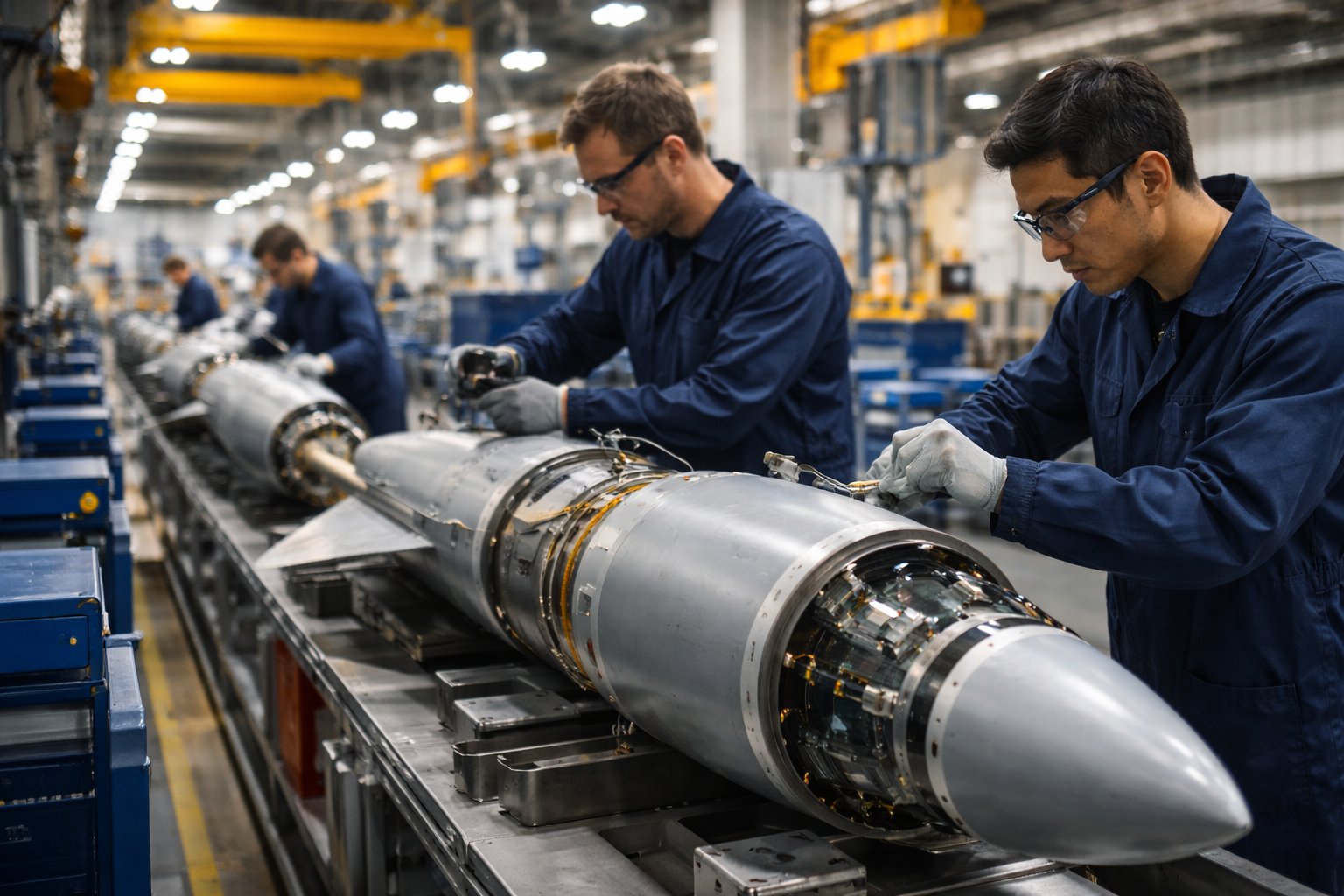
IN Brief:
- Adani Defence & Aerospace will supply Indian-made 7.62×39mm ammunition to Indo-Russian Rifles for five years.
- The ammunition supports AK-203 rifles manufactured at Korwa under India’s 601,427-rifle procurement programme.
- The agreement connects expanding private ammunition capacity at Kanpur with a long-term domestic small-arms manufacturing programme.
Adani Defence & Aerospace has signed a five-year agreement to supply Indian-made 7.62×39mm ammunition to Indo-Russian Rifles Private Limited, linking private-sector ammunition capacity directly with India’s AK-203 assault-rifle production programme.
The ammunition will support rifles manufactured by IRRPL at Korwa in Uttar Pradesh. Neither the number of rounds, the financial value of the agreement, nor a detailed delivery schedule has been disclosed, but the five-year term gives the arrangement a longer production horizon than a single ammunition order and provides the rifle programme with a recurring domestic supply source.
India’s AK-203 programme is built around large-volume local manufacture. The Ministry of Defence signed a contract in December 2021 for 601,427 rifles, with production assigned to IRRPL, an Indo-Russian joint venture owned 50.5% by Indian defence public-sector companies and 49.5% by Russian partners.
The Korwa operation was established to manufacture the rifles in India and progressively increase indigenous content. That model extends localisation beyond imported finished weapons, creating work across parts, assemblies, tooling, testing, quality assurance, maintenance, and support. The new ammunition arrangement adds one of the rifle fleet’s highest-volume consumables to the same domestic production system.
A fleet of more than 600,000 rifles creates demand that continues long after the final weapon leaves the assembly line. Ammunition is consumed during training, qualification, routine readiness activity, and operational use, while reserve stocks require periodic replenishment. A five-year supply agreement therefore connects Adani to a recurring requirement rather than the one-off manufacture of a platform.
Adani’s ammunition business has expanded rapidly since the company opened its 500-acre ammunition and missile complex in Kanpur in 2024. The facility began with small-calibre output planned at 150 million rounds a year, which Adani at the time estimated represented about a quarter of India’s annual requirement. Company material published since then indicates that annual output has increased further as the site has developed.
The complex is designed to manufacture small-, medium-, and large-calibre ammunition, with automation, quality-control systems, and explosive-handling infrastructure intended to support several product families. Supplying IRRPL gives part of that capacity a named long-term domestic customer and ties the plant directly to one of India’s largest current small-arms programmes.
Small-calibre ammunition is a high-volume manufacturing problem rather than a low-complexity one. Production has to hold tight dimensional tolerances while maintaining consistent primer, propellant, case, and projectile performance across very large lots. Variability that appears small at component level can become significant when millions of rounds are produced for a standard service rifle.
Quality control is particularly important because the ammunition and weapon are produced at different sites by separate organisations. Chamber dimensions, pressure limits, feed geometry, case behaviour, and ballistic performance all have to remain within agreed specifications if ammunition from one production line is to function consistently across a large rifle fleet.
The five-year structure should also improve production planning. Adani can organise raw-material procurement, workforce, quality assurance, and inventory against a longer demand profile, while IRRPL gains greater visibility over one element of its through-life supply chain. The undisclosed volume means the extent of the commitment cannot be measured against the Kanpur plant’s capacity, but the contract duration supports a more stable manufacturing relationship.
The agreement also broadens private-sector involvement in a programme created through an inter-governmental India-Russia manufacturing arrangement. India has spent several years trying to expand the number of domestic companies able to produce ammunition and other recurring defence consumables, reducing reliance on a narrower state-owned manufacturing base and imported supply.
Local ammunition does not automatically remove every external dependency. Propellant ingredients, specialist machinery, production tooling, materials, or technical inputs can still contain imported content, and the level of localisation in the 7.62×39mm round has not been detailed publicly. The industrial value will depend on how much of the manufacturing chain is controlled domestically and whether output can be sustained at the quality and volume required.
For the AK-203 programme, the agreement fills a practical part of the support structure that receives less attention than rifle assembly itself. Once deliveries scale, the question is no longer simply whether India can build the weapon domestically, but whether it can supply the ammunition, spares, maintenance, and production inputs needed to keep a fleet of more than 600,000 rifles usable over its service life.