IN Brief:
- An unconventional submarine at Jiangnan Changxingdao shipyard has moved to a fitting-out quay.
- The approximately 120-metre hull appears to lack a conventional sail and may use X-form stern controls.
- Outfitting must integrate masts, sensors, access, propulsion, and control systems without a traditional upper structure.
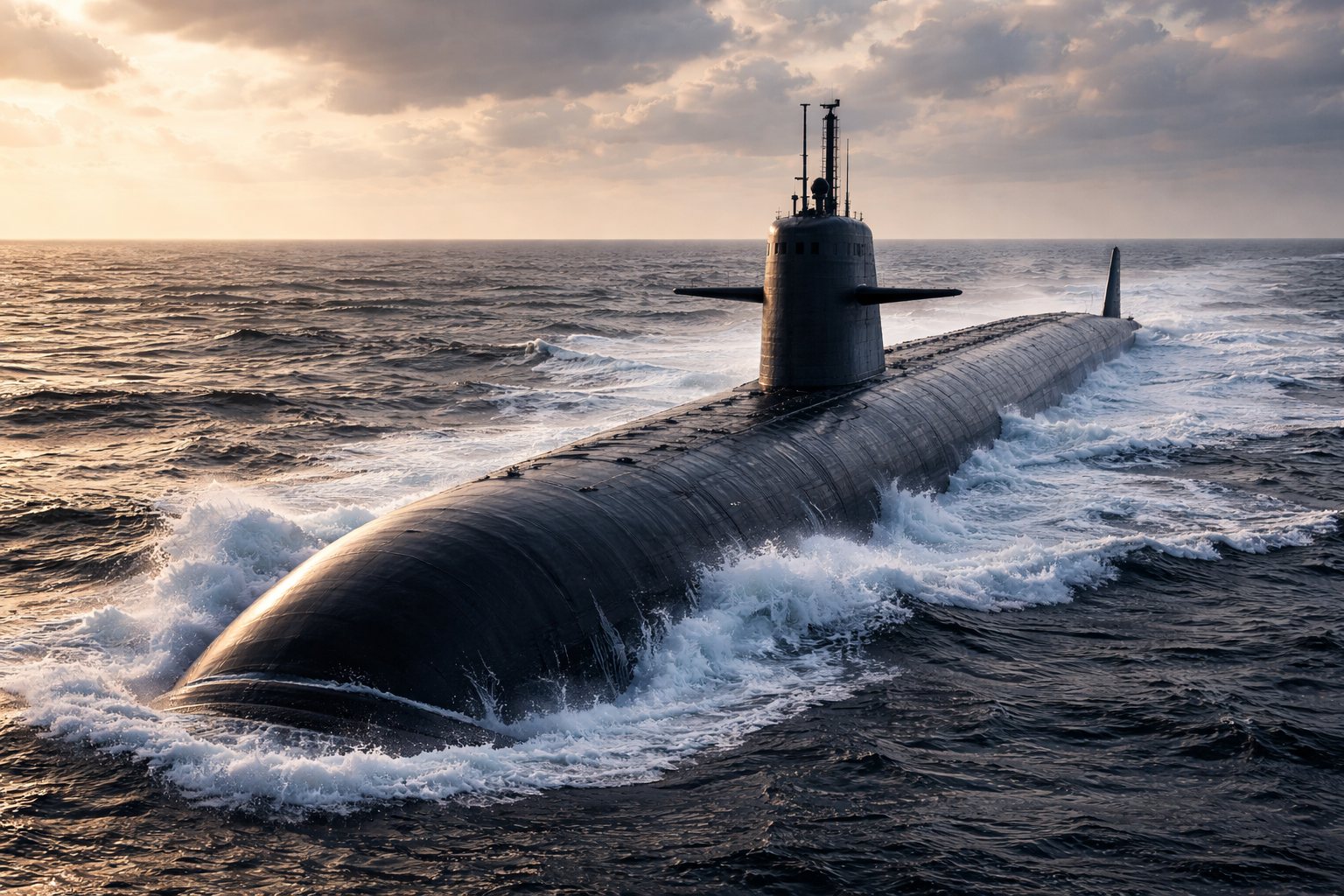
An unconventional Chinese submarine has moved alongside the fitting-out quay at Jiangnan Changxingdao shipyard, advancing a design distinguished by the apparent absence, or extreme reduction, of a conventional sail.
Commercial satellite imagery shows the approximately 120-metre vessel beside the yard with scaffolding and support activity around the hull. The images also suggest an unusual stern arrangement that may use X-form control surfaces, although their resolution and viewing angle do not establish the final configuration conclusively.
Its mission, propulsion type, displacement, and intended operator remain unconfirmed, so the vessel cannot yet be assigned reliably to an operational role. The observable evidence supports its description as an experimental or unconventional submarine undergoing construction and systems integration.
Launching the hull indicates that its principal structural sections and enough internal equipment have been completed for the vessel to float, but outfitting concentrates much of the programme’s remaining risk. Mechanical, electrical, sensor, combat, communications, habitability, and propulsion systems must now be connected into a coherent platform.
A conventional sail performs several functions, supporting masts, periscopes, antennas, air-induction equipment, an elevated bridge position for surface navigation, and aspects of access and stability. Reducing or eliminating that structure may lower drag, flow noise, and radar signature, although all the equipment normally housed within it must be relocated.
A clean hull creates crowded engineering
Masts and sensors still need clear fields of view and protected routes through the pressure hull. Their hoists, cabling, drives, seals, and maintenance access must fit within a shallower upper structure or retract directly into the hull, with every penetration carrying structural, acoustic, and watertight-integrity requirements.
Surface operation creates another design problem because a submarine without a normal bridge position may depend more heavily on cameras, enclosed control positions, remote sensors, or a small retractable structure. Those systems need sufficient redundancy for harbour manoeuvring and poor visibility, particularly before the vessel reaches the deeper water for which its hull may have been optimised.
Hydrodynamic gains will depend on manufacturing accuracy. A smooth external form reduces turbulence only when hull sections, doors, coatings, sensor apertures, and control surfaces remain closely aligned. Weld distortion, fairing transitions, coating damage, and protruding fittings can erode the benefit of an otherwise clean design.
An X-form stern can provide strong control authority and improve manoeuvrability or seabed clearance, but it requires more complex control laws and actuator coordination. Failure in one control plane does not map as simply onto conventional vertical rudders and horizontal diving planes, placing greater weight on software assurance, redundancy, and actuator testing.
The hull’s length raises further questions over internal arrangement. Batteries, generators or reactors, propulsion machinery, weapons, accommodation, command spaces, auxiliary equipment, and buoyancy systems must be distributed while preserving trim. Removing a large sail may alter the placement of some trunks, tanks, and access routes, but it does not remove their function.
Energy storage could become particularly demanding if the vessel uses an unconventional power architecture. The introduction of lithium-ion submarine batteries elsewhere in the market has shown how battery chemistry reshapes cooling, containment, charging, software, certification, and through-life support. No reliable evidence identifies the Jiangnan vessel’s energy system, although any new arrangement will still be constrained by heat rejection, electrical distribution, safety, and acoustic isolation.
Jiangnan is associated principally with large surface-ship construction, yet the yard possesses extensive covered manufacturing, heavy lifting, modular assembly, and waterfront infrastructure. Building an unconventional submarine there could give Chinese engineers more room to test production techniques outside established submarine yards, while broadening the industrial base able to handle undersea construction.
Harbour trials should reveal more about electrical load, machinery integration, ballast systems, sensors, and control surfaces, while subsequent sea trials will examine manoeuvring, depth control, hydrodynamic noise, mast performance, and the practical effects of the reduced sail.
Experimental submarines frequently combine technologies that do not all proceed into fleet production. A new hull form can provide a test bed for propulsion, autonomy, sensors, weapons, reduced crewing, or acoustic treatments, with individual features retained even when the complete platform is not repeated.
Maintenance access may ultimately prove as important as hydrodynamic performance. Equipment concentrated beneath the upper hull must remain reachable for inspection and replacement, while reduced external structure leaves less volume for routes that engineers traditionally use to install and remove machinery.
Jiangnan has produced a hull sufficiently complete to launch and outfit, but the most difficult systems work is now concentrated inside it. The value of the sail-less form will rest on whether the yard can convert a striking external profile into a submarine that is quiet, controllable, maintainable, and safe at depth.