IN Brief:
- Leonardo disclosed results on 21 October from the CUGS main demonstration conducted at Nettuno, Italy, between 15 and 17 September.
- Three simulated scenarios involved European ground robots, vehicles and supporting aerial systems operating through a common open architecture.
- The European Defence Agency programme has a €35.5 million research budget and involves nine participating countries, with the reported demonstrations remaining under human supervision.
Leonardo has reported successful interoperability results from the European Defence Agency’s Combat Unmanned Ground Systems programme, with robotic vehicles and supporting aerial systems operating through a common open architecture during three simulated scenarios.
The Italian defence group disclosed the findings on 21 October 2026, following the programme’s main demonstration at Nettuno, Italy, between 15 and 17 September. The event brought together systems developed by European industrial partners to assess navigation, sensing, cooperation and the management of mission equipment under human supervision.
The distinction between the demonstration and the results disclosure is important. Italy’s defence authorities had already reported the September event, while Leonardo’s October account provides further detail about the interoperability demonstrated across different platforms and their functional modules.
The Combat Unmanned Ground Systems programme, or CUGS, was launched in February 2023 with a budget of €35.5 million. Coordinated by Leonardo, the European Defence Agency initiative involves nine contributing countries and a multinational industrial consortium developing technology for highly autonomous ground vehicles.
The original research programme was established to design functional modules that could be incorporated into existing platforms rather than requiring every participating manufacturer to develop an entirely new vehicle. Its three-year programme combines work on autonomy, communications, sensing and the technical interfaces needed to connect different equipment.
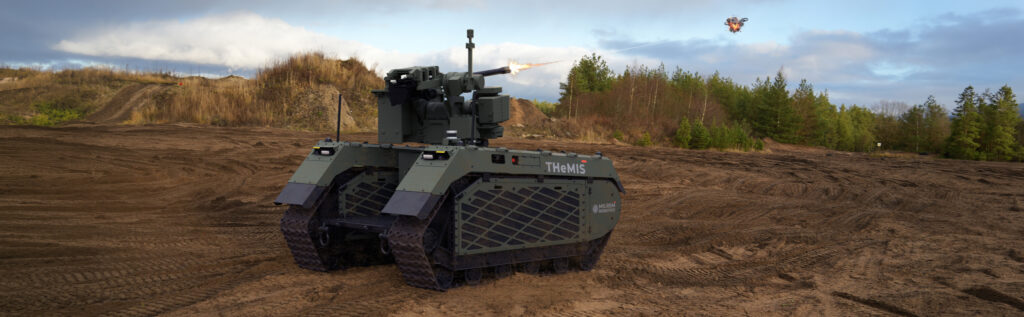
At Nettuno, the partners demonstrated vehicles and systems associated with Leonardo, Iveco Defence Vehicles, Milrem Robotics, Arquus, Rheinmetall, Patria, Thales, MBDA and Polish research and industrial organisations. The participating equipment included the Lince VTLM-2, THeMIS, Wiesel and Patria AMV platforms alongside other robotic vehicles and aerial systems.
These platforms differ substantially in their size, mobility, payload capacity and operating arrangements. Their inclusion allowed the consortium to assess whether shared functional modules and communications arrangements could support coordinated tasks without depending on a single manufacturer’s vehicle architecture.
During the simulated scenarios, systems were positioned in different locations and assigned tasks involving movement towards designated areas and the identification of potential threats. The command post was located several kilometres from the operating area, introducing a requirement for information exchange between distributed equipment and remote operators.
Leonardo reports that the participating ground and aerial systems demonstrated movement, detection, tracking, classification and simulated engagement functions supported by artificial intelligence. Human operators retained supervisory authority and could assume control of the platforms when required.
The demonstration therefore combined autonomous functions with human oversight rather than establishing unrestricted independent operation. The available accounts do not disclose the exact engagement authorisation arrangements, the proportion of tasks completed without intervention or independently verified performance measurements for individual platforms.
Interoperability between different vehicles begins with the information exchanged by their systems. Each platform needs to communicate observations, operating status and authorised commands in forms that can be interpreted correctly by other equipment, even where the underlying hardware and software have been developed independently.
A common interface can reduce the need to develop a separate connection between every pair of systems. This becomes increasingly valuable as the number of participating platforms grows, because individual proprietary connections would otherwise create a substantial engineering and maintenance burden.
However, using a common interface does not guarantee that information is accurate, timely or appropriate for every recipient. Data must retain its coordinate references, measurement status and timing information as it moves through the network, while receiving equipment must recognise uncertainty and avoid acting on information that has become outdated.
The challenges are particularly pronounced when ground and airborne platforms observe the same environment. A mobile robot’s position estimate may depend on local terrain features and onboard motion sensors, while an aerial system may use different positioning and sensing arrangements. Combining their observations requires consistent reference information and suitable processing.
Autonomous navigation also depends on the physical characteristics of the vehicle. A route suitable for a compact tracked robot may be impassable for a larger wheeled platform because of differences in width, turning radius, ground clearance or obstacle-crossing capability. Shared mission software must therefore respect the operating constraints of each host vehicle.
Sensor integration introduces additional variation. Optical equipment, ranging sensors and other perception systems can provide different kinds of information, with performance affected by environmental conditions and the installation arrangement. Algorithms used for object detection and classification must be assessed against those limitations rather than relying solely on their performance in controlled datasets.
Artificial intelligence can assist with the interpretation of observations and the selection of permitted actions, but its output still needs to be assessed through the system’s command and safety architecture. A classification result is not equivalent to confirmed target identity, and the reliability of automated decisions depends on the evidence available to the system.
The CUGS demonstrations incorporated mission equipment and effectors into the common architecture. That creates a requirement to distinguish ordinary vehicle-control messages from commands involving higher-consequence functions, with appropriate authorisation and operator supervision maintained throughout the operating sequence.
Communications reliability forms another part of the engineering problem. A distributed group of vehicles can encounter interrupted links, restricted bandwidth and changes in signal quality as platforms move through terrain. System behaviour during those interruptions must be predictable, particularly where equipment is operating without continuous direct control.
The programme’s modular approach also creates manufacturing requirements. Standardised functional units need defined mechanical, electrical and software interfaces, while suppliers must control changes to their equipment so that updated components remain compatible with approved platform configurations.
Earlier CUGS testing included trials in Norway under demanding winter conditions. Those activities provided a different operating environment from the September demonstration in Italy, contributing to the assessment of mobility, sensing and communications across the programme’s development work.
Completing an integrated research demonstration does not establish that the participating systems have been qualified for military service. Production equipment would require further configuration control, environmental testing, maintainability assessment, software assurance and customer acceptance against defined requirements.
The 21 October disclosure provides additional evidence of interoperability achieved during the September trials, but no common production contract, operational acceptance or procurement quantity has been announced. The subsequent application of the CUGS architecture will depend on decisions by participating defence organisations and the manufacturers developing future ground platforms.