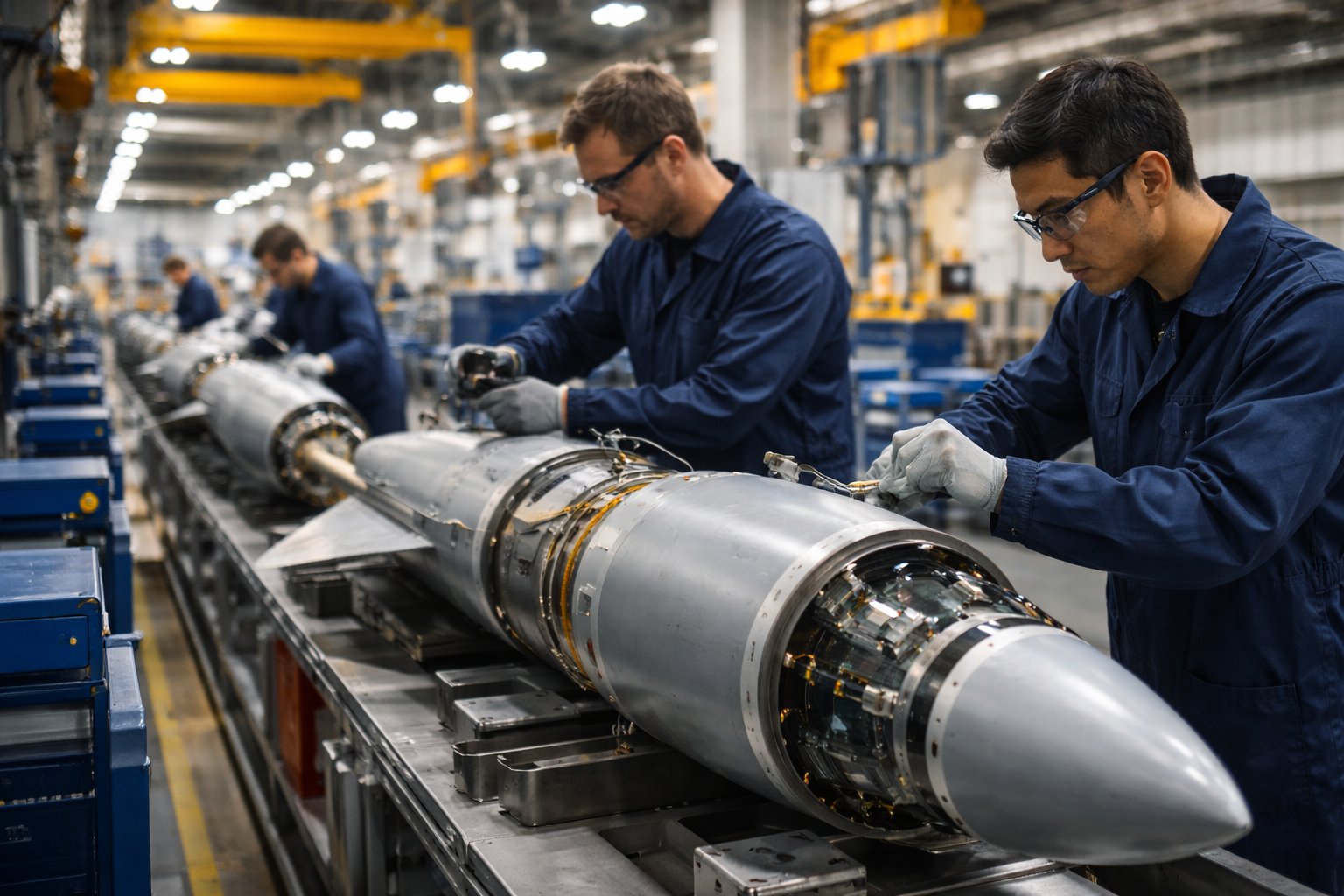
IN Brief:
- Five European developers have advanced to the Sentinel Strike field trial phase.
- Testing in Portugal will place their systems under common and realistic operational conditions.
- The trials should generate comparable evidence covering performance, supportability, configuration control, and production readiness.
The European Defence Agency has selected five developers to enter field trials through its Sentinel Strike Challenge for loitering munitions.
Helsing of Germany, Destinus of the Netherlands, C-Astral of Slovenia, UAVision of Portugal, and Spirit Aeronautical Systems of Greece will test their systems at the Santa Margarida military training area during the EU OPEX26 experimentation campaign.
More than 140 expressions of interest were submitted during the first stage. Each finalist will receive a €30,000 award before competing during the second phase, with overall winners expected to be announced in 2027.
Sentinel Strike is an experimentation initiative rather than a guaranteed procurement programme, but common trials will allow military observers to compare systems under the same environmental, communications, and mission conditions.
Published range, endurance, accuracy, and payload figures often depend on altitude, wind, link quality, search time, battery condition, and the amount of energy reserved for the final attack. Separate manufacturer demonstrations rarely produce a reliable basis for comparison.
A common exercise can measure the complete mission sequence, including transport, preparation, launch, navigation, target search, operator control, attack, abort procedures, and post mission handling. Communications resilience and operator workload will be as important as maximum flight performance.
The five finalists represent different parts of Europe’s growing uncrewed systems industry. Their products combine airframes, propulsion, sensors, datalinks, ground stations, launch equipment, navigation, mission software, and payloads in configurations intended for expendable use.
Manufacturing an expendable weapon creates a difficult cost balance. The aircraft must be affordable enough to buy and consume in quantity, yet every unit requires dependable flight controls, safety functions, communication, navigation, and energetic integration.
Commercial components can reduce price and shorten development, but their availability and configuration may change rapidly. Cameras, processors, batteries, motors, and radios can disappear from catalogues while military customers still expect the original weapon baseline to remain supported.
Configuration management will consequently form an important part of production maturity. The version tested in Portugal must remain traceable to the version eventually offered for sale, and later substitutions need enough evidence to show that they have not altered safety, range, control, or weapon effects.
Warhead manufacture and integration can limit output even when airframe production is straightforward. Fuzes, energetic materials, safe and arm systems, and storage arrangements require controlled facilities and specialist personnel who are also needed by conventional missile and ammunition programmes.
Support equipment can create another bottleneck. Ground control stations, launchers, antennas, batteries, chargers, test sets, transport cases, training rounds, and software tools must be delivered in proportions that allow the aircraft to be used rather than merely stored.
Poland has already linked several of those elements through contracts that expand production of GLADIUS, FLYEYE, and WARMATE systems. Sentinel Strike approaches the market through multinational experimentation, which may help smaller developers build evidence before national customers commit to procurement.
European demand remains fragmented, however, and countries may ask for different frequencies, encryption, warheads, control stations, or levels of sovereign software access. Extensive variation would dilute the manufacturing benefits created by a shared trial.
The EDA can improve the evidence available to customers, but production contracts will still depend on national budgets and requirements. Developers must therefore prepare for irregular order patterns while retaining enough capacity to expand quickly when a system is selected.
The Portugal campaign should also examine maintainability and training. A system that requires extensive specialist support or prolonged operator preparation may struggle to deliver useful mass, even when its aircraft performs well.
Electronic interference will provide another separation between designs. Loitering munitions must retain useful navigation and control when satellite signals or communications are disrupted, without allowing autonomous functions to exceed the authority retained by the operator.
Scaling from trial quantities to serial output will expose whether design documentation, supplier control, inspection, and final acceptance are mature. Hand built vehicles can perform impressively, but military customers need hundreds of interchangeable units whose behaviour remains predictable.
Sentinel Strike gives five European companies access to a demanding comparison that many could not reproduce independently. It also gives participating governments a clearer view of which products are ready for further investment and which still rely on laboratory conditions.
The finalists will be measured first in the field and later in the factory. Systems that combine credible operational performance with stable designs, available components, and controlled production will be best placed to progress beyond the experiment.