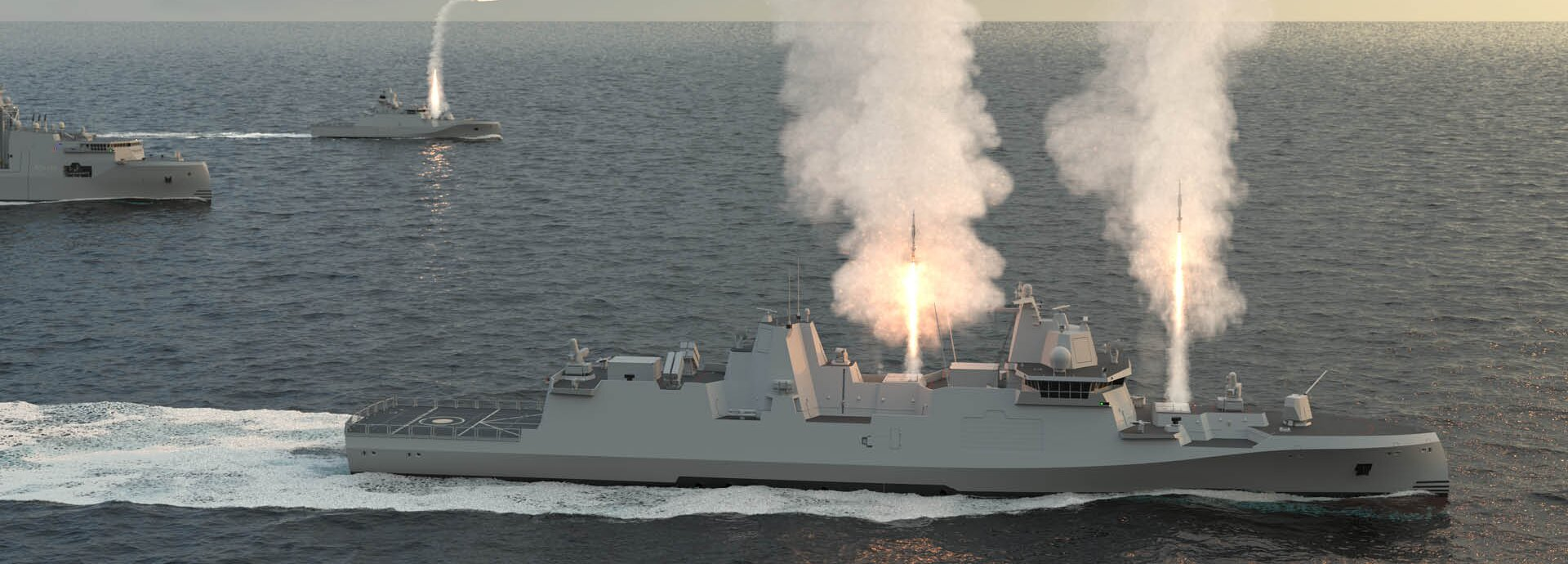
IN Brief:
- The 140-metre design displaces approximately 6,000 tonnes and carries 64 strike-length vertical-launch cells.
- Its combat-system options include Aegis and CMS 330 integration with American or European sensors and weapons.
- Rheinmetall intends to offer the frigate first through a North American procurement campaign.
Rheinmetall has unveiled the GMF 140, a 140-metre guided-missile frigate designed to combine fleet air defence, ballistic-missile defence, anti-submarine warfare, and long-range strike within a ship displacing approximately 6,000 tonnes. The company intends to offer the design first through a North American procurement campaign before approaching other allied navies.
The proposal moves Rheinmetall further into the market for complete surface combatants rather than individual weapons, sensors, protection systems, and subsystems. GMF 140 is presented as a blue-water platform for NATO and allied fleets, with sufficient flexibility for expeditionary, littoral, and coalition operations.
Its most prominent feature is a battery of 64 strike-length vertical-launch cells. Rheinmetall says the cells can accommodate modern air-defence, ballistic-missile-defence, and land-attack weapons, providing a magazine capacity and mission range often associated with larger destroyers.
The listed armament also includes anti-ship missiles, torpedo launchers, a five-inch main gun, close-in weapons, secondary guns, electronic warfare equipment, electro-optical systems, decoys, and provision for a laser. The final fit would depend on the customer and the technical configuration selected for a particular procurement programme.
For surveillance and fire control, the frigate is designed around American primary radar options, including configurations capable of tracking ballistic missiles. Rheinmetall identifies the Aegis Combat System as the baseline route, while Lockheed Martin’s CMS 330 can be incorporated where a customer wants broader integration of European sensors and weapons.
That combination targets navies seeking interoperability with US and NATO forces while retaining scope for national or European equipment. It also creates a substantial engineering burden: radar, combat management, weapons, electronic warfare, communications, and ship services must operate as one qualified system.
Each customer choice can alter software, power demand, cooling, topside layout, cabling, certification, support, and programme cost. Open architecture can reduce some integration barriers, but it does not remove the need to test every interface under representative operating conditions.
The anti-submarine warfare configuration includes a low-signature hull, acoustic management, hull-mounted and towed sonar systems, torpedo weapons, and support for American or European maritime helicopters and uncrewed systems. Together, those elements would give the frigate several methods of detecting and prosecuting underwater contacts.
They also compete for space, weight, personnel, maintenance capacity, and electrical power within a 6,000-tonne ship. Towed arrays require handling equipment and stern access, helicopters require aviation facilities and support personnel, and uncrewed systems add storage, communications, launch, and recovery demands.
Rheinmetall describes GMF 140 as minimally manned, placing automation and workload management near the centre of the design. Reducing crew numbers can lower accommodation requirements and personnel costs, but it does not remove watchkeeping, damage control, weapons handling, aviation support, maintenance, or command responsibilities.
The credibility of the crewing model will depend on which functions are automated and how the ship performs after damage or equipment failure. A small complement may be sustainable during routine operations while becoming more difficult to maintain during prolonged deployments, simultaneous faults, or high-tempo combat activity.
Future growth is another stated design principle. A ship expected to carry powerful radar, extensive computing, new missiles, and potentially directed-energy equipment requires margins in generation, cooling, displacement, and internal volume. Those margins will be scrutinised because combat-system upgrades normally arrive long before the hull reaches the end of its service life.
The initial North American focus is commercially significant. Rheinmetall has not named the procurement campaign, customer requirement, construction location, shipbuilding partner, price, or delivery schedule. Any bid in that market will be tested against established yards, domestic-content rules, existing combat-system supply chains, and the integration risk associated with a new hull.
Availability, training, ammunition supply, export approval, software authority, fleet commonality, and through-life support can carry as much weight as an individual specification. A 64-cell magazine makes an immediate impression, but a customer must also understand how the ship will be built, qualified, maintained, upgraded, and supported over several decades.
GMF 140 is therefore a market offer rather than an active construction programme. Rheinmetall has defined the intended mission set, principal systems, and integration approach; the next substantive milestone will be a named customer requirement and an industrial team capable of converting the concept into a priced, buildable, and supportable warship.