IN Brief:
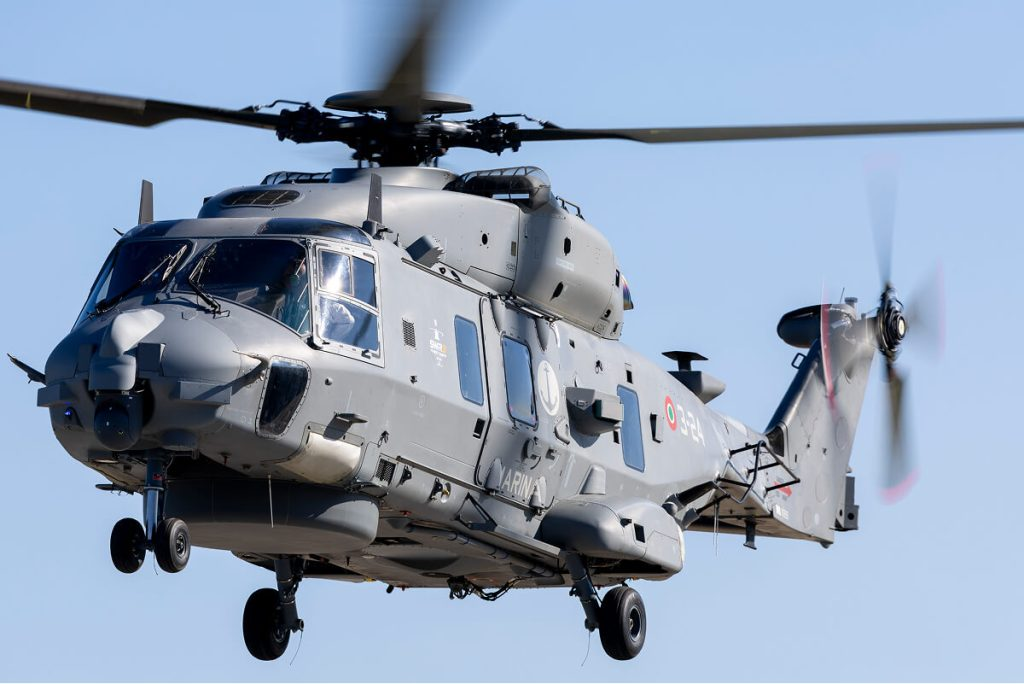
- An Italian Navy SH90 completed the first Software Release 3 flight on 21 July.
- Block 1 adds Link 22, LEOSS-T electro-optics, navigation upgrades, weapons functions, and enhanced sonar equipment.
- The aircraft has entered a qualification campaign required before the configuration can enter operational service.
NHIndustries has completed the first flight of an NH90 helicopter in the Software Release 3 configuration, opening the flight-test campaign for the upgrade known as Block 1. The 21 July flight used an Italian Navy SH90 modified to the new standard, two years after NHIndustries and the NATO Helicopter Management Agency signed the development and qualification contract.
Software Release 3 is intended for both principal NH90 variants: the Tactical Transport Helicopter and the NATO Frigate Helicopter. Airbus Helicopters, Leonardo, and GKN Aerospace have developed the package through the NHIndustries partnership, combining communications, sensor, navigation, weapons, and mission-system changes within one controlled configuration.
The most prominent addition is Link 22, which NHIndustries describes as the first integration of the NATO tactical data link aboard a helicopter. Link 22 supports secure line-of-sight and beyond-line-of-sight communications without depending solely on satellite connectivity, allowing the aircraft to exchange tactical information with ships, aircraft, and other participating units across a wider operating area.
Installing the link involves considerably more than adding a radio terminal. The equipment must be integrated with the helicopter’s mission computer, displays, antennas, cryptographic systems, electrical supply, and crew procedures. The qualification campaign will need to show that the communications capability operates alongside existing avionics without creating unacceptable interference, workload, or reliability penalties.
Block 1 also introduces the LEOSS-T high-definition electro-optical observation system, upgraded civil GNSS and flight-management navigation equipment, and additional weapons functions. The naval configuration gains enhanced anti-submarine warfare capability through the OTS-90 Mark II and FLASH sonar systems, supporting the detection, identification, acquisition, and tracking of underwater contacts.
Those changes make the Italian test aircraft the focus of a broad integration programme. Individual sensors may already have established performance, but fitting them to a helicopter requires software, wiring, cooling, structural mounting, data processing, and human-machine interfaces to work as one system.
The first flight confirms that the initial aircraft-level integration is mature enough for airborne evaluation. It does not complete qualification. Testing must now build evidence across the relevant flight envelope and mission conditions, including system performance, electromagnetic compatibility, failure behaviour, crew interaction, and the effect of the new equipment on maintenance and support.
That distinction matters for a multinational aircraft programme. NH90 operators use different national configurations, weapons, mission equipment, software baselines, and certification arrangements. A common upgrade can reduce duplicated development, but each customer still has to control how the new standard is introduced across its fleet.
NHIndustries says the equipment is intended to reduce crew workload while improving information exchange and interoperability. Achieving both aims will depend on how effectively the mission system filters, prioritises, and displays data. Additional sensors and communications links can improve situational awareness, but they can also generate more alerts, tracks, and decisions unless the information is organised around operational tasks.
The anti-submarine warfare configuration illustrates that challenge. Sonar equipment can produce improved detection and tracking information, while Link 22 can distribute tactical data across the wider force. The operational result depends on track quality, communications resilience, timing, and the ability to manage the helicopter as one element within a distributed naval sensor network.
Navigation improvements are equally relevant because maritime helicopters routinely operate at low level, over featureless water, and in poor visibility. Greater positional accuracy and more capable flight-management equipment support route planning, sensor deployment, weapons employment, and recovery to a moving ship.
The programme must also demonstrate that the additional equipment does not undermine aircraft availability. New hardware creates inspection, spares, documentation, training, and configuration-management requirements. Software changes can introduce further dependencies between national mission systems and the common aircraft baseline.
Block 1 sits within a longer NH90 development path. NHIndustries and NAHEMA are separately conducting a Block 2 architecture study intended to define the technical foundations of a later configuration for requirements extending into the 2040s. Software Release 3 is the nearer-term package, intended to place defined capabilities into the existing fleet while that future architecture is examined.
The two programmes address different modernisation problems. Block 1 must qualify specific equipment and software for operational use, while Block 2 is concerned with the architecture needed to accept later technologies more efficiently. Experience from the current campaign should provide evidence about integration effort, configuration control, and the limits of the existing aircraft design.
No entry-into-service date accompanied the first-flight announcement. The next significant milestones will be completion of qualification testing, approval of the configuration, and the start of installations or deliveries for participating fleets. Until then, the Italian Navy aircraft remains a development platform carrying the programme’s most extensive recent upgrade rather than an operational Block 1 standard.