IN Brief:
- PT PAL cut first steel for Indonesia’s first Scorpène submarine in Surabaya on 7 August.
- The two-boat programme combines local hull production with Naval Group technology, training, and specialist systems expertise.
- Indonesian engineers now face the longer test of converting transferred skills into repeatable submarine production and sustainment capability.
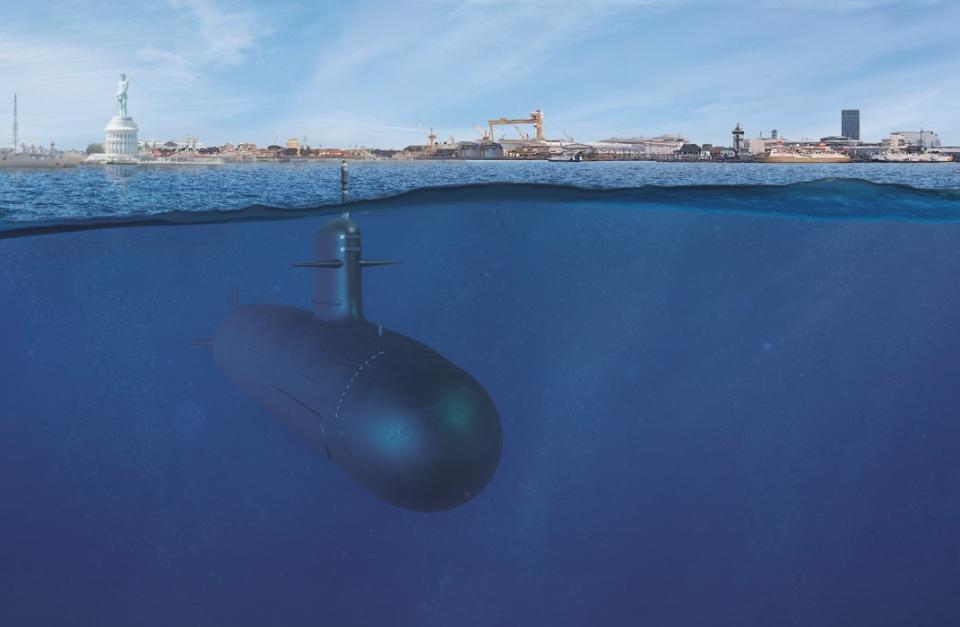
Indonesia has started physical construction of its first domestically built Scorpène submarine, with a first steel-cutting ceremony at PT PAL Indonesia in Surabaya on 7 August marking the beginning of work on the operational hull.
The Indonesian Navy says the programme is expected to take 96 months, while overall programme progress has reached about 20.5%. The first boat is being constructed with support from France’s Naval Group as part of a two-submarine agreement centred on local production, technology transfer, workforce development, and long-term industrial capability.
The Scorpène Evolved programme was structured around construction in Indonesia rather than the delivery of completed submarines from France. Naval Group and PT PAL agreed that both boats would be built at the Surabaya yard, with Indonesian personnel trained in submarine production methods and specialist engineering before the first operational steel was cut.
Preparation has included qualification work intended to demonstrate that PT PAL can meet submarine manufacturing standards in welding, material treatment, inspection, pre-outfitting, and production control. Indonesian engineers have also trained at Naval Group facilities in France, giving the local yard access to processes that are considerably more demanding than ordinary commercial shipbuilding.
Pressure-hull manufacture leaves little room for improvisation. Material preparation, welding parameters, dimensional control, non-destructive testing, traceability, and documentation all need to remain within tightly controlled limits because faults in the pressure boundary cannot be treated as routine production defects. The steel-cutting ceremony therefore marks the point at which earlier skills and process qualification begin to generate hardware that will eventually go to sea.
The programme also carries a broader systems-integration burden. A modern submarine brings together propulsion, energy storage, cooling, electrical distribution, combat systems, sensors, communications, weapons, hydraulics, life-support equipment, and large volumes of cabling and pipework inside a hull where space and weight margins are tightly managed.
Scorpène Evolved uses lithium-ion batteries rather than the traditional lead-acid arrangement associated with many conventionally powered submarines. Integrating that energy system requires close control of power management, charging, cooling, fire protection, monitoring, and safety systems, particularly because the submarine must sustain those functions during long submerged periods.
The programme’s industrial value will depend partly on how much of that integration knowledge remains with PT PAL. Building steel sections to transferred drawings creates useful manufacturing capability, but a durable submarine industry also needs engineers who understand interfaces, configuration changes, testing, acceptance, maintenance, and the consequences of modifying one system after the platform has entered service.
Indonesia has already indicated that submarine systems integration is expected to become a larger domestic responsibility. Potential missile integration on later boats has been discussed as PT PAL develops deeper experience in combat-system and weapons work, adding another layer of software, safety, qualification, and certification activity to the local industrial base.
That prospective missile-integration work makes the performance of the first two boats more consequential than the delivery of two additional hulls alone. A yard that can manufacture, integrate, test, maintain, and later modify submarines has considerably more strategic value than one limited to licensed fabrication.
The first boat still faces years of work. Hull sections must be produced and joined before machinery, electrical systems, piping, sensors, combat equipment, propulsion components, and accommodation can be installed. Harbour acceptance, system commissioning, sea trials, and Navy acceptance will follow only after the submarine has passed successive production and inspection gates.
Those stages will expose the maturity of the local supply chain as well as the prime partnership. Submarine programmes depend on specialist materials, precision-machined parts, electrical equipment, valves, pumps, cabling, coatings, sensors, and test equipment, much of which must be supplied with documentation and quality records suitable for naval acceptance.
For PT PAL, repeatability will become the stronger measure of technology transfer. Producing a first boat with extensive assistance establishes capability, but building the second with better productivity, fewer defects, controlled design changes, and a greater share of domestic engineering would show that knowledge has moved beyond individual training courses and into the yard’s production system.
Indonesia’s Navy has also begun preparing personnel to operate the new submarine, with crews being sent to France for training. That operational preparation runs alongside the manufacturing programme because locally built platforms still require a trained user community capable of feeding maintenance experience, technical faults, and upgrade requirements back into the industrial support system.
First steel is consequently a measurable production milestone rather than the completion of Indonesia’s submarine localisation effort. The harder evidence will arrive over the next several years as PT PAL turns individual plates into qualified hull sections, integrates the first complete boat, and establishes whether the skills transferred from Naval Group can be retained across production, maintenance, and future upgrades.