IN Brief:
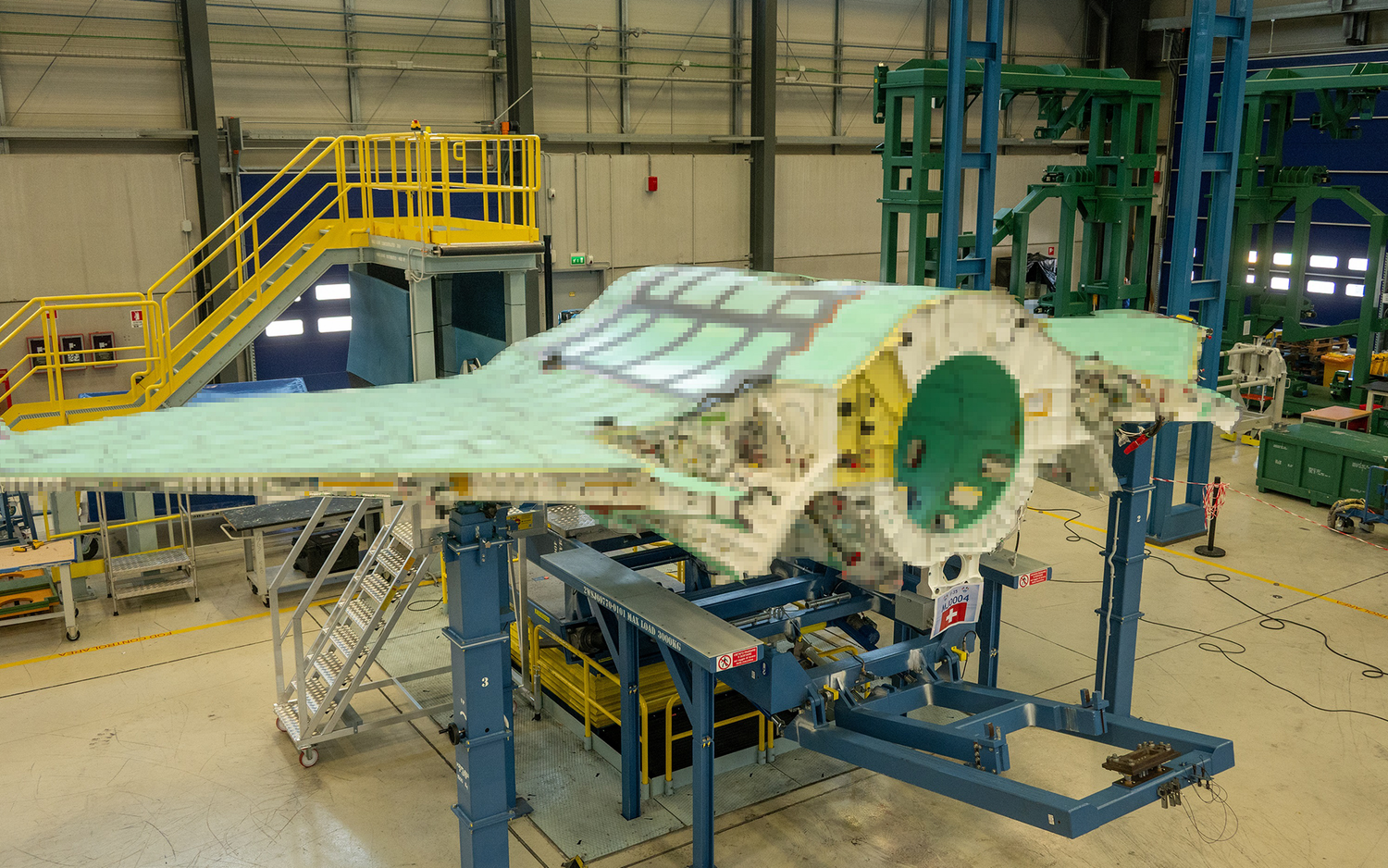
- The first fuselage section and wing for Swiss F-35A J-6004 have been assembled at Cameri.
- Cameri can manufacture up to 20 F-35s annually and produces around one-third of the programme’s wings.
- Swiss aircraft introduction begins at Payerne from mid-2028 before extending to Meiringen and Emmen.
Leonardo‘s Cameri facility in northern Italy has assembled the first fuselage section and wing destined for Swiss F-35A J-6004, moving Switzerland’s fighter procurement further into physical production ahead of fleet introduction.
The fuselage section carries production serial MJ-4 and will ultimately form part of aircraft J-6004. Once work at Cameri is complete, the structure and attached wings will be transported to Lockheed Martin’s Fort Worth plant in Texas, where they will be combined with the aircraft’s remaining components.
The route illustrates the distributed manufacturing system behind the F-35. Cameri is one of three sites worldwide where F-35 aircraft are manufactured, alongside Fort Worth and Nagoya in Japan, and it contains the programme’s European final assembly line.
Switzerland’s aircraft will use both American and European production routes. The first eight Swiss F-35As are due to be based initially at Ebbing Air National Guard Base in Arkansas from mid-2027, allowing pilots and ground crews to train before aircraft begin transferring to Switzerland.
The first F-35A assembled at Cameri for direct delivery to Switzerland is expected from mid-2028. J-6004 follows a different sequence because its Italian-built major structure will move to Fort Worth for completion, with arrival in Switzerland expected at the end of 2029.
Cameri can produce up to 20 F-35 aircraft annually and supports both F-35A and F-35B manufacturing for Italy. The facility also produces around one-third of all wings for the programme, giving it a role in the wider international fleet rather than functioning solely as an Italian final assembly operation.
That manufacturing network extends across more than 2,100 suppliers worldwide. Germany produces the F-35A’s centre fuselage section, while the rear fuselage section is manufactured in the UK. Italy, the UK, the Netherlands, Denmark, and Norway are European programme partners alongside the United States, Canada, and Australia.
Such geographical distribution gives the programme industrial depth but creates a demanding logistics and configuration-control problem. Major structures produced in several countries have to arrive at assembly sites in the correct sequence and configuration, while specialised suppliers producing electronics, propulsion hardware, structures, and other components must maintain compatible production schedules.
A delay at one supplier can therefore affect aircraft allocated to customers far beyond that supplier’s home market. Conversely, distributing production across several allied industrial bases gives the programme access to manufacturing capacity and specialist skills that would be expensive for each customer to reproduce nationally.
For Switzerland, aircraft delivery is only one part of the introduction programme. Payerne is scheduled to begin operating the F-35A from mid-2028, followed by Meiringen from 2030 and Emmen from 2032. Infrastructure, maintenance capability, security, tooling, training, and logistics must develop alongside the aircraft if those dates are to translate into usable fleet capacity.
Cameri’s proximity to Switzerland provides a close European manufacturing connection without turning the programme into a nationally self-contained supply chain. The facility lies roughly 40 kilometres from the Swiss border, but the production route for aircraft such as J-6004 still crosses the Atlantic and depends on common programme infrastructure in the United States and other partner countries.
The arrangement also explains why national delivery totals reveal relatively little about where an individual F-35 was actually built. A Swiss aircraft can incorporate a fuselage section and wing assembled in Italy, additional structures manufactured elsewhere in Europe, and final integration in Texas before entering service from a Swiss air base.
Maintaining common configuration across that network becomes harder as production continues and aircraft standards evolve. Suppliers have to introduce approved changes without disrupting throughput, while customers expect aircraft produced at different final assembly sites to enter service with compatible hardware, software, maintenance data, and support arrangements.
MJ-4 is a small structural milestone within that system, but it marks Switzerland’s programme moving further from procurement paperwork into manufacturing, training, and base preparation. The remaining risk now sits increasingly in production throughput and fleet introduction rather than aircraft selection — and those are problems that cannot be solved by signing another contract.