IN Brief:
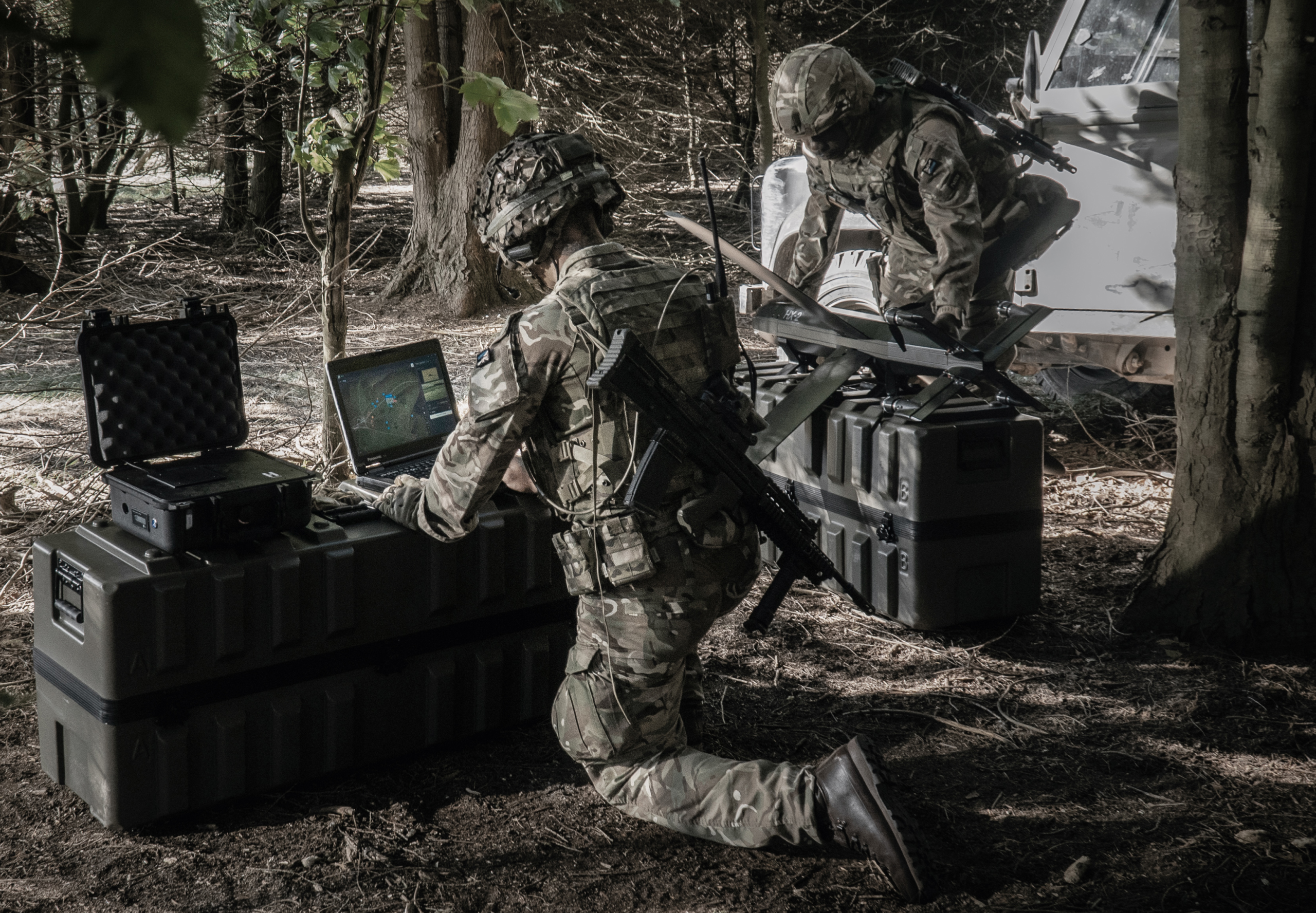
- Japan's Ground Self-Defense Force is testing Helsing's HX-2 strike drone through the end of September.
- HX-2 combines a 100km range, onboard AI, electronic-warfare resilience, and networked operation through Helsing's Altra software.
- Rakuten is supporting Helsing through the commercial and procurement process around a prospective Japanese sale.
Helsing has enlisted Japanese technology group Rakuten as it seeks to move its HX-2 strike drone from military evaluation towards a potential sale to Japan’s Ground Self-Defense Force.
The Japanese force is testing HX-2 through the end of September, while Rakuten is helping the Munich-based defence technology company navigate the commercial and institutional process around a possible procurement. Helsing says it reached an initial agreement earlier this year for the Japanese government to use its systems, although no final order, quantity, or delivery schedule has been announced.
HX-2 is an electrically propelled X-wing precision munition designed for beyond-line-of-sight engagements against targets including artillery and armoured vehicles. Helsing specifies a range of up to 100km, a weight of 12kg, and a maximum speed of 220km/h, with multiple payload configurations including anti-armour and anti-structure options.
The system is built around onboard software rather than continuous remote control. Helsing says its AI can search for, re-identify, and engage designated targets if the data connection is disrupted, while a human operator remains in or on the loop for critical decisions. HX-2 can also operate through Helsing’s Altra reconnaissance-strike software, linking multiple effectors with ISR assets, artillery, and battlefield-management systems.
Those characteristics place the Japanese evaluation within a wider move towards smaller precision weapons designed around software, distributed production, and operation in contested electronic environments. The engineering problem is not simply extending range, but maintaining navigation, target identification, command authority, and mission execution when communications are unreliable or deliberately denied.
Manufacturing has been built into Helsing’s HX-2 proposition from an early stage. The company’s first Resilience Factory in southern Germany has an initial production capacity exceeding 1,000 HX-2 systems per month, while a previously announced Ukrainian order covers 6,000 aircraft. Helsing describes the factory model as a way of establishing distributed manufacturing capacity that can be expanded in customer nations rather than concentrating output at a single site.
Japan presents a different challenge from scaling an established European production line. An overseas defence technology company with a short corporate history must fit into a procurement environment dominated by established domestic suppliers, long acquisition cycles, government interfaces, and detailed support requirements that extend well beyond an aircraft demonstration.
Rakuten’s role addresses that commercial and institutional problem rather than the engineering of HX-2 itself. The Japanese group has limited history as a defence prime, but it has extensive domestic technology operations, government-facing experience, and a commercial network Helsing can use while pursuing the opportunity.
Rakuten has identified complex procurement procedures and access to government agencies as barriers for newer defence technology companies entering Japan. Acting as an intermediary gives Helsing a local route through those structures while the Ground Self-Defense Force separately determines whether the aircraft’s performance and operating concept meet its requirements.
The arrangement reflects the changing supplier base around autonomous military systems. Companies whose original expertise lies in software, AI, data processing, or commercial technology increasingly need access to procurement structures developed around conventional defence primes, while customers have to establish how comparatively young suppliers will provide long-term support, configuration management, software updates, and production assurance.
Those questions become particularly relevant for HX-2 because Helsing treats software updates as part of the weapon’s operating model. The company says over-the-air updates can be used to respond to changing threats and electronic-warfare conditions, while Altra supports coordinated operation of multiple aircraft rather than treating each HX-2 as an isolated munition.
A Japanese acquisition would therefore require more than proving that the aircraft can fly and engage a target during field evaluation. Decisions would also be needed on software control, communications interfaces, training, local maintenance, industrial participation, data handling, integration with Japanese command systems, and the extent to which production or support would be carried out domestically.
Helsing’s existing manufacturing model gives it a basis for discussing localised capacity, although no Japanese production arrangement has been announced. The company’s Resilience Factory concept is explicitly intended to support distributed manufacture, but applying that model in Japan would depend on the structure and scale of any eventual procurement.
The current evaluation provides a more immediate test. Japan can assess HX-2 against its operational requirements while Rakuten works on the commercial route needed to turn a successful demonstration into a contract. With field testing due to continue through September, the next material step will be whether the initial agreement develops into a defined procurement programme and what industrial role Japan requires alongside the aircraft itself.