IN Brief:
- Fairbanks Morse Defense is investing €6.98 million in its Redzikowo manufacturing operation.
- The expanded plant will support production of up to 150 davits annually and increase annual output by 80%.
- Completion in late 2027 will add machining, fabrication, assembly, testing, and European lifecycle-support capacity.
Fairbanks Morse Defense is investing €6.98 million to expand its Vestdavit manufacturing operation in Redzikowo, Poland, creating a larger European production and support base for naval launch-and-recovery equipment.
The site will become the company’s global Davit Manufacturing Centre of Excellence, with Fairbanks Morse expecting the expansion to increase annual output by 80% and nearly double its overall production capacity for davits and related maritime handling equipment. The investment is being undertaken with support from the Pomeranian Regional Development Agency through the Polish Investment Zone programme.
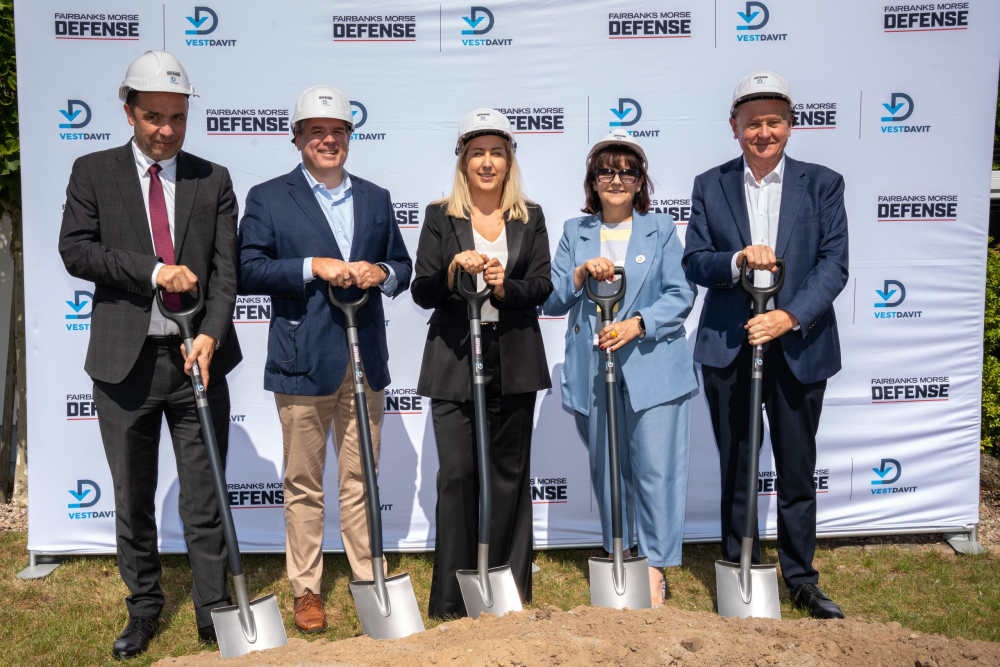
The project follows an 13 August groundbreaking ceremony and is scheduled for completion in the fourth quarter of 2027. Around €5 million is allocated to new buildings, with a further €1.9 million earmarked for manufacturing equipment and a dedicated test yard.
Existing floorspace will increase from approximately 3,000m² to 5,600m², adding dedicated halls for steel fabrication, machining, assembly, and testing. The expanded operation will also accommodate hydraulic and electrical assembly, winch installation, and additional CNC machining capability.
Fairbanks Morse says the enlarged plant will be capable of producing up to 150 davits annually, with a layout allowing several systems to move through assembly in parallel. That matters because launch-and-recovery equipment is becoming more closely linked to the expansion of both crewed naval craft and uncrewed maritime systems.
A davit may appear comparatively simple beside a ship, submarine, or autonomous vessel, but its performance is defined by a demanding set of mechanical and operational requirements. The equipment has to control heavy loads in a moving sea environment, fit within the host vessel’s deck arrangement, withstand corrosion and shock, and recover craft reliably when weather and vessel motion are working against the operation.
The requirements become more specialised as navies add autonomous and remotely operated boats alongside conventional rigid-hulled inflatable boats and other deployed craft. Weight, centre of gravity, lifting points, launch geometry, recovery speed, electrical interfaces, sea-state limits, and deck handling all affect whether a vehicle can be deployed routinely rather than simply demonstrated in benign conditions.
Fairbanks Morse is positioning Redzikowo around that broader demand. The plant will produce systems associated with both Vestdavit and Welin Lambie, giving it a role across several handling-system product families rather than functioning solely as an additional assembly line for one design.
The investment builds on Fairbanks Morse Defense’s acquisition of Vestdavit in 2025, which added the Norwegian-founded handling-system specialist and its Polish manufacturing operation to the US naval technology group. Bringing more fabrication, machining, assembly, and testing together at Redzikowo should reduce the number of manufacturing stages that have to move between separate facilities.
That consolidation also has a sustainment dimension. Fairbanks Morse intends the Polish operation to provide lifecycle support for European naval customers, placing manufacturing expertise, spares, maintenance capability, and technical support closer to fleets operating in the region.
For NATO navies trying to increase the number of deployable autonomous systems, that support capacity can be as important as initial equipment production. A launch-and-recovery system that becomes unavailable through a failed hydraulic component or control issue can prevent the associated boat or autonomous vehicle from performing its mission even when the vehicle itself remains fully serviceable.
Regional manufacturing can shorten some of those support chains, although localisation does not remove dependence on specialist components or materials. Davit production still requires structural steel, hydraulic equipment, winches, drives, control systems, electrical components, machining, welding, inspection, and testing, all of which have their own supplier and qualification requirements.
The Redzikowo expansion therefore reflects a wider defence-industrial issue: increasing fleet numbers creates demand throughout the equipment chain rather than only at the level of major platforms. New autonomous vessels require handling systems; handling systems require actuators, controls, structures, and test equipment; and all of those systems require technicians and maintainers once they enter service.
Workforce expansion is part of the Polish project. Fairbanks Morse expects employment at the site to grow by around 30% over the next three years, with demand for welders, electricians, hydraulic technicians, assemblers, and engineers. The company and Vestdavit are working with local authorities and education providers to support that recruitment.
By late 2027, Redzikowo is intended to combine higher-volume manufacture with European testing and lifecycle support. The investment is modest beside a new shipyard or missile plant, but the 80% output increase shows how capacity expansion is moving into the less conspicuous equipment required to put naval and autonomous systems into the water and recover them afterwards.