IN Brief:
- Hanwha Systems and TTA are collaborating on an AI-enabled tactical 5G communications architecture.
- Development will combine terrestrial 5G with non-terrestrial connectivity, including satellite communications.
- International standards form part of the programme as Hanwha considers domestic and overseas military applications.
Hanwha Systems and South Korea’s Telecommunications Technology Association are developing an AI-enabled 5G tactical communications architecture intended to combine terrestrial and satellite networks while aligning military connectivity more closely with international telecommunications standards.
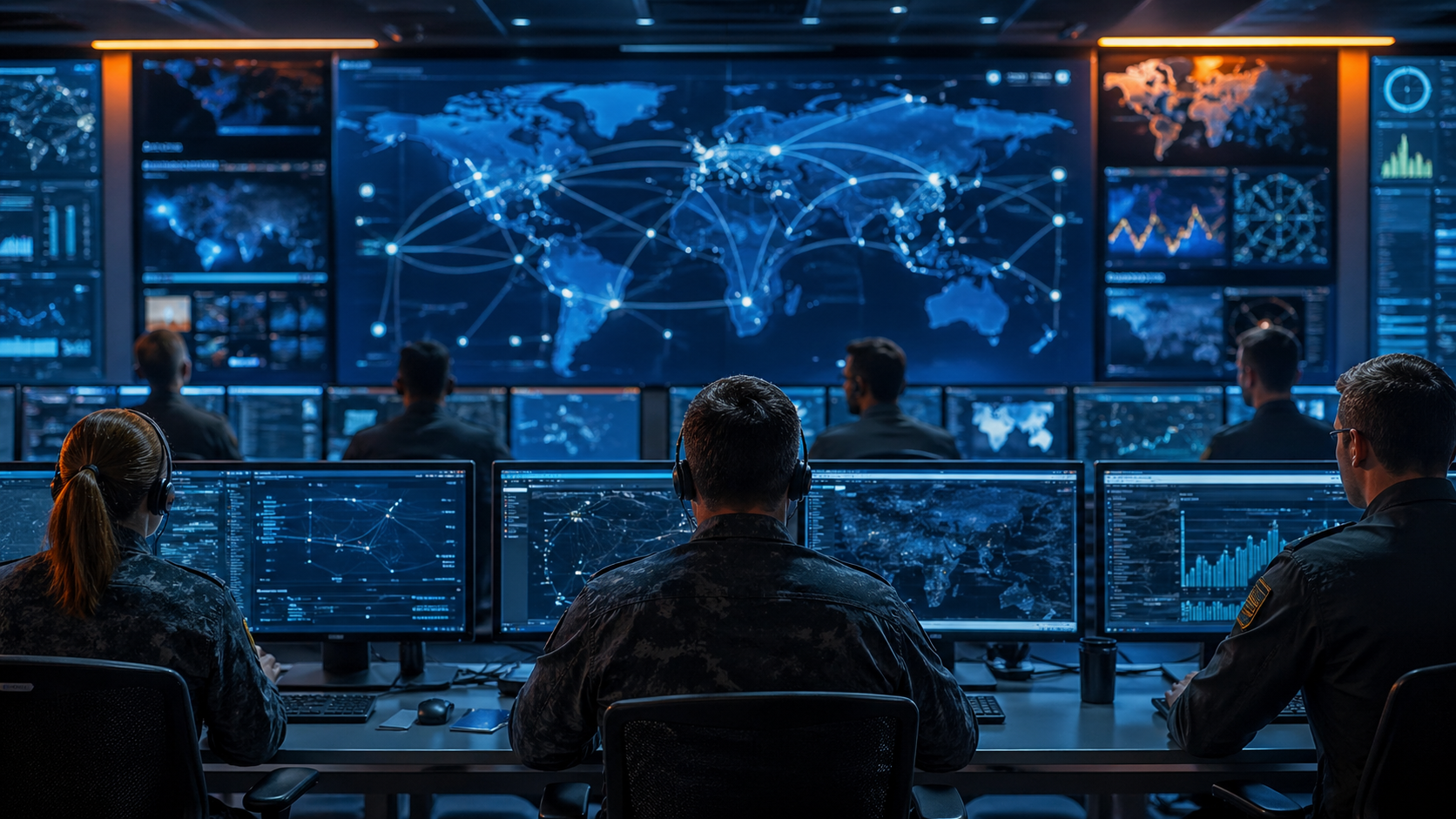
The organisations are working on integration between 5G terrestrial networks and non-terrestrial systems, including satellite communications, with artificial intelligence expected to support management of connectivity across a future military communications environment.
Hanwha Systems is positioning the work for South Korean requirements while also considering overseas customers. TTA contributes telecommunications standardisation, testing, and certification expertise, giving the partnership an interoperability role alongside development of the network itself.
The use of commercial 5G technology in defence is attractive because civilian telecommunications investment has already created a large ecosystem of radios, processors, chipsets, software, network-management tools, and standards. Military users can potentially draw on that development base rather than fund every part of a tactical communications architecture independently.
Operational requirements are considerably less forgiving than commercial ones. Tactical networks may have to function while infrastructure is damaged, units are moving, spectrum is congested, and an adversary is deliberately attempting to detect, jam, deceive, or penetrate communications.
Commercial 5G therefore has to be adapted rather than simply installed. Equipment must be ruggedised, security architecture strengthened, network management made more autonomous, and assumptions around permanent infrastructure replaced with a system capable of being deployed and reconfigured quickly.
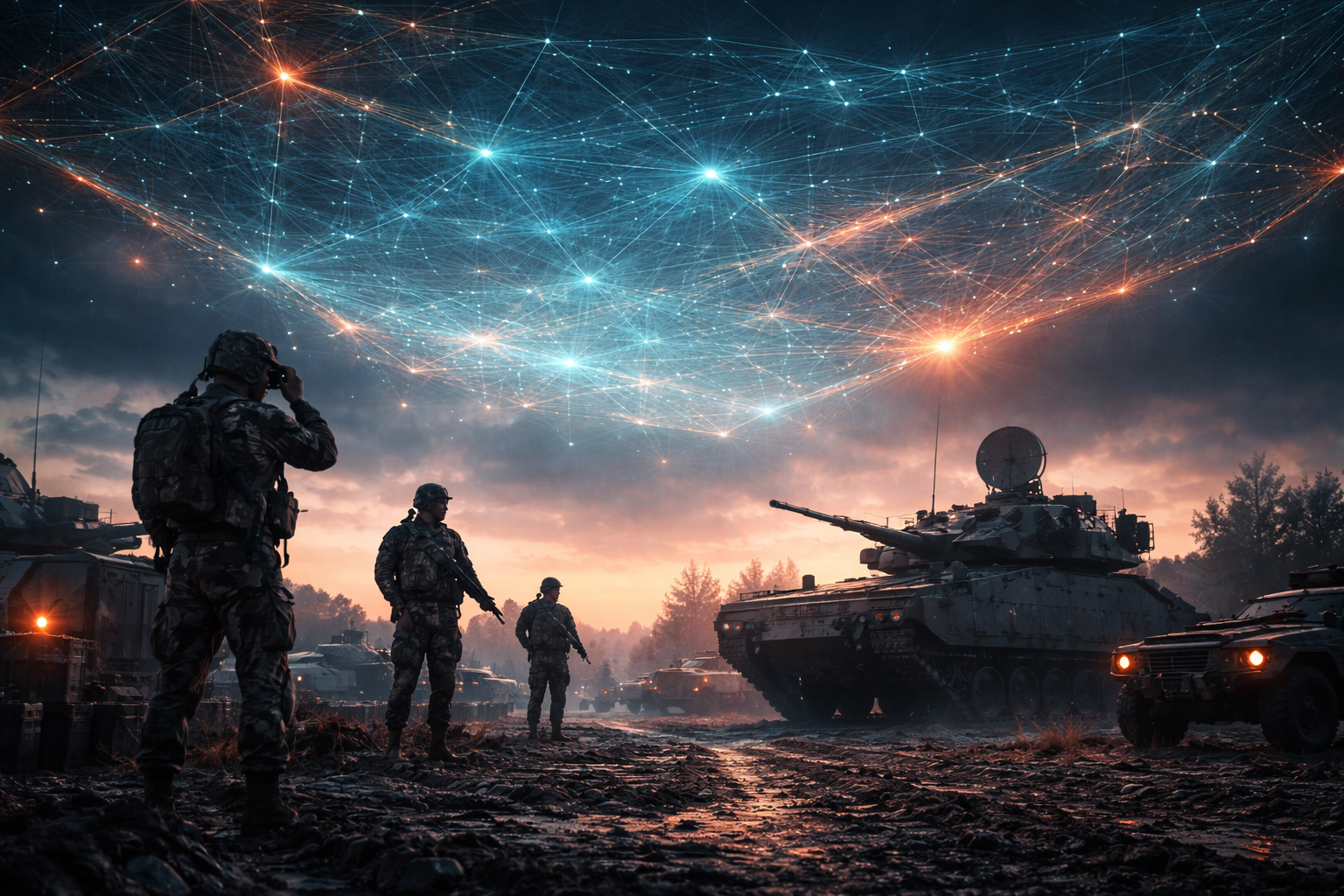
Integrating terrestrial and non-terrestrial networks is intended to address some of those constraints. A unit might use a local 5G network where terrestrial coverage is available, then move traffic towards satellite connectivity when distance, terrain, or damage removes that route.
The network-management system has to decide which connection is available and appropriate without forcing operators to reconfigure communications manually during a mission. Artificial intelligence could support that process by monitoring network quality, predicting congestion, selecting routes, allocating bandwidth, or identifying abnormal behaviour.
The useful objective is not autonomous networking for its own sake, but reducing the management burden as more radios, sensors, vehicles, aircraft, and command systems compete for limited communications capacity.
That problem becomes more difficult as military units collect larger volumes of data. Full-motion video, radar tracks, electronic-warfare information, uncrewed-system feeds, command data, targeting information, and routine voice communications all impose different requirements for latency, bandwidth, resilience, and security.
A network capable of carrying one type of traffic efficiently may perform poorly when several compete at once. Automated prioritisation could help preserve critical information flows, provided commanders can understand and control how the system allocates capacity.
Satellite integration extends coverage beyond terrestrial infrastructure but brings another set of limitations. Capacity is finite, latency varies according to orbit and architecture, terminals may need suitable sky access, and satellite links can themselves become targets for jamming or electronic attack.
The network therefore has to treat satellite communications as one bearer within a larger architecture rather than a guaranteed replacement for terrestrial systems. Traffic may have to move between several paths as availability changes.
TTA’s involvement is significant because interoperability remains a persistent problem in military networking. Defence organisations operate equipment acquired from different suppliers, at different times, and frequently from allied countries. Proprietary interfaces can make it expensive to exchange information or replace one component without changing several others.
Building around recognised telecommunications standards can reduce some of that friction, although military security and performance requirements will still demand specialised extensions. Standards also matter commercially because Hanwha’s export ambitions depend on the network integrating with customers whose spectrum arrangements and existing equipment differ from South Korea’s.
The cybersecurity burden grows as military networks adopt more commercial technologies and software-defined functions. Greater flexibility means more interfaces and more code, increasing the number of components that must be authenticated, monitored, patched, and protected.
AI-supported management adds a further assurance problem because operators need confidence in why the network changes routes or priorities and how it responds when data is incomplete, corrupted, or deliberately manipulated.
Electronic-warfare resilience sits beside conventional cybersecurity. An adversary does not need to penetrate the network if it can deny the spectrum carrying its traffic, identify transmitters for targeting, or force systems onto less efficient communications routes. Tactical 5G equipment therefore has to balance connectivity with emission control, mobility, and survivability.
The industrial advantage is that much of the underlying technology already exists at commercial scale. South Korea’s mature telecommunications and electronics sector can provide components, software expertise, standards knowledge, and manufacturing capacity that Hanwha can adapt around military security, integration, and deployment requirements.
The collaboration remains a development effort rather than a fielded network. Neither organisation has disclosed a procurement quantity, deployment schedule, or final technical architecture, while any overseas adoption would depend on qualification, security accreditation, spectrum compatibility, and customer-specific integration.
Its significance lies in the direction of travel. Future tactical communications are unlikely to depend on one radio bearer or a single network. Terrestrial 5G, satellite links, legacy military radios, and other data paths will have to coexist, with software taking a larger role in determining how information moves between them.
Hanwha and TTA are attempting to make that convergence manageable through AI and common standards. The technical test will be whether the resulting architecture remains secure, interoperable, and useful once the clean assumptions of civilian telecommunications are replaced by movement, disruption, and deliberate interference.