IN Brief:
- The US Army has ordered six K9 Mobile Howitzer prototypes, with options covering 12 additional systems.
- Hanwha is establishing a US integration and test operation in Opelika, Alabama, as the first phase of its localisation strategy.
- Prototype testing will determine whether the K9-derived system progresses towards a larger US artillery production programme.
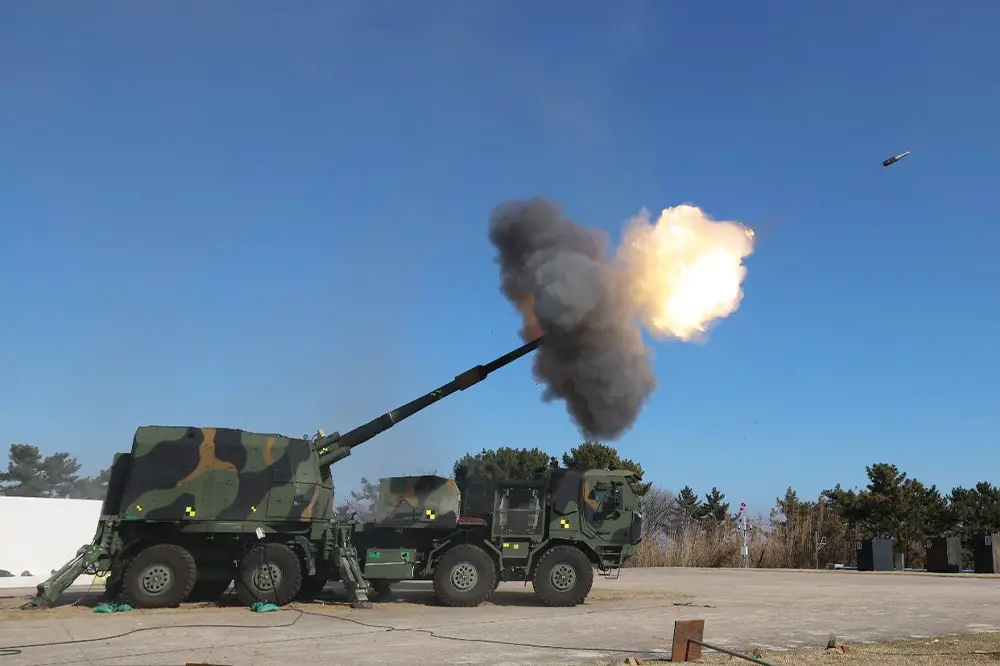
Hanwha Defense USA has secured its first major US Army contract, covering accelerated delivery of six K9 Mobile Howitzer prototypes for the service’s Mobile Tactical Cannon programme. The agreement also includes an option for a further 12 systems, moving the K9-based proposal from competitive positioning into a formal Army evaluation.
The K9MH is a wheeled variant of Hanwha’s established 155mm K9 artillery family and is intended to operate with the Army’s existing artillery munitions. More than 2,500 K9 howitzers are already fielded internationally, giving the US programme access to an existing production, engineering, and sustainment base rather than starting with an entirely new weapon architecture.
Hanwha is pairing the prototype award with a phased US localisation programme. A three-year lease has been signed for a site in Opelika, Alabama, which will act as the company’s first American integration and test facility for the K9 family. Further locations and production phases remain under evaluation as the company develops its US artillery footprint.
The Opelika operation puts industrial preparation alongside the Army’s technical assessment. Integration, customer-specific engineering, testing, supplier qualification, and configuration control can be established before any decision on larger-scale production, limiting the need to commit prematurely to a full manufacturing facility while still creating domestic capacity around the programme.
Mike Smith, chief operating officer and president of Land Systems at Hanwha Defense USA, said the company intends to deliver capability “at speed, at scale, on cost, and onshore”. The prototype phase will provide the Army with hardware against which those claims can be measured through mobility, firing, integration, maintainability, reliability, and support testing.
Hanwha has used localisation extensively in other K9 markets. Production and support arrangements have been established in Australia, Egypt, Poland, and Romania, combining South Korean manufacturing experience with national suppliers, workforce development, and sovereign sustainment capacity. The US plan follows the same broad model, although the scale of any domestic production network will depend on what follows the prototype campaign.
That industrial structure will be scrutinised alongside the artillery system itself. Modern land-force procurement increasingly places manufacturing resilience, repair capacity, supplier depth, and the ability to increase output alongside range, mobility, and firing performance. A mature platform can shorten some elements of development, but transferring production into another country’s supply chain creates a separate set of engineering and qualification tasks.
The initial quantity keeps the programme firmly in prototype territory. Six systems are sufficient for a structured Army evaluation, while the option for another 12 gives the service room to widen testing if the first phase performs as required. Neither element represents a production commitment, and Hanwha has not disclosed a follow-on quantity or timetable beyond the current agreement.
The programme also gives the Army access to a wider K9 user base. Commonality across allied fleets can support ammunition compatibility, training experience, maintenance data, and supply-chain cooperation, although the US configuration will still have to meet Army-specific requirements rather than simply reproduce an overseas vehicle.
For Hanwha, the contract gives its US land-systems business a concrete programme around which to build facilities and supplier relationships. The company has been expanding its American defence interests across artillery, munitions, combat vehicles, and shipbuilding, and the Mobile Tactical Cannon award creates an opportunity to demonstrate whether its localisation model transfers successfully into the US Army procurement environment.
The next evidence will come from physical delivery and test results rather than further industrial announcements. The K9 family brings established production history to the competition, but the Army will be assessing a US-specific prototype and the support system behind it. Opelika provides the first domestic engineering foothold; progression beyond that site will depend on how convincingly the prototypes perform.