IN Brief:
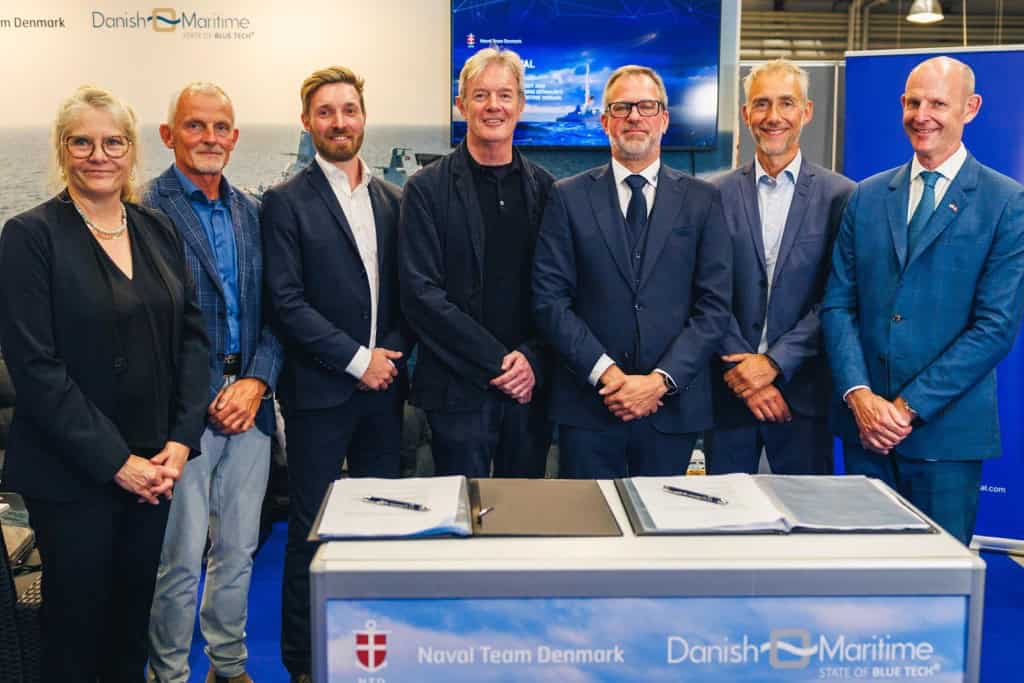
- Babcock has signed agreements with STORMBORN, CUBEDIN, and SH Group at DALO Industry Days.
- STORMBORN and CUBEDIN will examine autonomous systems and standardised physical and digital integration interfaces.
- The SH Group agreement covers ship and naval platform systems alongside greater Danish industrial participation.
Babcock has signed three memoranda of understanding with Danish companies covering hybrid naval capability, autonomous systems integration, and ship-platform equipment as Denmark expands work around future crewed and uncrewed fleets.
Two agreements with STORMBORN and CUBEDIN will examine how autonomous technology and standardised interfaces could be integrated with larger naval programmes. A third agreement with SH Group will explore cooperation on ship and naval platform systems, with an explicit aim of increasing Danish industrial participation on vessels built for Denmark and for export.
The agreements were unveiled at DALO Industry Days on 19 August and sit within a broader UK-Danish naval relationship. Babcock points to Arrowhead 140 as an established example, with the design developed from the Danish Iver Huitfeldt class and subsequently used as the basis for international frigate programmes.
The latest work moves the industrial relationship towards a different integration problem. A hybrid fleet combining crewed ships with uncrewed surface, air, and potentially subsurface systems requires more than individual autonomous vehicles. Mission systems, communications, power, data, physical interfaces, command functions, and safety processes all have to work across equipment from multiple suppliers.
CUBEDIN’s proposed role is centred on standardised physical and digital interfaces for mission systems and autonomous capabilities. Naval autonomy becomes difficult to scale when each new payload or uncrewed platform needs a separate mechanical, electrical, software, and certification solution before it can operate from a host ship.
Common interfaces can reduce that burden, but only if the standards are sufficiently precise to govern real integration work. Connector types and data protocols are only part of the picture; power quality, cybersecurity, timing, environmental limits, electromagnetic compatibility, software version control, and safe launch and recovery arrangements can all affect whether a supposedly modular system is genuinely interchangeable.
STORMBORN brings the uncrewed-platform side of the proposed work. The company and Babcock intend to explore how its technology could be incorporated into larger naval programmes, giving the partnership a route to test whether autonomy can be introduced as part of a fleet architecture rather than treated as a standalone demonstrator.
That distinction becomes important as navies evaluate fleets in which a crewed command platform can direct dispersed autonomous systems carrying sensors, communications equipment, countermeasure systems, or other mission payloads. The operational concept depends on the host ship and the uncrewed systems sharing data and tasking without forcing crews to manage several incompatible control environments.
Babcock has already been extending its maritime-autonomy work into more specific mission areas. In July, the company formed a maritime counter-UAS partnership with ACUA Ocean Technologies and Frankenburg Technologies, combining an uncrewed surface vessel, modular launcher, and guided interceptors. The Danish agreements broaden that direction from one mission package towards the interfaces and industrial arrangements needed to support several autonomous systems.
SH Group adds a production and support dimension. Its agreement covers ship and naval platform systems and is intended to increase Danish involvement in equipment supplied for domestic and export vessels. That could encompass manufacturing, installation, integration, maintenance, and through-life support if the cooperation progresses into contracted programmes.
For Denmark, local participation can retain engineering skills and support capacity around future naval procurement while giving domestic suppliers access to wider Babcock programmes. For Babcock, Danish partners can provide technology and equipment while reinforcing an industrial relationship already connected to the Arrowhead design family.
The three memoranda remain cooperation agreements rather than procurement contracts. No contract value, platform quantity, production schedule, or customer commitment has been disclosed, and the technical architecture has not yet been defined publicly.
The next useful milestones will therefore be engineering rather than commercial headlines: interface definitions, representative system selections, integration trials, and demonstrations showing how crewed and uncrewed assets exchange data and operate under a common command structure. Those stages will also expose where responsibility sits for configuration control, cybersecurity, safety, and mission-system certification.
A hybrid fleet only becomes scalable when new systems can be added without reopening the entire ship design each time. Babcock’s Danish agreements establish the industrial relationships needed to test that proposition; the harder work is turning separate company technologies into interfaces and assurance processes that can survive naval qualification and repeated deployment.
Repeatability will be the deciding factor. A successful one-off demonstration can prove that two systems communicate, but procurement at fleet scale requires documented interfaces, controlled software baselines, defined maintenance responsibilities, and suppliers able to reproduce the integration across different ships. Those are the conditions that separate a technology trial from an architecture that can support operational service.