IN Brief:
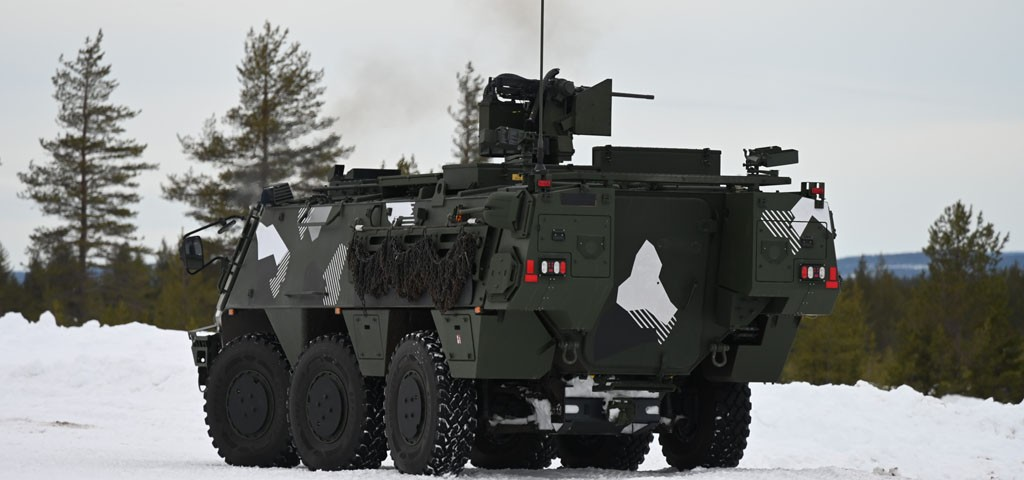
- Norway has ordered 20 Patria 6×6 C2 vehicles under the multinational CAVS programme.
- Kongsberg PROTECTOR RS4 remote weapon stations, support, training, and spare parts are included.
- Options cover another 40 C2 vehicles, while deliveries of the initial order are due to begin during 2026.
Norway has placed its first vehicle order under the Common Armoured Vehicle System programme, buying 20 Patria 6×6 vehicles in command-and-control configuration with Kongsberg PROTECTOR RS4 remote weapon stations. The agreement also includes support, training, and spare parts, with options for another 40 C2 vehicles and associated RS4 systems. Deliveries are scheduled to begin during 2026.
The order turns Norway’s participation in CAVS into a defined serial procurement only months after it joined the programme framework. CAVS was launched in 2020 and now includes Finland, Latvia, Sweden, Denmark, Norway, Germany, and the UK. Patria says the programme has accumulated nearly 2,000 vehicle orders and more than 400 deliveries, while vehicles are already operational with several participating nations and in Ukraine.
Norway has selected the C2 variant, although the detailed mission-system configuration has not been published. The announcement identifies the Patria chassis and Kongsberg weapon station but does not specify radios, battle-management software, computing equipment, antenna arrangements, or other command systems. Those items will shape the final integration workload because a command vehicle carries a heavier electrical, communications, and data burden than a basic protected transport configuration.
The PROTECTOR RS4 introduces another Norwegian subsystem into the package. Integrating a remote weapon station requires structural, electrical, software, sighting, and crew interfaces to be controlled across the vehicle and weapon, alongside ammunition stowage, safety arrangements, and maintenance access. The common 6×6 platform can simplify the automotive baseline, but national mission equipment still creates configuration differences between fleets.
CAVS is designed around that balance between commonality and national adaptation. Participating countries can share procurement, product development, spares, and lifecycle knowledge while tailoring vehicles to different roles. The economic advantage depends on keeping enough common hardware and documentation across the fleet for those shared arrangements to remain practical.
Configuration growth is the obvious counter-pressure. Different communications suites, armour packages, remote weapon stations, software, national standards, and support policies can gradually turn one common vehicle into several divergent variants. Interface control and change management therefore become increasingly important as more countries place follow-on orders and introduce their own equipment.
The programme is already using different industrial models. Germany is moving towards local assembly and final integration of CAVS vehicles through KNDS Deutschland, with serial deliveries due to ramp up from 2027 as technology transfer increases domestic production. Norway’s order does not disclose an equivalent local assembly plan, so the same model cannot be assumed. Kongsberg’s RS4 nevertheless gives the Norwegian configuration a clear national industrial contribution.
The RS4 fit also gives Norway a route to standardise part of the vehicle’s weapon architecture around equipment already produced by a domestic supplier. Common remote weapon stations can simplify training and support across vehicle fleets, but only where sensors, ammunition, software, and control interfaces are kept sufficiently aligned. Any national changes to the C2 mission suite will therefore have to be managed without undermining the repeatability of the base vehicle and weapon installation.
The delivery schedule is relatively compressed. Starting deliveries in the same calendar year as the order is possible because Norway is buying into an established platform, production system, and multinational programme rather than funding a clean-sheet vehicle development. Customer-specific integration and acceptance work remain necessary, but the baseline chassis, supply chain, documentation, and training structures already exist.
Support and spare parts are included from the outset, which will matter once the vehicles enter service. Fleet availability depends on tyres, driveline components, electronics, weapon-station parts, diagnostic equipment, technical data, and trained maintainers as much as on the vehicles delivered from the factory. A larger multinational installed base can improve purchasing scale and parts availability, provided national configuration differences do not fragment the support system.
Because the first deliveries are due this year, acceptance planning will have to run alongside final integration rather than follow it. Training, spares, and support infrastructure will need to arrive in step with the vehicles if the fleet is to move quickly from receipt into useful service.
The initial 20 vehicles represent a modest Norwegian fleet beside the wider CAVS order book, but exercising all options would triple the number of C2 vehicles covered by the agreement. The first test will be delivery and acceptance during 2026, followed by integration of the Norwegian mission fit and the performance of the support package. Any conversion of the 40-vehicle option or decision on deeper domestic industrial participation would then show how far Norway intends to expand its role inside the CAVS production and sustainment model.