IN Brief:
- AeroVironment has received a $51 million US Army delivery order for additional Switchblade 600 Block 2 systems.
- The same award includes Block 1 equipment for an unnamed allied customer through the Foreign Military Sales process.
- The procurement follows a $186 million February order and sits under the Army's five-year, $990 million Lethal Unmanned Systems IDIQ.
AeroVironment has received a $51 million US Army delivery order for additional Switchblade 600 Block 2 loitering munition systems, extending procurement of the upgraded weapon under an existing five-year contracting framework. The same award includes Switchblade 600 Block 1 systems for an unnamed allied customer through the US Foreign Military Sales process.
The order was placed under the Army’s $990 million Lethal Unmanned Systems indefinite-delivery, indefinite-quantity contract, awarded in August 2024. It follows a $186 million delivery order announced in February for Switchblade 600 Block 2 and Switchblade 300 Block 20 systems, which represented the Army’s first procurement of the latest Switchblade variants. The August award is therefore a follow-on buy rather than a new programme or contract vehicle.
AeroVironment has not disclosed how many systems are covered by the $51 million order, how the value is divided between the US and allied requirements, or which country will receive the Block 1 equipment. Without quantities, the contract value cannot be converted into a meaningful system price, particularly because delivery orders can include supporting equipment and services alongside expendable air vehicles.
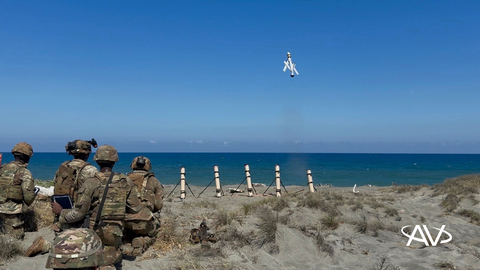
Switchblade 600 combines surveillance, target acquisition, navigation, communications, guidance, and a warhead in a loitering munition intended for longer-range precision attack. Unlike a reusable reconnaissance aircraft, the air vehicle is consumed during an engagement, making production capacity and replenishment central to the programme. Demand is therefore determined not only by the number of Army units fielding the system but by training expenditure, operational stock requirements, and replacement rates.
Block 2 introduces updated avionics and automatic target-recognition functions including AeroVironment’s SPOTR AiTR technology. The company also lists integrated resilient communications using Silvus mobile ad hoc network radios, improved navigation, and changes intended to support operation where GPS is challenged. The variant was developed in collaboration with US Special Operations Command and is also described as ruggedised for maritime and other contested environments.
Those upgrades add software and electronics content to an already supply-intensive expendable weapon. Production requires airframes, propulsion, batteries, electro-optical sensors, processors, radios, navigation hardware, flight-control electronics, launch equipment, and energetic components to arrive at compatible rates. Increasing final assembly alone achieves little if specialised optics, communications equipment, or qualified warhead components remain constrained.
AeroVironment says Switchblade 600 has been fielded across more than 20 US Army brigade combat teams since 2025, with hundreds of soldiers trained to operate the system. That installed base creates a continuing support requirement even for an expendable weapon. Training rounds and equipment, launchers, batteries, software updates, spares, documentation, and operator instruction all have to remain aligned with ammunition deliveries as additional formations adopt the system.
The coexistence of Block 1 and Block 2 adds another production consideration. The Army is ordering the newer configuration while the Foreign Military Sales element of the latest award uses Block 1, meaning AeroVironment has to support more than one approved baseline. Export customers can carry separate communications, software, documentation, training, and sustainment requirements, and export-control conditions can further distinguish an allied configuration from the US system.
The Lethal Unmanned Systems IDIQ gives the Army scope to place additional orders without establishing a new overarching contract each time, but its $990 million ceiling is not a guaranteed spend. Successive orders will depend on funded requirements and AeroVironment’s performance against previous deliveries. The February and August awards show the framework being used repeatedly, while the company says it is expanding manufacturing capacity and working to accelerate delivery schedules.
That expansion comes as loitering munitions occupy a larger place in defence production planning. Their combination of relatively compact launch infrastructure and precision attack capability has increased demand, but expendability means inventories cannot be treated like fleets of aircraft expected to remain in service for decades. Manufacturing throughput, component availability, storage life, and the cost of replacing expended systems become part of operational capacity.
The FMS component broadens that pressure beyond the Army. An allied customer joining the production queue can increase volume and support a larger manufacturing base, but different configurations also reduce some of the efficiency gained from producing one standard design. AeroVironment has not disclosed delivery dates for either portion of the latest order, so the effect on its production schedule remains unclear.
The $51 million award adds another procurement increment rather than transforming the Switchblade programme on its own. Its importance lies in the repetition: the Army has followed February’s larger next-generation order with another Block 2 buy while an allied Block 1 requirement enters through the same award. The next useful measure will be whether AeroVironment’s capacity expansion translates into shorter delivery times without creating configuration or supply bottlenecks across the two variants.