IN Brief:
- The Netherlands has signed a multi-year agreement covering Saab's Barracuda Mobile Camouflage System.
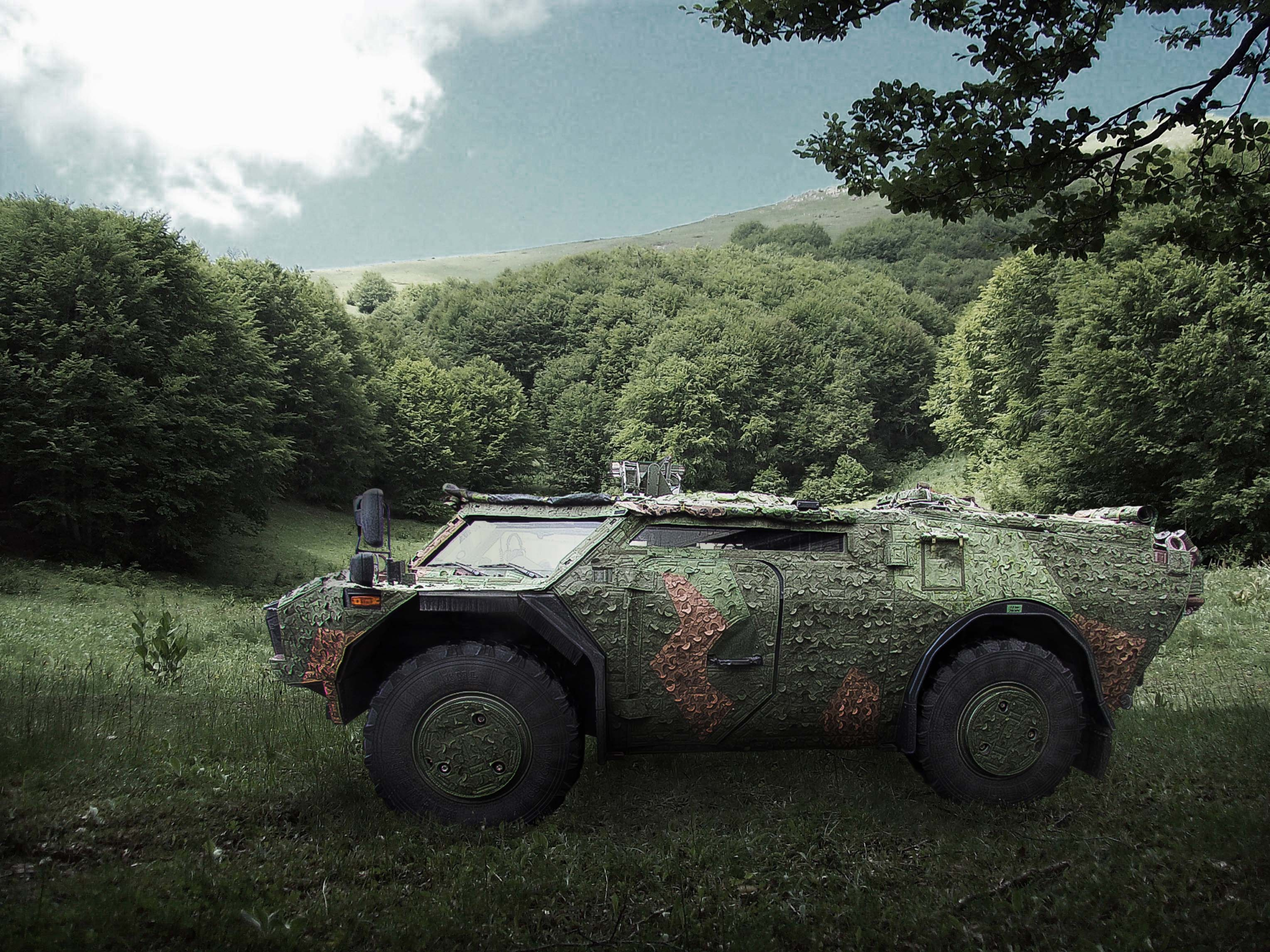
- The first order covers existing Royal Netherlands Army Fennek and Panzerhaubitz vehicles.
- Options allow additional vehicle types to be brought under the framework in future orders.
Saab has signed a multi-year agreement with the Netherlands Ministry of Defence for its Barracuda Mobile Camouflage System, with the first order covering existing Royal Netherlands Army Fennek reconnaissance vehicles and Panzerhaubitz self-propelled artillery.
The framework allows the Netherlands to place further orders during its term and includes options for additional vehicle types. Saab has not disclosed the contract value, quantity covered by the initial order, or the full duration, but says deliveries will take place over the coming years.
Saab develops Barracuda MCS as a vehicle-specific multispectral covering rather than a generic camouflage net. Panels and materials are tailored around each platform so that signature reduction can be added without blocking hatches, weapons, optics, antennas, ventilation, or maintenance access.
The Dutch order reflects the expanding sensor problem facing land forces. Visual concealment remains useful, but vehicles can now be searched for with thermal imagers, night-vision equipment, synthetic-aperture radar, laser-related sensors, and other systems operating outside the visible spectrum.
Barracuda is intended to alter the contrast between a vehicle and its surroundings across ultraviolet, visible, near-infrared, short-wave infrared, thermal-infrared, and radar bands. Saab also incorporates heat-reduction properties, hot-surface management, and silent-watch considerations into the system.
The two Dutch platforms create markedly different integration cases. Fennek is a compact wheeled reconnaissance vehicle whose mission already places a premium on observation and low detectability, while Panzerhaubitz 2000 is a substantially larger tracked artillery system with different heat sources, external geometry, crew access, and maintenance requirements.
That difference makes the framework significant from an engineering perspective. A camouflage system that works effectively on one vehicle cannot simply be enlarged for another because exhaust outlets, cooling airflow, moving weapons, suspension travel, optical apertures, stowage, and electromagnetic characteristics all affect how the material is fitted.
Saab says MCS can be configured for woodland, urban, and arctic environments. Pattern and colour are only part of that work: materials also have to manage how the vehicle appears to sensors at wavelengths the human eye cannot see, particularly where thermal contrast or radar reflection would otherwise reveal a platform despite effective visual camouflage.
Thermal behaviour brings a second benefit and another design constraint. Reducing solar loading and heat transfer can lower internal temperatures and lessen cooling demand, but the camouflage still has to tolerate exhaust heat and other hot surfaces without interfering with the vehicle’s own thermal-management system.
Those properties have practical consequences for through-life support. Vehicle-mounted panels will be exposed to mud, vegetation, abrasion, fuel, heat, repeated washing, and frequent removal during maintenance, so signature performance depends on the condition and installation of the material long after its initial acceptance test.
A fleet framework therefore creates a recurring support requirement. Different vehicle types need distinct panel sets, mounting arrangements, repair procedures, and replacement stocks, while maintenance organisations have to preserve the correct configuration as vehicles undergo upgrades or changes to antennas, weapons, and external equipment.
The Netherlands can now add other vehicle families under the same agreement if it exercises the available options. That avoids restarting the commercial framework for each fleet, although every additional platform still requires its own adaptation and verification work before a system can be fielded at scale.
For Saab, the programme extends an established Barracuda business that supplies signature-management products to more than 50 customers. The manufacturing challenge is less about proving that multispectral camouflage exists and more about producing repeatable, platform-specific systems whose spectral behaviour remains consistent across batches and operating environments.
As camouflage becomes part of a vehicle’s configured protection package, it also has to be documented, supported, repaired, and updated with greater discipline. Material performance on a demonstration vehicle means little if panels are routinely removed, damaged, or fitted incorrectly during ordinary fleet maintenance.
The first Dutch order will establish that baseline on Fennek and Panzerhaubitz vehicles. If the framework expands, Saab will have to manage a growing catalogue of platform configurations while the Army decides how broadly multispectral concealment should be applied across its land fleet.
No total programme value or final fleet quantity has been published, so the scale will depend on subsequent orders. The industrial test will be whether the framework can turn bespoke vehicle integration into a repeatable production and support process as more platform types are brought under the same camouflage architecture.