IN Brief:
- Hanwha Aerospace has signed an execution contract with Indra Sistemas covering K9 self-propelled howitzers and related equipment for Spain.
- Contract value, quantities, and delivery schedule remain confidential; the 128 artillery vehicles previously announced relate to Spain’s wider development programme.
- Indra plans Spanish hull manufacture, national mission-system integration, and €130 million of new industrial capability around the programme.
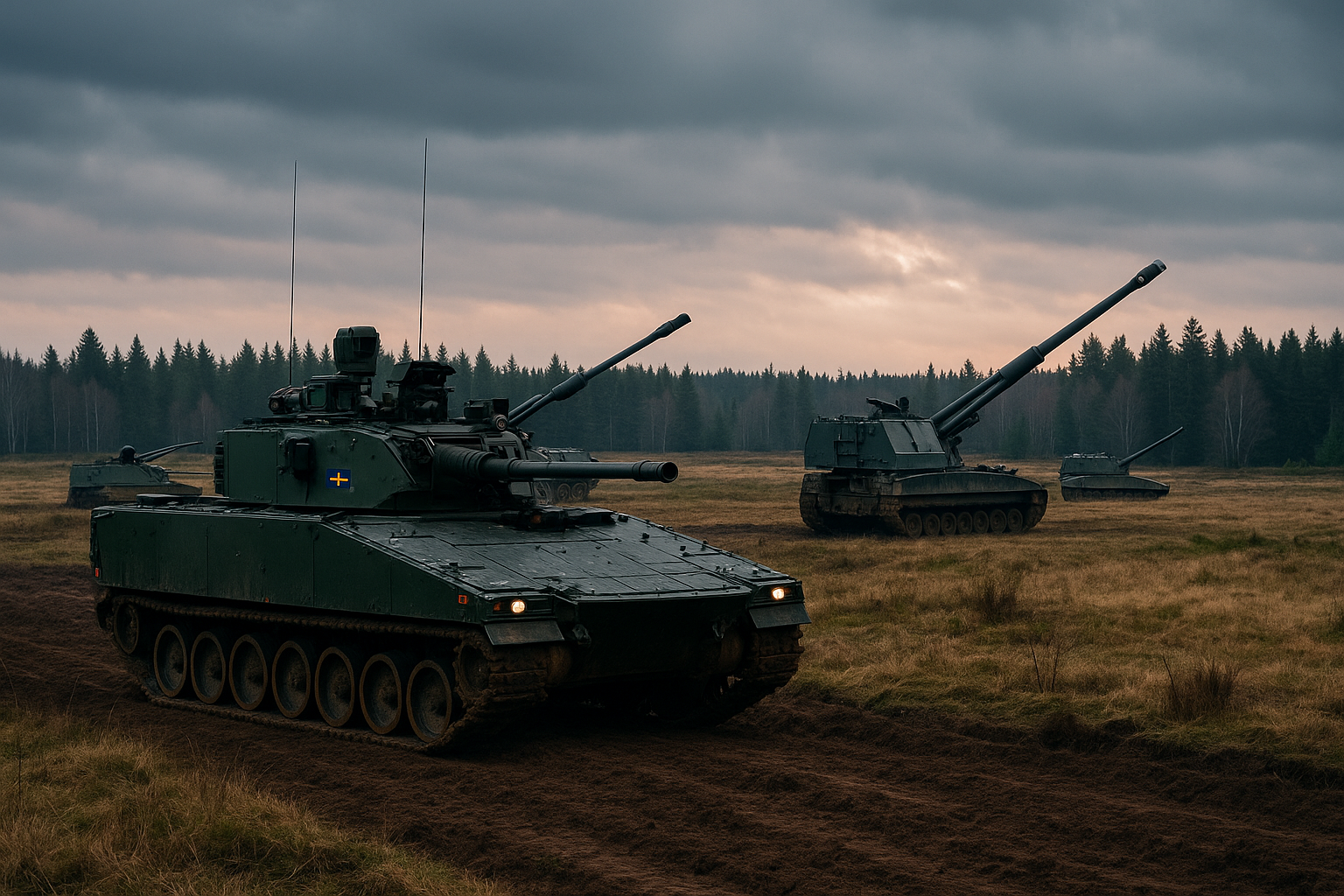
Hanwha Aerospace has signed an execution contract with Spain’s Indra Sistemas for the export of K9 self-propelled howitzers and related equipment, giving Spain a contracted route into the K9 family after the companies established their broader industrial partnership earlier this year. Hanwha disclosed the agreement on 31 August after signing it on 28 August.
The company has not published the value, quantity, or delivery schedule, citing commercial confidentiality. Hanwha will receive an initial advance equivalent to 20% of the contract value after signing, followed by another 5% by the end of 2026. Those payment terms establish that the programme has moved beyond a cooperation memorandum, but they do not reveal the size of the immediate equipment package.
That distinction is important because a larger set of Spanish programme quantities has already been made public. In March, Indra and Hanwha signed a binding agreement to develop a Spanish family of tracked artillery vehicles based on the K9 platform. Indra said that wider programme would comprise 128 tracked artillery vehicles, 120 ammunition resupply vehicles, 11 command-and-control vehicles, and 21 recovery vehicles.
Those figures should not be treated as the disclosed contents of the August execution contract. Hanwha’s latest filing leaves the number of K9 systems and associated equipment confidential, so the immediate order could cover all or part of the broader requirement. Until either company publishes the contractual quantity, the two sets of information need to remain separate.
Spanish production goes beyond final assembly
The March agreement sets out an unusually deep localisation model. Indra intends to design and manufacture Spanish hulls derived from Hanwha’s K9 family, over which the Spanish company would hold design authority, rather than simply importing complete South Korean vehicles and fitting national radios after delivery.
Indra also plans to integrate its own mission system, 360-degree vision equipment, battlefield management system, and communications. The company is responsible for designing and manufacturing the command-post systems, including communications, NBC-related equipment, and automatic fire and explosion suppression functions.
That work changes the nature of the programme from an equipment purchase into a land-systems industrial development effort. A national hull configuration has to maintain structural performance, mobility, protection, weapon integration, crew ergonomics, maintainability, and transportability, while national electronics must operate reliably within the vehicle’s power, thermal, electromagnetic, and software architecture.
Indra has committed €130 million to the industrial infrastructure required for the project. Its plans include new machinery at the company’s Gijón plant and an additional integration facility in the city. Indra estimates that the programme will support around 500 direct jobs and a further 1,000 indirect and induced positions.
Those investments will matter as the programme moves from design work into repeatable manufacture. Tracked artillery vehicles rely on a large supply chain covering armour structures, suspension and running gear, powertrain equipment, gun systems, electronics, hydraulic equipment, wiring, communications, and test systems. Establishing national production involves qualifying those processes and suppliers as well as creating space for final integration.
A mature platform still requires a new configuration
The K9 provides Spain with a mature starting point. The 155mm tracked system has already been adopted by several European NATO users, including Poland, Finland, Norway, Estonia, and Romania, as well as customers outside Europe. Hanwha says Spain represents the K9’s first entry into Western Europe and takes the number of operating countries to 11.
A mature platform can reduce development risk, but Spain’s localisation ambitions introduce a separate layer of engineering work. Once nationally produced structures, mission systems, vision equipment, communications, and command arrangements are introduced, the Spanish configuration has to be controlled and qualified as its own integrated system.
Technology transfer will be central to that process. Indra needs enough design data, manufacturing knowledge, interface information, and engineering authority to produce and support the national vehicle family, while Hanwha has to ensure that locally developed changes remain compatible with the K9 technical baseline.
That relationship will continue into through-life support. Spain’s objective is not merely to assemble an initial batch but to establish domestic capability around the design, manufacture, maintenance, and future evolution of tracked land platforms. Local access to engineering information can shorten modification cycles and reduce dependence on overseas support, provided the industrial workshare is sufficiently deep.
The execution contract is therefore significant without providing enough information to call the Spanish production plan complete. It attaches supply and payment obligations to a partnership that previously centred on programme architecture, industrial investment, and technology transfer. The undisclosed quantity and timetable, however, mean there is still no public basis for assigning the full 128-vehicle artillery requirement to this particular contract.
The next useful milestones will be industrial rather than ceremonial: completion of the Gijón investments, configuration definition, supplier qualification, transfer of manufacturing processes, prototype or first-production activity, and disclosure of a delivery programme. Those steps will show how rapidly a proven South Korean platform can be converted into a Spanish-controlled production system.
For Hanwha, the contract extends the K9 into another European market while preserving a role in a locally adapted platform family. For Indra, it provides the technical foundation for a much broader land-vehicle ambition. The August agreement confirms that hardware supply is now contracted; the larger question is how much of the programme’s engineering and production value ultimately moves into Spain.