IN Brief:
- Greece has signed a €3.035 billion agreement for the Achilles Shield anti-aircraft, anti-ballistic, and counter-drone network.
- David’s Sling, SPYDER, BARAK MX, ELTA MMR radars, and a Rafael-led national C2 system form the disclosed Israeli architecture.
- Nineteen Greek companies are already involved, with domestic participation exceeding 25% and €750 million plus a planned export-capable production base.
Rafael Advanced Defense Systems will lead significant elements of Greece’s Achilles Shield programme after Athens and Israel signed a €3.035 billion intergovernmental agreement covering a national anti-aircraft, anti-ballistic, and counter-drone network. The package combines several Israeli interceptor and radar families under a common command-and-control architecture, while allocating more than €750 million of work to the Greek defence and technology sector.
The agreement was signed in Tel Aviv on 31 August and provides for immediate commencement of implementation. Greece’s Ministry of National Defence says 19 Greek companies are already participating in the relevant procedures, with domestic involvement exceeding 25% of programme value. The agreement also provides for the establishment of a production base in Greece with export potential.
Those industrial commitments substantially sharpen the programme compared with a conventional imported air-defence purchase. Public information does not yet identify the 19 companies, divide the €750 million between manufacturing, integration, software, support, and other activity, or specify which systems will be produced locally. Even so, the figures put domestic participation inside the formal programme structure rather than leaving localisation to a later negotiation.
Several defence layers feed one command system
The disclosed architecture includes Rafael’s David’s Sling and SPYDER systems, Israel Aerospace Industries’ BARAK MX, ELTA Systems multi-mission radars, and a new national command-and-control system to be developed under Rafael’s lead. A separate €26 million agreement covers Rafael Drone Dome equipment for protecting strategic sites against uncrewed aircraft.
Israel’s Ministry of Defense describes Achilles Shield as the first occasion on which it will supply a complete defensive array spanning ballistic missiles, conventional aerial threats, and hostile UAVs. Greece characterises the programme as a unified anti-aircraft, anti-ballistic, and anti-drone shield, making integration between the individual layers central to the acquisition.
Different interceptors exist because those threat classes place very different demands on sensors, engagement ranges, reaction times, and weapon performance. Using a high-end interceptor against every small uncrewed aircraft would be economically unsustainable, while a short-range weapon cannot replace a system intended to counter more demanding ballistic targets. A layered architecture allows different effectors to be assigned according to the threat, provided the sensor and C2 network can make that decision quickly enough.
The new national C2 layer is consequently one of the more important pieces of the programme. Radar and other sensor data have to be fused into a coherent air picture, tracks classified, threats prioritised, and an appropriate interceptor assigned. The network must then manage engagements without creating conflicting actions between separate missile families and defence units.
That challenge becomes more demanding as national and imported equipment are combined. Each radar and effector family carries its own communications interfaces, software baselines, engagement logic, maintenance requirements, and upgrade cycles. The national system has to preserve interoperability when one component is modified without forcing disruptive changes across the rest of the network.
Greek industry gains a defined programme share
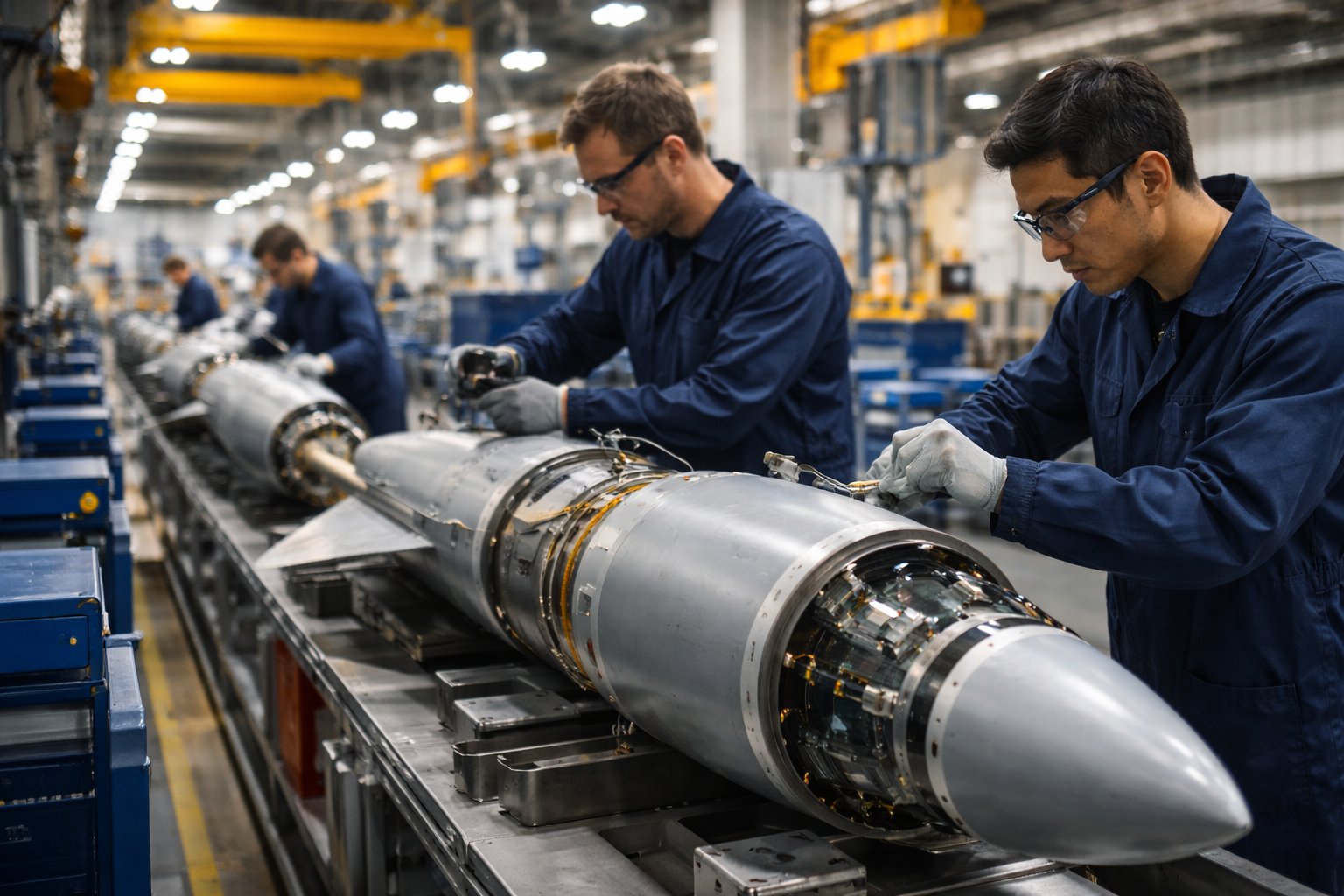
The Greek Ministry’s industrial figures give Achilles Shield a second major engineering dimension. Domestic participation exceeding 25% represents more than €750 million within the €3.035 billion programme, with the government explicitly identifying the creation of a production base capable of supporting exports.
A domestic production base could cover a wide spectrum of work. Structures, electronics, communications, software, integration, test equipment, maintenance, and component manufacturing all sit inside a modern air-defence supply chain, but the agreement released so far does not assign those activities to named companies. The eventual industrial value will therefore depend on the depth of the transferred work rather than the percentage alone.
Technology and knowledge transfer are also part of the Israeli government’s description of the agreement. That creates a route for Greek companies to participate beyond construction of simple mechanical parts, although the technical scope and intellectual-property arrangements remain undisclosed.
For the Israeli suppliers, localisation creates its own programme controls. Components and software produced or integrated in Greece will have to conform to the configuration used by Rafael, IAI, and ELTA, while security requirements around sensitive radar, seeker, command, and communications technology will shape what can be transferred and how it is supported.
Sustainment will become increasingly important once the first systems are fielded. A national architecture built around several interceptor types needs stocks of missiles, spares, trained personnel, test equipment, software support, and maintenance capability across multiple equipment families. Launcher numbers alone do not determine readiness if interceptor inventories or support pipelines cannot sustain operations.
The public announcements have not disclosed launcher numbers, radar quantities, interceptor stock levels, deployment locations, or a complete delivery schedule. Those gaps mean the €3.035 billion agreement defines the programme’s financial and system architecture more clearly than its final physical order of battle.
Implementation will also require the individual systems to pass national integration and acceptance activity. Radar coverage, communications, engagement logic, electronic protection, cyber security, and command procedures have to work across the complete network before a collection of independently capable systems becomes a functioning layered shield.
The programme now has several measurable industrial commitments: a fixed headline budget, named principal systems, a common C2 requirement, 19 participating Greek companies, more than €750 million of domestic involvement, and provision for an export-capable production base. That is considerably more concrete than the localisation language attached to many large defence procurements.
The more difficult milestones come next. Greece and its Israeli partners have to turn the agreement into factory work, software integration, qualified installations, trained operators, interceptor stocks, and a national network capable of handling different classes of threat as one system. Achilles Shield has moved into implementation; whether it becomes an integrated industrial and operational capability will be determined by the engineering work that follows the signature.